How UK IT leaders are spending, saving and prioritising
AI is starting to make its presence felt in IT budgets

Computing’s latest research among 100 UK IT leaders finds IT budgets holding up, but demand increasing from cloud inflation and AI rollouts.
IT teams are being asked to modernise infrastructure, strengthen cybersecurity, improve resilience, reduce costs, and place judicious bets on the future - all at the same time.
They are also contending with the distorting effect of AI, whose gravitational pull is drawing attention away from other issues.
How much should they bet on this technology when most AI projects are yet to show any return on investment?
Of course, AI is advancing rapidly, and no-one wants to be left behind, but does it make sense to shuffle more funding towards AI to the possible neglect of other less visible but equally important areas? It’s quite the gamble.
One IT leader commented: "We really don't know what is around the corner because AI solutions are changing so rapidly and we don't want to back the wrong technology."
Examples of best practice can be hard to come by too, with projects in their infancy and each organisation shaped by its own combination of legacy technology, regulatory demands, market positioning, experience and expertise.
IT leaders must juggle priorities including AI, cloud contracts, cybersecurity, hiring and skills, compliance and governance, as well as increasingly important sovereignty and supply-chain concerns.
Budgets are holding up
The good news is that, by and large, IT budgets are holding up. Thirty-nine percent of 100 UK IT leaders polled last month reported a real-terms increase on last year, compared to 12% reporting a decrease.
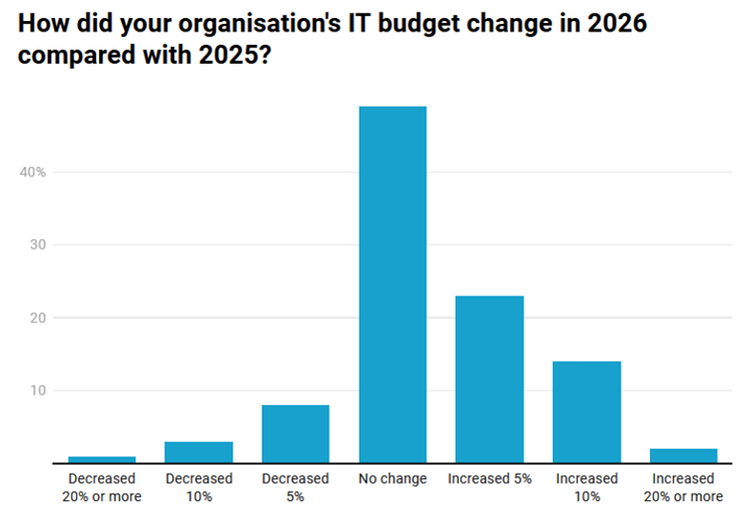
Looking towards 2027, predictions are, if anything, a little more optimistic - 46% expect an increase while 9% fear a squeeze.
However, the general picture is not one of a spending boom. The overall economic picture is too uncertain for that. Rather, it is a process of maintaining momentum, careful prioritisation and placing a few judicious bets.
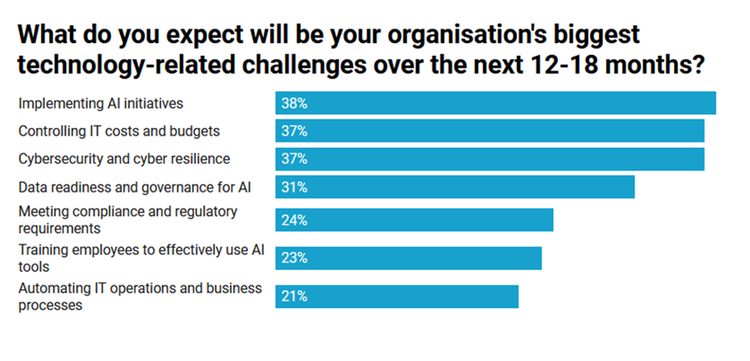
The funding may be there – but so are the demands, and they’re increasing too. Cost control is fast becoming a strategic imperative.
Thirty-seven percent of respondents selected controlling IT costs and budgets as one of their biggest technology-related challenges for the next 12 to 18 months, level with cybersecurity, near the top of the rankings.
But implementing AI initiatives is at the top (selected by 38%), with other AI-related concerns featuring too.
These issues are all connected. As AI moves from proof of concept into production, token consumption and thus prices tend to rocket, while new attack surfaces and vulnerabilities can be created.
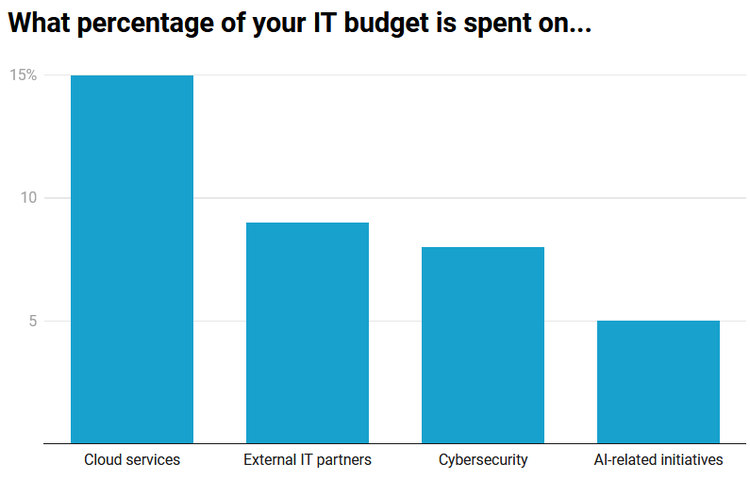
Despite hogging the headlines, spend on AI - both generative and traditional - has been relatively modest up to this point. It’s now definitely making its presence felt, soaking up a median of around 5% of IT budgets, but still consuming less than cybersecurity (8%), partners (9%) and cloud (15%). Again, though, these divisions are not clear cut: most AI is consumed via the cloud, after all.
Cloud costs
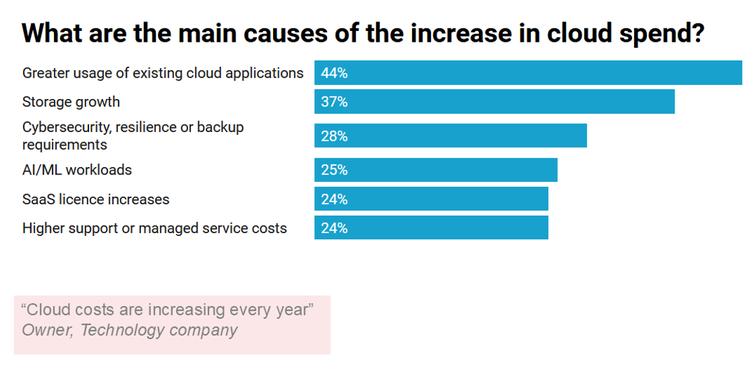
Cloud spending continues to rise. Two-thirds of our respondents expect further cloud spending increases in the coming 12 months. Only 2% anticipate a decrease.
Interestingly, the main factor behind these increases was not AI or even licensing but greater use of existing cloud applications and storage.
That said, delegates at the Computing IT Leaders Summit last week were critical of vendors' frequent switching of licensing terms to try to push them to a more lucrative tier.
"They try to monetise everything," complained one IT leader.
"Once the price goes up it doesn't come down again," said another.
Cloud providers themselves are facing cost pressures due to the global shortage of memory and chips, which is starting to affect hardware prices, as well as subsidising AI. At the very least, we can expect cloud prices to continue their trajectory of 5%-10% annual increase.
How organisations are responding
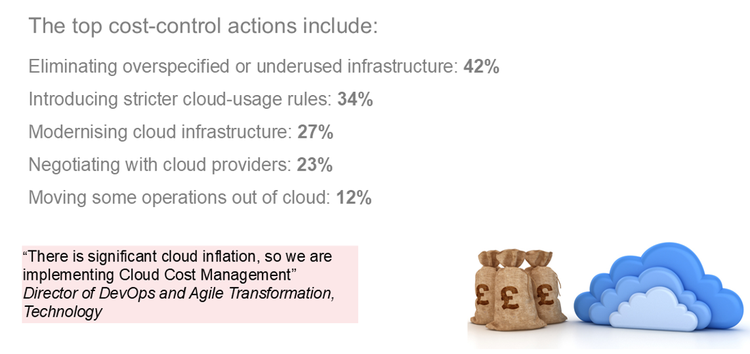
Cloud costs may be exacerbated by a lack of visibility and control. How many organisations are running duplicate services, buying new instead of rationalising what they already have? The average organisation wastes 30% of its cloud budget on unused or misconfigured resources, according to analysts at Data Stack Hub.
Discovering and eliminating these "ghost services" is a primary cost-cutting measure, reported our respondents. Another popular intervention is introducing stricter rules about usage.
AI-specific cost controls are also appearing.
As AI tools spread across the enterprise and proof-of-concept projects move into production, token use can increase dramatically. Meanwhile, AI companies are trying to claw back some of their enormous infrastructure investments by restricting free tiers and raising subscription prices, even as their most advanced models consume more tokens per task.
In response, organisations are starting to restrict access to the most expensive frontier models to where they can really add value, substituting lower-cost, smaller models where appropriate, and trying to get a handle on usage through improved consumption monitoring.
Sovereignty
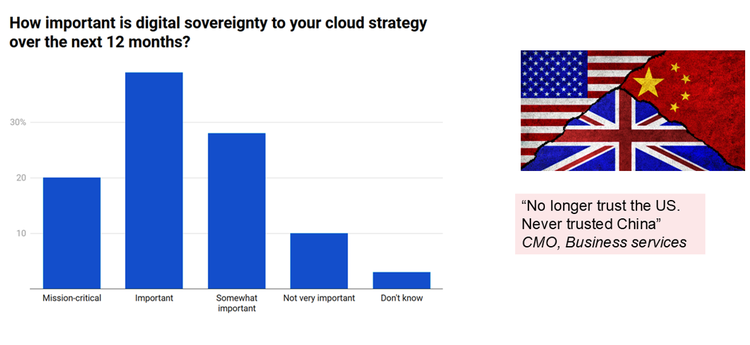
While AI is driving boardroom conversations, sovereignty is starting to reshape cloud strategy.
In fact, 20% of respondents described digital sovereignty as no less than "mission critical" to their cloud strategy.
But there's a major mismatch here. CEOs and IT leaders may say that digital sovereignty is crucially important to their business, but we found little evidence of migration at scale towards alternative cloud providers.
There's a similar picture in national government: ministerial speeches about procurement reforms and the importance of supporting local suppliers are followed, as night follows day, by new contracts for Palantir.
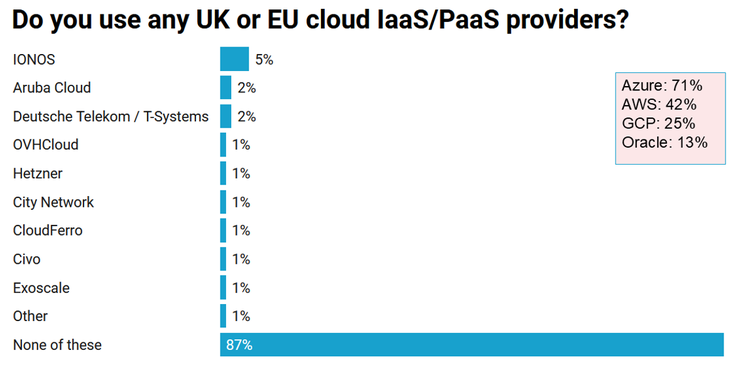
Seventeen percent of respondents said they have already moved some workloads off US and Chinese clouds. If so, where have they put them? Uptake of UK and European cloud alternatives is minuscule compared with use of Azure, AWS and GCP.
From these results, it seems that most sovereignty talk is aspirational at this stage. In truth, organisations remain heavily dependent on hyperscalers because dependencies are deep-rooted and moving away is hard.
For most organisations, digital sovereignty represents more of a signpost towards future procurement plans than a determined uprooting and redeployment of existing workloads. It's a process that will take many years to play out.
AI is rising up the ranks
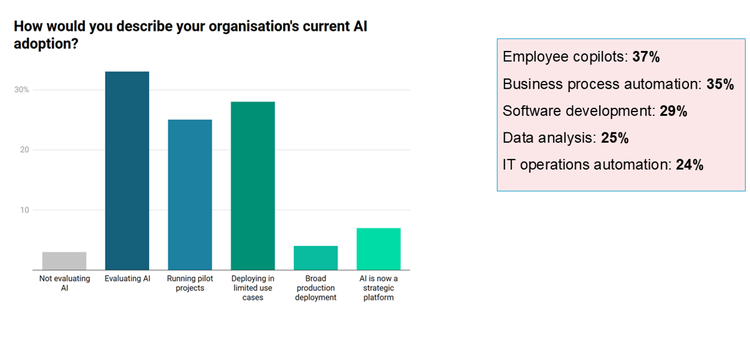
Sovereignty may be informing infrastructure planning, and cloud may be the largest budget item, but there's no doubt that it's AI that's dominating boardroom discussions.
Sixty-four percent of respondents have progressed beyond simply evaluating AI, with 27% using it in limited production use cases and 11% reporting either broad deployment or strategic-platform status.
Use cases are topped by employee copilots, business process automation and software development.
The 2026 data shows spending shifting toward concrete use cases and operational deployment.
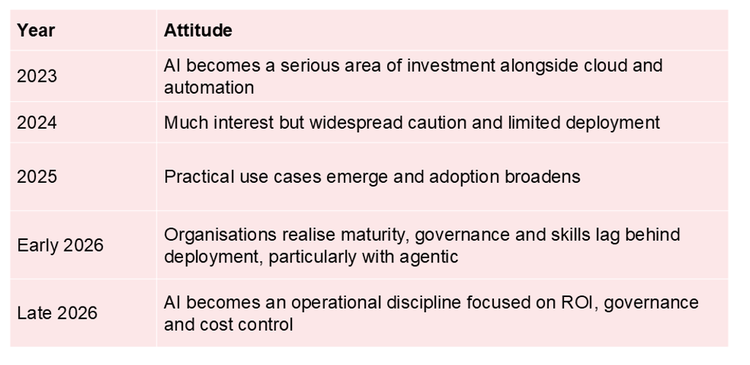
Indeed, AI's trajectory is beginning to resemble that of cloud computing. The early interest and excitement has not disappeared and neither has the fear over security and control. Following the early adoption wave, organisations are increasingly focused on the practicalities of economics, governance and measurable business value rather than the what-ifs and hypotheticals. They are proceeding with cautious determination rather than succumbing to AI mania or rejecting it outright.
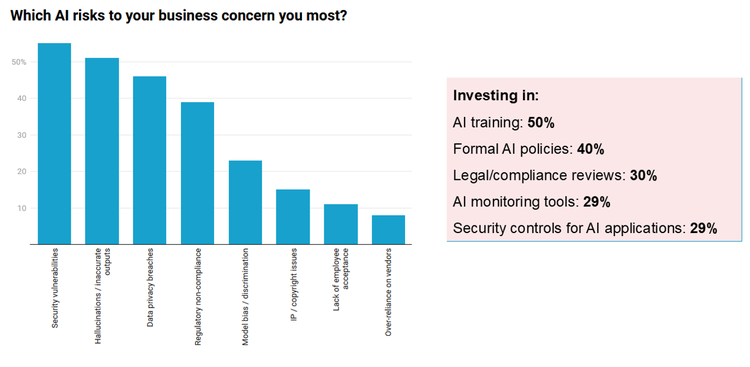
And caution is the watchword. As governments squabble over how to regulate AI, and the heads of AI companies blow hot and cold over regulation - while wondering aloud whether their invention might actually wipe us all out - IT leaders are having to find their own way to move forward while doing their best to mitigate the harms they can predict.
Chief among their concerns: security vulnerabilities, inaccurate output and privacy breaches.
And of course, as AI moves deeper into the business, costs associated with governance, integration, data management, security and consumption all continue to grow.
Governance
To prepare their organisations, 50% are investing in training, 40% in formal AI policies and 30% in legal reviews.
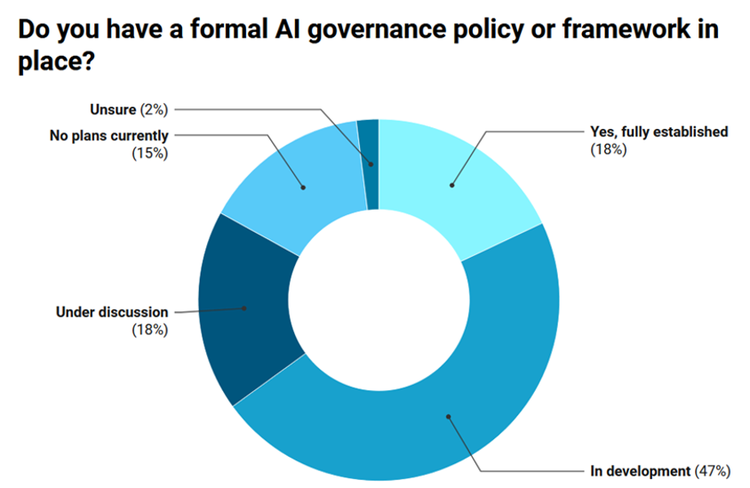
Around one in five respondents say they have a formal AI governance policy or framework in place – although a similar number have no plans. Many are struggling with understanding the direction of travel and lack the expertise to manage it.
Indeed, when we look at the AI skills gap, AI governance skills come second, behind AI engineers and architects. Clearly there's an appetite to understand the risks and to get on top of them.
But only 4% said they were completely confident in their ability to deploy and manage AI effectively, suggesting that most will be dependent on partner organisations to fill the gap for some time.
According to Computing's research, AI specialists are now harder to recruit than the cloud and cybersecurity experts which always tend to top these polls. We shouldn’t be too surprised by this - AI is riding a hype wave bigger than any before, the fear of missing out is real, and the talent and experience pipelines are narrow.
Causes for optimism
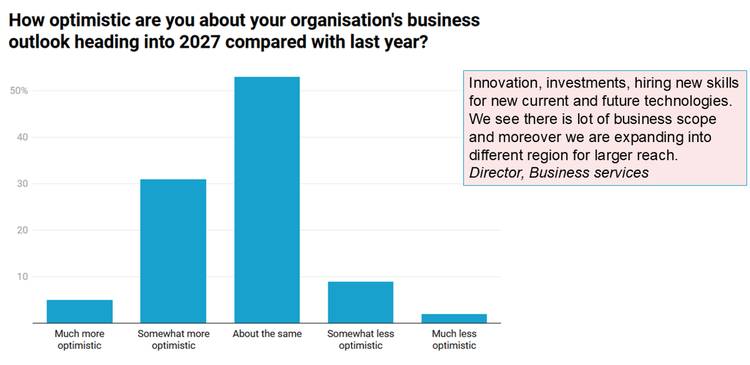
To round up, we asked how optimistic IT leaders are. What do they feel about the hand they’ve been dealt, their ability to play it and the funds available to see them through?
Most are optimistic – if anything a little more so than last year - seeing new opportunities opening up and previous tech strategies paying off. Most, but not all. Several respondents are wrestling with declining markets, an increasing tax burden and bureaucratic hurdles.
Summing up
In summary then budgets are holding up, but cloud inflation and competing demands are limiting IT leaders’ choice.
AI has moved from experimentation to operational deployment, bringing cost, governance and skills firmly into focus.
Digital sovereignty is starting to inform cloud and procurement strategy, but there is little evidence of concrete action as yet.