Researchers put AI bubble probability as high as 97%
Bubble hype may be rife, but there is strong evidence that we are in one right now
Researchers have provided a timely answer to an age-old question: can you detect an economic bubble while it is actually happening?
Researchers from the London Business School and the University of Cambridge used an LLM to analyse 795,964 articles from The Economist published between 1843 and 2013, comparing bubble signals in those articles with 22 financial bubbles across ten countries. They found that bubble talk in the financial press is an unreliable indicator of investor over-exuberance. Bubble speculation makes for good headlines, after all.
“The financial press systematically warns of bubbles and impending crashes far more frequently than such events actually occur,” the authors point out.
Indeed, the average predicted chance of an imminent collapse is about 20% whereas the historical frequency is 5.7%.
However, their paper Crying Wolf: Media Warnings and the Predictability of Financial Bubbles did find that unusually intense warnings of a bubble over a short period correlated with actual bubbles. Historically, the model successfully picked out bubble periods around 74% of the time, rising to 94% during the dotcom boom.
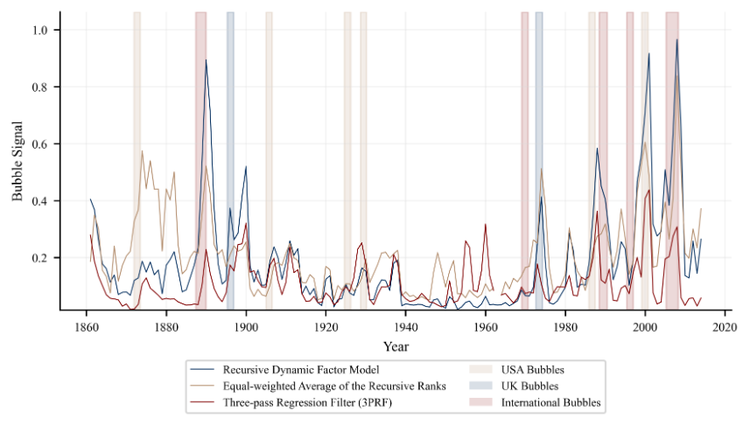
Useful predictive measures included strong speculative narratives, regulatory warnings, signs of speculative excess, valuation concerns, and references to booms and euphoria. These were the five most useful measures selected from 14 indicators analysed by the researchers, and were combined in different ways to produce the researchers’ bubble indices.
Is AI a bubble?
One method, the dynamic factor model (DFM), put the probability of an AI-related bubble at 97% when used to analyse articles up to September 2026. Two other analyses put it at around 40%.
However, despite the wide discrepancy, the authors say all three are considerably higher than recent historical averages, and similar to the levels associated with the dotcom bubble of 2000. “The results suggest that our index warns of significant concerns about a financial bubble, and the indices are at levels that historically have been associated with bubbles,” the paper states.
Notably, this analysis was conducted before the fallout from the Anthropic IPO and the Nvidia shenanigans.
The authors are careful not to conflate investor over-exuberance with overestimating the potential of the technology itself.
“The existence of a financial bubble does not imply that the underlying technology is not transformative,” they write. “Historically, some of the most consequential technological innovations have been accompanied by speculative booms and subsequent crashes in asset prices, such as railroads and the internet.”
However, as in those earlier cases, investors can “substantially misjudging the magnitude, timing, or distribution of the financial returns it generates.”
Panic or hold tight?
For organisations investing in AI, the main lesson is to distinguish the technology’s potential from assumptions about return on investment and where value will emerge.
Organisations should also be wary of treating AI as some sort of magical technology exempt from ROI calculations or the risks of vendor lock-in, as some of the more speculative narratives might imply. But neither should they overreact to the possibility of a bubble.
For investors, there may not be a crash coming, but the researchers' modelling predicts lower returns for the tech-heavy NASDAQ, which has seen huge rises over recent years thanks to the AI boom.
Historically, periods with stronger bubble characteristics have been followed by significantly lower NASDAQ returns over the following six months to two years, the authors found.