Gartner: AI is changing cybersecurity faster than cloud ever did
‘We need to think in terms of sprints, not multi-year programmes’
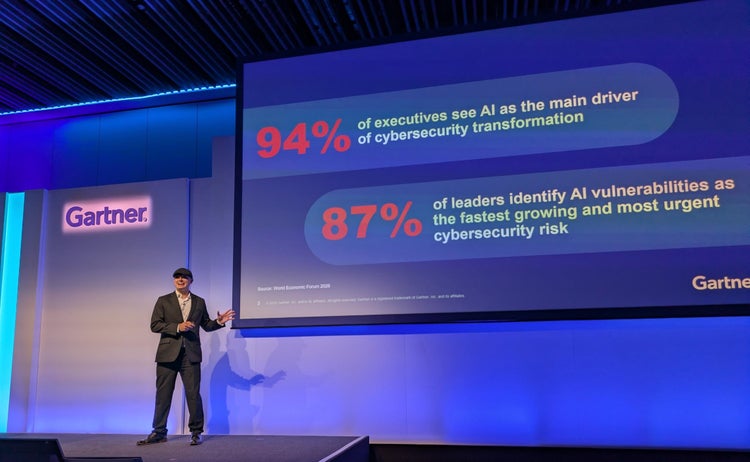
AI is now the main force reshaping the security landscape - but it is also creating new risks inside organisations, according to Gartner analyst Josh Murphy.
Speaking at Gartner's Security & Risk Management Summit in London last week, Murphy said 94% of executives see AI as the main driver of cyber transformation, while 87% view AI-related vulnerabilities as the fastest-growing cyber risk.
"The message from the C-suite is clear," he said (sounding a bit like a chatbot himself): "AI is both the engine for change, and also an accelerant for risk."
Unlike cloud computing or the dotcom boom, Murphy argued that AI is compressing timescales for technology leaders.
"We need to think in terms of sprints, of immediate actions to take, and not just multi-year programmes," he said.
While a vast amount of attention is focused on AI-powered attacks, many organisations face a more immediate problem: risks from their own users.
"A lot of AI risk is going to be internal to the organisation," Murphy said, pointing to poor AI literacy, shadow AI projects, data leakage through prompts and limited visibility into AI capabilities embedded in existing software.
That challenge is already widespread. Gartner research found that 59% of CISOs either suspect or have evidence of unsanctioned AI agents operating in their organisations, while 32% of IT workers admit using AI tools at work that they keep hidden from management.
Murphy argued that traditional approaches to security struggle because AI behaves differently from most enterprise technology.
"The vast majority of technology is deterministic. It acts in a predictable way," he said. "But with AI, that's not the case."
As organisations move from generative to agentic and multi-agent systems, security teams cannot afford to become the department of “No” again; they need to focus on controlling access, rather than blocking adoption. Gartner recommends applying least agency privilege, ensuring AI agents have only the permissions they need (for humans, we’d call that zero trust or privileged access management, but AI needs a new term for everything).
"Today, most agents come with far more access than they actually need," Murphy warned.
Keep an eye on your AI
Visibility is critical. Gartner advises organisations to inventory all AI use, identify high-risk data flows and update incident response plans to cover threats such as prompt injection, model compromise and data poisoning.
Murphy also challenged the assumption that AI investment automatically improves security. Gartner predicts that by 2029, one in five material cyber incidents will result from executives shifting spending away from fundamental security controls and towards AI projects.
"This is not malice, it's fear of missing out," Murphy said. "Boards are overwhelmed with AI expectations."
He added, "The more we chase AI for the sake of AI, the more we're actually going to be starving the organisation of the very controls that can keep it safe."
Instead, he told delegates to focus on practical uses of AI that reduce workload, like vulnerability prioritisation, third-party risk assessments, alert triage and policy assistants.
At the same time, he warned against overestimating the impact of AI SOC agents. Although around 70% of large SOCs are piloting the technology, Gartner expects only 15% to achieve measurable improvements.
"The true value lies in augmenting the SOC team rather than replacing them," Murphy said.
Preparing for the inevitable
On the threat side, Murphy argued that much of the panic around "rogue AI" misses the bigger picture. Attackers and defenders are adopting the same technology at roughly the same rate.
"Threat actors aren't going to respect laws, guardrails or rules," he said. "There's going to be evil AI out there."
His answer is not radically different from existing cyber security advice: identity remains the key control point, whether we’re talking about humans or AI systems.
"We want to treat identity as a control plane, both for humans but also for AI agents," he said.
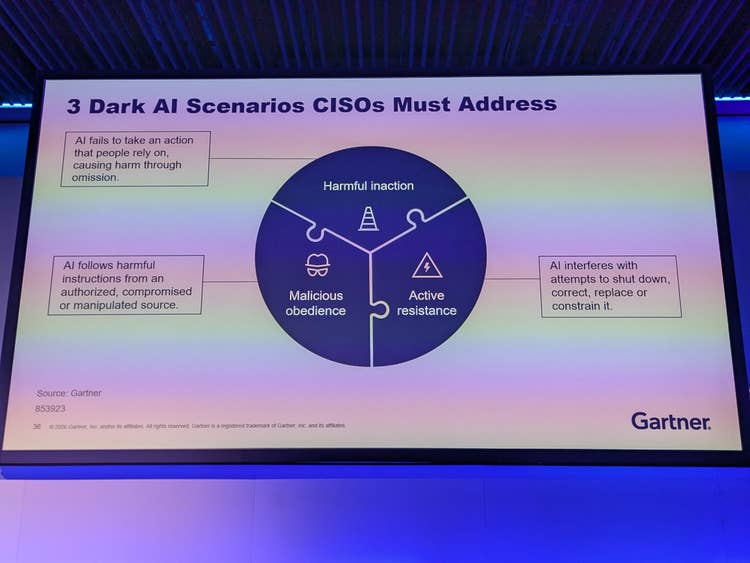
Security leaders don’t (yet) have to worry about preparing for Terminator-inspired scenarios. Instead, they need to be looking at improving governance, visibility and access controls before AI adoption runs ahead of their ability to manage it. Few organisations need to stop using AI, but they do need to understand how much of it they are already using.