Smart regulation won’t kill AI innovation
Inertia, lack of investment and confidence will

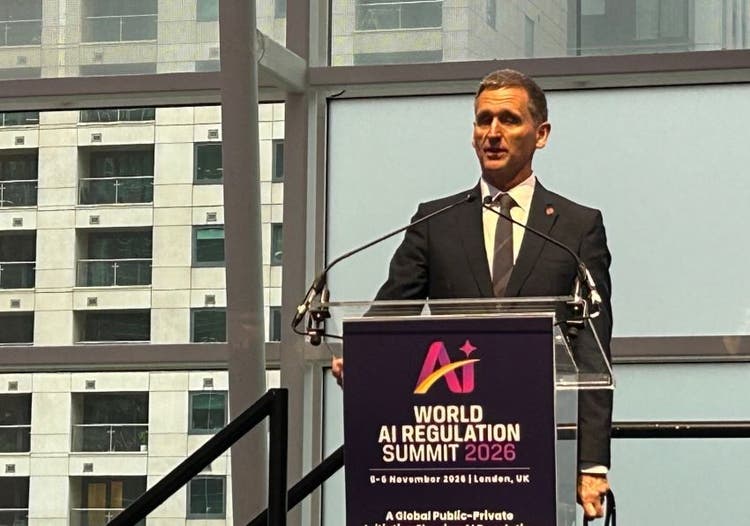
At the World AI Regulation Summit, a panel of UK, EU and US speakers rejected the idea that regulation stifles innovation and, despite differing on how specific rules should be, agreed that governments must start regulating even if they don’t get it right first time.
Global AI regulation is often framed (wrongly and in most cases deliberately) as a battle between wealth-creating innovation and economic malaise. Yesterday at the World AI Regulation Summit, a panel spanning the UK, EU and US discussed the differences in regulatory regimes and shared some ideas of how to break the global impasse in AI regulation.
Moderated by Emmanuel Daniel, Chairman and Founder TAB Global, the discussion exposed competing approaches to oversight but also shared reflections about existing legislation along with concerns about expertise, fragmented enforcement and corporate power.
Rules can create competitive advantage
Lord Holmes, campaigner for principles-based, cross cutting AI legalisation and Summit Chair, began by dismissing the familiar claim that regulation inevitably undermines innovation as “nonsense.” It’s a false dichotomy and well-designed regulation creates the confidence that attracts investment rather than drives it away.
“Would you invest into a market with no rules? Would you put your IP, your copyrighted material, into an economy, a jurisdiction with no rules? Of course you wouldn’t,” Lord Holmes said. “Regulations, legislation, they’re just the rules of how we go about it.”
Drawing on the UK’s fintech sector, Lord Holmes argued for proportionate regulation as an economic advantage. His proposed AI authority would support existing sector regulators, coordinating expertise across industries rather than requiring each watchdog to build its own capabilities independently which they have neither the expertise nor the resources to do.
He said: “It seems sensible to have a small, agile AI authority to bring this AI regulatory mission together. I don't think we are fully empowering our existing regulators by giving them AI and saying, ‘over to you.’ I think they'd be far more empowered and enabled to have that support of a right-sized, horizontally focused AI authority.”
Europe’s complexity problem
Gabriele Mazzini, Lead architect and Drafter of the EU AI Act brought the EU dimension to this discussion. He agreed that regulation could indeed steer innovation but there were many pitfalls – particularly in a union as complex as the EU.
“Simplicity is really an asset, and focusing on what really matters and what can create that alignment will enable, in my view, to reduce the regulatory arbitrage,” he said. “If you have too many laws or too complex laws, that risk of arbitrage will increase.”
To illustrate this point Mazzini described the AI Act’s product-legislation approach as an attempt to avoid concentrating oversight in the country where a provider establishes itself. In his account, allowing enforcement across jurisdictions helps counter the incentive to choose a more lenient regulatory home.
Many of the mandates contained within the EU AI Act have been delayed – basically at the behest of the US tech companies. Mazzini also reflected, in response to a delegate question, on whether he would, with the benefit of hindsight, have drafted that legislation differently. His answer focused on the timing of legislation rather than the articles.
“The first thing regulators should do is to think about AI holistically,” he said. Governments should first establish a roadmap, examine how AI intersects with existing legislation, identify the expertise needed and decide “where actually we want to set the needle in terms of risk and opportunities”.
Only after governments have thought about how to organise themselves and acquired the necessary expertise should they move to legislate because only then will that government have “a much better understanding, not only of how to write the law but also how to execute it.”
How specific should regulation be?
Another delegate raised the question of just how specific AI regulation should be. Alex Engler, Executive Director, Penn Center on Media, Technology and Democracy thought that algorithms should be the focus of regulation. This was informed by the work he did at a US thinktank.
“The work I did at Brookings was AI application by AI application regulation. These applications are wildly different. A lot of colleges set their costs by algorithm for example. The process for doing that looks nothing like the process to estimate the cost of a home or approve a mortgage. They’re so different that I do not think you can govern them the same way.
“I think you need a sectoral specific regulator that makes very nuanced decisions around specific types of algorithms. It shouldn't apply to every algorithm just high impact ones and it should issue really good specific guidance for each set of applications.”
Mazzini was cautious on industry specificity. “The moment you give more specificity to companies, you enable a faster cycle for product development and compliance,” he said. He pointed to GDPR as a warning that high-level provisions may take years of litigation to clarify, leaving smaller companies in particular struggling to translate enduring principles that are supposed to prtect everyone into practical obligations.
America’s missing protections
Representing the considerably less regulated US on the panel, Alex Engler offered a stark counterweight to European and UK concerns about regulation induced administrative burdens. In the US, he said, “the total absence of domestic technology regulation is such a big challenge” that regulatory arbitrage becomes “a fundamentally secondary concern”. He linked that vacuum to the political influence of extremely wealthy technology companies and warned that the government provides almost no meaningful check on the industry.
His defence of European digital protections was grounded in his everyday experience. He said: “Every single day, I get unsolicited texts from political donors. I get unsolicited scam phone calls,” he said, describing a data-broker industry so pervasive that opting out can offer little lasting protection.
Don’t let perfection be the enemy of the good
For businesses, the panel’s message was more demanding than choosing between a permissive America and a restrictive Europe. Regulatory quality depends on institutional capacity, practical guidance and the ability to address harms in their specific settings.
There was no shared blueprint for global convergence, but Engler rejected inaction. “We have to regulate in this space, and we have to find the right balance,” he said. “Maybe you don’t nail it the first time, but it has to begin.” The common challenge was to build institutions that can recruit technical expertise, explain requirements clearly and adjust when implementation exposes weaknesses.
We’ve all heard a great deal about the AI “race” this year, mainly in the context of the US versus China, as if the development of AI has a finish line that only one party can cross. One side claims they can only win if they don’t have to abide by any rules. The other side has rules but isn’t keen on making them public.
Perhaps we should focus more not on which country can write the fewest rules, but on making oversight and accountability credible enough to protect people and avoid strangling innovation with uncertainty.