What the Met Office learned from letting go
Trust first. Tech second

Partnerships aren’t the risk, pretending you can still do everything yourself is.
When the Met Office switched off its 70-year supercomputing legacy it was “difficult to let go,” said CDIO Charles Ewen. But the reality is that the speed and scale of the modern world mean "you just can’t do it all.”
That’s why the Met Office decided to walk away from seven decades of running its own supercomputer and build its newest model in the Microsoft cloud, Ewen explained at this month’s Met Office In the Cloud event.
Using partners to manage areas outside your core competencies unlocks new growth, resilience and innovation potential, but it’s not a simple process. Trust has to live at the heart of any partnership.
"The organisation has to become more comfortable with abstraction – knowing when to make moves and when to trust,” said Ewen. “Turning off the supercomputer was a very difficult and emotional decision and required a huge amount of trust in the partnership. The supercomputer sits right at the heart of everything we do, so it’s a big deal to trust anybody else with those kinds of responsibilities.
“Culturally, it’s about recognising that now is the time when we just don't need to do things ourselves, and others can do it at least as well as we do.”
Trust sits at the heart of AI success
Trust is a recurrent issue in 2026, whether talking about partnerships, security or AI. Several speakers at the Met Office event pointed out that trust is deeply tied to AI adoption, especially among the public.
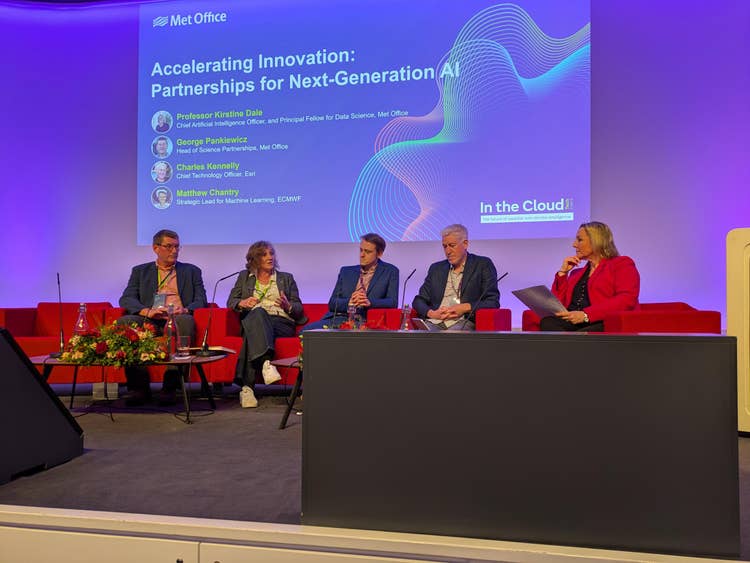
George Pankiewicz, head of science partnerships at the Met Office, said winning public trust for AI is “a journey we’re on.”
“We need to show the AI forecasts are just as reliable as our physics-based forecasts. Using our partners, we can make sure the data that’s coming out of it genuinely reflects what is happening in the real world.”
Kirstine Dale, the Met Office’s chief AI officer, said the organisation is using AI now for “downscaling” weather forecasts, and we caught up with her to learn more. Watch for an article later in the week.
Success also means winning the trust of AI itself.
Traditional search engines rank most government agencies, including the Met Office, as trusted, high-quality sources. That may not be the case when it comes to AI.
“An agent provided by a commercial organisation may make its decisions about trust in a different way,” said Charles Kennelly, CTO of Esri.
“If an agent is asking questions to solve a problem, why would it come to you? There are a lot more exciting weather forecasts out there. ‘Six hundred mile per hour snowbomb is going to attack Edinburgh’ is better than, ‘It’s going to be a bit damp’.”
Failure is a feature
For Kennelly – and other IT leaders we’ve talked to in the last four years – AI success means focusing on outcomes, not specific tools. Despite knowing so, we’re very much in an age of experimentation; that means throwing a lot of stuff at the wall to see what sticks.
One particular message, repeated several times, was that most AI projects fail – and that’s a good thing.
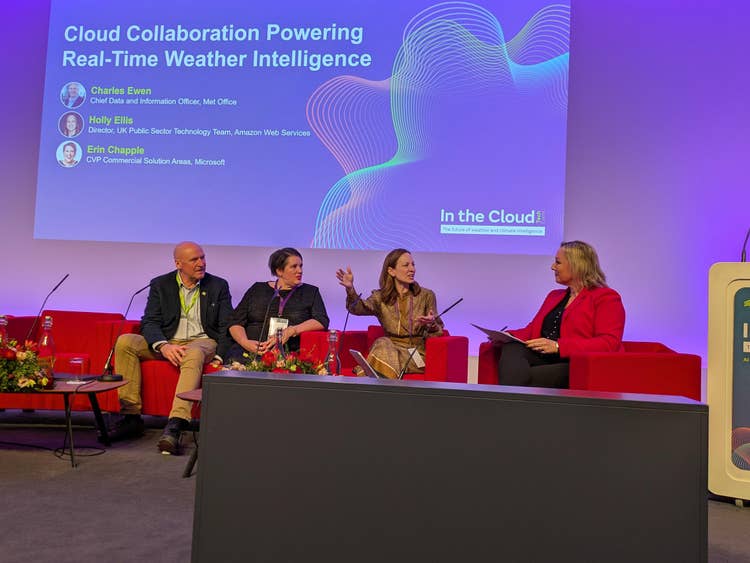
Reflecting on an AWS-Met Office AI pilot, Holly Ellis (AWS’ director of the UK public sector technology team) explicitly said low production rates are not a sign of weakness, but of healthy experimentation:
“There are some amazing stats on how few PoCs go into production, and they always say ‘only’. I think the ‘only’ is a good thing, because you’re learning an enormous amount as you go through that process.”
That attitude reflects the reality for many IT leaders, and not just with artificial intelligence. Rather than a warning sign, delegates framed project failures as an inevitable consequence of working at speed, at scale and in unfamiliar territory.
The Met Office, said Ewen, has had “many failed attempts” at public-private collaboration. He stressed that keeping a tight focus on a set outcome is what distinguishes successful partnerships.
Pankiewicz agreed, noting that sometimes partners “just walk away” - which is not only acceptable, but expected in the fast-moving tech landscape.
The Met Office began its supercomputer partnership by acknowledging the importance of letting go. Even with the stress that can cause and trust it demands, being able to do so is now part of responsible leadership.
Where are you still holding onto responsibilities that someone specialised could handle?