Cloudy with a chance of lightning speed: Met Office CIO on the supercomputing switch
From four-ton Ferranti to forecasts-as-a-service

After turning off a 50-year supercomputing legacy, what is the future for the UK’s weather forecasts?
It began in a tea shop.
More than 70 years ago, the LEO I – built by restaurant chain J. Lyon’s & Co. - was the world’s first business computer. The Lyon’s team went on to work with the University of Manchester and Ferranti to develop the Ferranti Mark 1, the world's first commercially available electronic digital computer.
The Mark 1, which weighed about 4.5 tonnes, didn't sell in high numbers, but for one customer the machine was the start of its own supercomputing journey – a journey that’s just taken a big evolutionary leap.
“The Met Office were a buyer of a Ferranti Mark 1,” says CIO Charles Ewen. “Since that time, we’ve had 13 iterations of compute platform.”
Each of those platforms has had a shelf life of about five years, and initially they were only used for research purposes, helping meteorologists produce a weather forecast. But as the computers became “more and more accurate, more and more reliable, more and more useful,” they also took over more and more work.
While the combination of humans and data is “absolutely the right model,” it's an unfortunate fact that “humans aren’t terribly scalable.” So, the Met Office’s computer – now rightly known as a supercomputer – has had an increasingly important role to play in weather forecasting.
A supercomputing storm
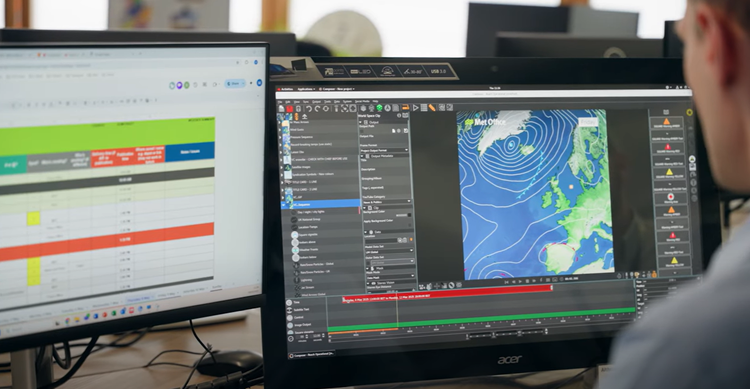
Earlier this year, with little fanfare and even less notice, the Met Office quietly turned off its on-prem supercomputer for the last time.
That meant the processing of 50 billion daily weather observations was being handled solely by a supercomputer in the Azure cloud, which had been running in parallel for more than a month.
Even though the move ended a long-standing legacy, it was the right decision, says Charles.
“Essentially, we ran out of sufficient power to run the scale of the machine that we needed to run.” They then started to ask, “Do we really want to be in the business of building and operating supercomputers, anyway?”
A “rigorous and fair” tender determined Microsoft to be the preferred operator, and the Met Office is now on gen 1 of a platform “six times bigger than what we had before, sat within the Azure infrastructure.”
Four times the structure, six times the data
The new supercomputer is designed for the modern era. Far from being “just” a research machine, it’s also a data factory – and those two applications have very different infrastructure demands.
Microsoft and the Met Office got around this by delivering the supercomputer as a quads system: “Actually four systems in two different data centres [that] we're able to configure optimally for laboratory and/or factory work.”
That new computer is currently running on old storage, though that's set to change soon. Since 2022, the Met Office has been undertaking “the biggest point-to point-movement of data ever tried across the Internet,” moving around 500 petabytes from its own archives to Azure storage. In a few months, that will become the primary data source for the new supercomputer.
"Primary” doesn’t mean “only,” though. The Met Office has been working with other operators, like AWS, for almost a decade and continues to use a multi-cloud approach for its operational data.
“We've got hot clones that are used for cache and immediate operational use storage that we send all over the place, and we archive those where we push them... It's a buffer, if you want to think about it that way.”
That hot operational data isn’t small: the supercomputer produces about 350TB every day. With a machine six times the size of the old on-prem model, Charles expects that to change in both shape and scale.
“The computer allows us to do new things in new ways, so the formats - if you like - of the data are going to change. We know that. And the size of the data is going to get bigger.”
Even with all this new power it's going to take some time before the consumer starts to see changes in the weather forecast, but the plans are in motion.
“The immediate science plans are around being able to predict 14 days [of weather] in the same way that we currently do for five... [and going] a little bit further into seasonal forecasting: the ability to say ‘Will the upcoming winter be more or less of this or that?' They're two of the immediate benefits that will be driven.”
Some readers will be wondering, “Why spend money you don’t have to if the benefits are minimal?”
To which Charles, CIO of the country’s premier forecasting organisation, has an easy answer:
“There are some things that are so big you have to respond, and you have to respond now.”