AI won’t save your SOC (but you still need it)
Here’s what AI really changes in cybersecurity
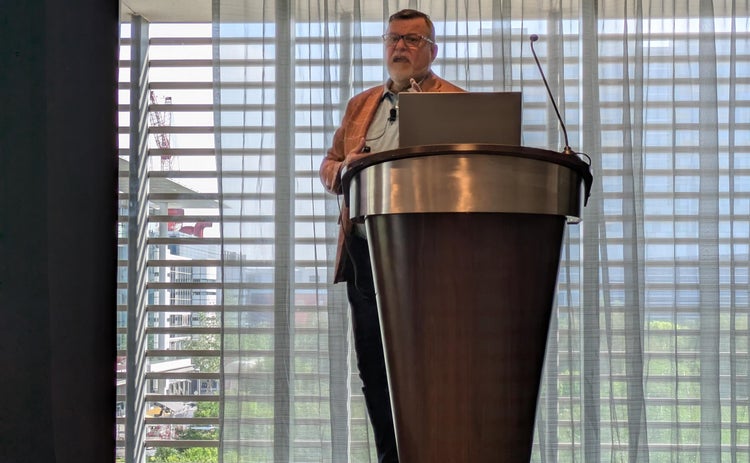
AI has so far failed to be completely transformational in either cybersecurity or business systems. But that doesn’t mean its impact is limited.
There’s “nothing new or novel” about artificial intelligence in security, says Gartner’s Paul Furtado; the vision of the fully autonomous SOC remains a nebulous promise for the future. But AI has raised the volume and velocity of attacks, and you need to respond in kind.
Or, as Paul put it at MES Spring in Houston this week, a flagship event by our sister brand MES Computing: “You can’t fight machine speed with human speed.”
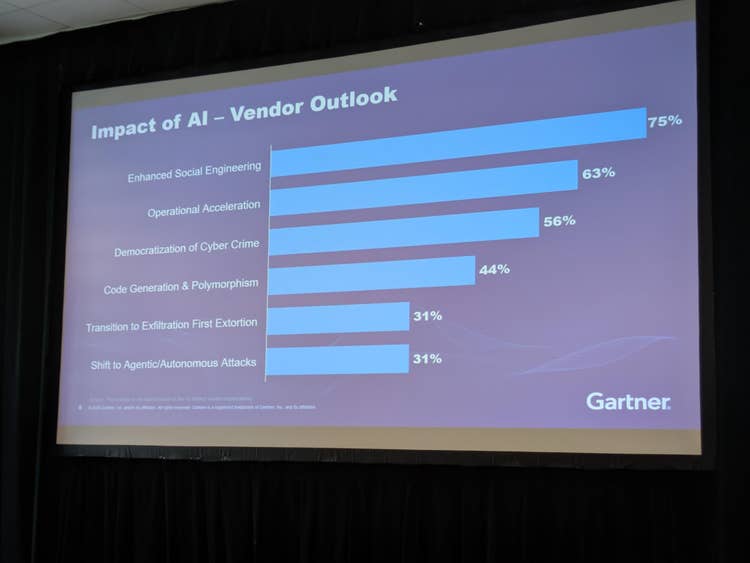
Looking specifically at ransomware, where AI’s impact is most obvious, the anatomy of an attack chain remains unchanged: it still starts with phishing and progresses through execution, payload staging, discovery & lateral movement and defence disruption, finishing with data exfiltration, destruction and disruption.
The key is that the time to move between links in the chain has shrunk, and continues to get smaller. Last year, it took an average of 24 hours to move from execution to exfiltration. This year it’s less than two hours – and the fastest 25% of attacks in 2025 took place in just 72 minutes.
“You can’t order and eat lunch in 72 minutes,” Paul said.
Dwell time has plummeted, too. Only 10% of attackers remain in the system for a month or more before launching an attack; 80% are ready to pull the trigger within a week, so you need to be confident that your systems can identify threats fast.
Even deepfakes aren’t a widespread problem
The days of badly constructed phishing emails are on their way out. Social engineering attacks are now hyper personalised and rely on information scraped from social media and business websites.
That is a much more prevalent issue than deepfakes. While in many ways these are the ultimate AI tool for attackers - and there are already some scary stories about them – the impact is not widespread.
Attackers have spun up a variety of new services like deepfake-as-a-service, deepfakes for ID fraud, voice impersonation and agentic AI orchestration to automate it all.
“Their capabilities are outpacing our detection capabilities,” said Paul, “but they’re not doing it for everyone in your organisation.”
That’s because, while simple deepfakes that follow a script are quick and simple to produce, the most convincing dynamic ones take time and resources.
“We have to be worried about this for critical people in the organisation: executives, maybe some people in finance... and the people who support them.”
Be sceptical about Mythos
Claude Mythos Preview, an AI tool that can detect previously unknown vulnerabilities, has thrown regulators and security experts into fits this month. The idea of such a system getting into the wrong hands (oh wait, it’s already happened) is deeply concerning.
But, says Paul, Mythos isn’t the only system that can do this, and there are unanswered questions about its development. For example, there is no information on how realistic the much-quoted test environment was (Paul called and asked).
“Keep in mind who released it: the person that wants to sell you the software when it comes out of review.”
Speed is the challenge and the answer
Ultimately, even if the type of attack hasn’t changed (much), AI is bringing new levels of volume and velocity. You need to do the same for defence, which does mean AI adoption. But that’s easy to get wrong.
Paul advised keeping three things in mind when considering AI in your environment: efficacy (can it do it right?); effectiveness (can it do it well?); efficiency (can it do it fast?). How does any system drive those three elements?
“AI is an accelerator. Mature your [processes], because if they’re bad you’re just going to see bad stuff happen faster.”
That might even involve looking to the past for lessons; Paul called out analogue operations like the nuclear launch system, which requires two people with physical keys.
“Whether it's finance, whether it's key business decisions, whether it's sharing critical IP or any sort of sort of confidential information, what does the analogue control look like?”
Make no mistake: to stay ahead in the cybersecurity arms race, we are all going to have to use AI, but it’s there to augment rather than replace staff. It’s no magic pill, but it can be a strategic uplift.
Remember – at these speeds, you don’t have time to order and eat lunch. Whatever can give you time back is no longer just ‘nice to have.’