Partner Content: What today's end-user computing challenges mean for IT decision-makers
End-user computing has rarely faced as much scrutiny, or as much change, as it does today
Organisations are under pressure to control costs, simplify operations, improve security and deliver a seamless user experience, all while navigating significant shifts across the virtualisation landscape.
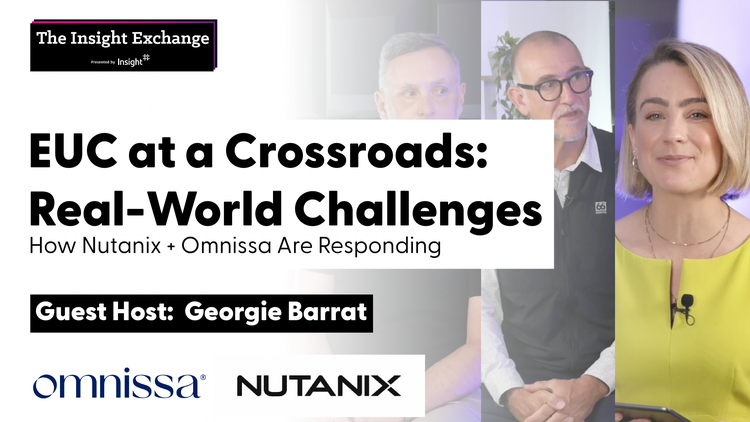
That was the central theme of Insight’s recent LinkedIn Live, EUC at a Crossroads: Real-World Challenges and How Nutanix and Omnissa Are Responding, featuring leaders from Insight, Nutanix and Omnissa.
The discussion explored why many organisations are reassessing long-held EUC strategies, the risks of standing still, and how a new generation of platforms is providing a path forward. Here are the four biggest takeaways for IT leaders.
1.EUC has reached a genuine crossroads
Many organisations can no longer rely on a "business as usual" approach to EUC.
For years, organisations built virtual desktop and application environments around technologies that became deeply embedded in their infrastructure. Today, however, changing market dynamics, evolving licensing models and increasing operational demands are forcing IT leaders to reconsider whether existing environments remain the best fit for the future.
At the same time, business expectations continue to grow. IT teams are expected to deliver better employee experiences, support hybrid work, strengthen security and keep costs under control.
The result is a difficult balancing act. Organisations are being asked to do more with less while maintaining complex estates that were often designed for a very different era.
As the panel noted, this is why EUC is now a strategic business discussion rather than simply a technical one.
2.Rising costs are only part of the challenge
While cost pressures are often the catalyst for change, they are rarely the only issue organisations face.
“[The biggest real-world challenge that customers are currently facing] is cost,” says Spencer Pitts, Partner CTO & Senior Director EMEA at Omnissa. “It’s always cost. But beyond that, IT leaders are increasingly looking beyond simple cost reduction exercises and toward the bigger picture”.
Instead, as the panel discusses, they are searching for ways to reduce complexity, improve resilience and create a platform that can evolve with future business requirements.
Across customer conversations, several recurring themes emerged:
- Increasing licensing and infrastructure costs
- Growing operational complexity
- Skills shortages across EUC teams
- Difficulty managing multiple tools and platforms
- Greater security and compliance requirements
- Uncertainty around future technology roadmaps
More than just flat affordability, organisations are now looking at their accumulated layers of infrastructure, management tools and operational processes and the effort it takes to maintain and optimise them.
3.Before making changes, organisations need a clear assessment of where they are today
One of the strongest recommendations from the discussion was the need to pause and take stock.
Many organisations jump straight into technology evaluations without fully understanding the strengths and weaknesses of their current environment. However, successful transformation programmes typically begin with a detailed assessment of the existing estate.
The panel discussed the importance of conducting an EUC health check that examines everything from current infrastructure and architecture, and licensing and operational costs to future scalability requirements and operational capabilities.
This is where Insight's EUC Crossroads Workshop can play an important role. By evaluating an organisation's current position, IT leaders can gain clarity on both immediate optimisation opportunities and longer-term transformation options.
4.Success depends on combining technology with the right expertise
While much of the discussion focused on technology, the panel was clear that successful EUC transformation is about far more than selecting the right platform.
One key concern is the skills gap. Past talent acquisition, internal training is important but is easier said than done. As Darren Woolward, Field CTO at Nutanix says, “Existing talent may have to be retrained or reskilled, and that’s a challenge because people generally like to just keep doing what they’ve always done.
“Nostalgia is not a strategy—you always have to be open to change and progress. Without a clear strategy, even the most promising technology investments can struggle to deliver their intended outcomes.”
The speakers went on to highlight the importance of understanding the current environment before making major decisions. Through an EUC assessment or "crossroads" workshop, organisations can gain a clearer picture of their existing cost profile, operational challenges and future requirements. This creates the foundation for a roadmap that aligns technology decisions with wider business objectives, rather than simply reacting to immediate pressures.
From there, the focus shifts to validation. Rather than committing to large-scale change based on assumptions alone, organisations can work with partners to design and test a future-state platform through pilots and proof-of-concept deployments. This approach allows IT leaders to evaluate the potential impact on user experience, operational efficiency and overall costs before moving forward with a full migration.
By combining the capabilities of Nutanix and Omnissa with Insight's assessment, migration and managed services expertise, organisations can reduce risk throughout the transition while ensuring their EUC environment continues to evolve alongside changing business and user demands.
Check out the full LinkedIn Live Discussion here.
This article is sponsored by Insight