Meta’s sustainability surprise
Meta isn’t usually praised for its transparency, but its sustainability reporting might be an exception

The final instalment of Computing’s sustainability research series examines Meta, which has no enterprise customers demanding sustainability disclosure or transparency. This made the findings of our analysis all the more surprising.
Why did we include Meta in this analysis? Meta is, despite Mark Zuckerberg's best efforts, primarily a social media company, owning Facebook, Instagram, Threads and WhatsApp. It doesn’t provide enterprise cloud services, but it operates on the same scale as the hyperscalers and has invested heavily in AI infrastructure as it moves away from VR and the metaverse.
And I mean heavily. In 2024, Meta spent $39.2 billion on CapEx. That escalated to nearer $72 billion in 2025 and on its earnings call from Q1 this year, Meta raised its full-year 2026 CapEx guidance to more than 2024 and 2025 combined to $125 to $145 billion.
This combination of vast CapEx and the lack of scrutiny from procurement teams that similar sized hyperscalers would be subject to led to Meta’s inclusion in this year’s analysis.
Emissions reporting
Given that Meta is answerable to no one other than its shareholders, one might expect a low standard of environmental reporting from the company – especially given the way it has made very public its repudiation of all things the present US administration might regard as woke.
Whether it’s a legacy of former COO Sheryl Sandberg or former President of Global Affairs Nick Clegg, the standard of Meta’s environmental reporting is, bar one category, superb. If we ranked all ten of this year’s AI clouds in terms of transparency and detail, Meta would sit at the top by some margin.
The company publishes targets in line with most of its hyperscale peers. It aims to be net zero by 2030, to have reduced Scope 1 and 2 emissions by 42% in 2031 from a 2021 baseline, and to not exceed the 2021 baseline Scope 3 emissions by the end of 2031.
Meta also says it will continue to match 100% of electricity use with clean and renewable energy, a goal it hit in 2020 – well ahead of Microsoft (2025) and Amazon (2023). Google reached this target in 2017.
The chart below shows the extent of progress toward these emissions, and whilst it isn’t great, it's broadly in line with other equivalent size companies. In terms of GHG footprint, Meta is closest to Amazon.
Scope 1 emissions (direct emissions) have fallen a little since 2023, but only a small amount. Scope 2 market-based emissions (those produced indirectly by the consumption of electricity) look very small, but when you look at location-based emissions (which take into account the average emissions intensity of the grid where consumption occurs) across the Scope 2, and Scope 3 categories, these have increased by around 2.2 MMTCO2e (million metric tonnes CO2e.)
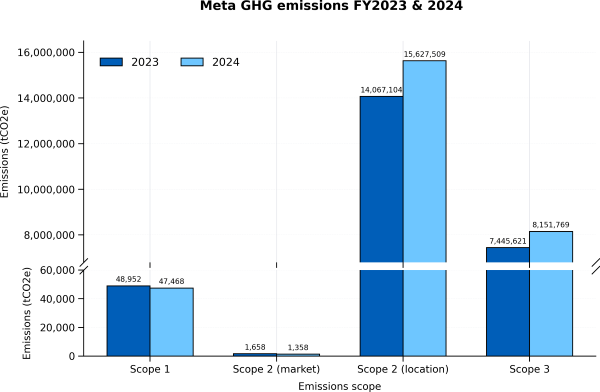
Because Meta breaks its data into emission categories so cleanly and clearly, it’s easy to see that the big increases in Scope 3 emissions have come from the capital goods, upstream transportation and distribution categories. This points towards 2024 being a year when Meta started to build a lot of capacity.
One thing Meta does that goes way beyond the visibility provided by other hyperscalers is to break down emissions per datacentre, and provide data for both market-based and location-based emissions per datacentre.
Renewable energy matching & carbon credits
Like every other hyperscale consumer of electricity, Meta buys Energy Attribute Certificates (EACs) and Renewable Energy Certificates (RECs). An EAC is a contractual instrument. Each EAC represents the environmental attributes of one megawatt-hour (MWh) of electricity generated from renewable sources. EACs basically underpin carbon accounting and are supposed to serve as proof that a unit of renewable energy has been generated – but not necessarily consumed - by the buyer. It is sold, unbundled from the unit of renewable energy it represents. A REC is a specific type of EAC, standardised for US and Canadian markets.
It is the fact that an EAC is unbundled from the unit of renewable energy it represents that contributes to the cynicism surrounding carbon accounting. EACS can be purchased without directly funding new renewable energy projects. An EAC is not, therefore, proof, that you have added to the stock of renewable energy in the world. And the companies buying them can do so whilst still consuming fossil fuels via their local grids. This is why, for full transparency, location-based emissions should always be included in environmental reporting.
Meta gets ahead of this to some extent by expressly stating its adherence to the principle of buying renewable energy in the same grid region as their datacentres,
“We adhere to the following EAC market boundaries in accordance with Meta’s Management’s Criteria:
- EACs from same grid region
- EACs from same market (in accordance with GHGP Scope 2 Guidance)
- EACs from same Geographic Region: Americas (AMER); Europe, Middle East and Africa (EMEA); Asia Pacific (APAC).”
Meta also confirms that it procures and retires one EAC for every MWh of electricity used to power global operations. It also lists every one of its operational datacentres and sets out the sum of both location and market-based emissions per datacentre which, as hyperscale transparency goes, is unparallelled.
Also impressive is the fact that, unlike its hyperscale cousins, Meta makes relatively light use of carbon credits. In fact, it’s been making progressively less use of carbon credits since 2020, using them only to offset residual, hard-to-abate operational emissions.
Carbon credits represent a verified climate benefit equivalent to the removal, avoidance or reduction of one mtCO2e.
Environmental groups have drawn attention to many of the problems with relying on carbon credits in carbon accounting. It is very hard to prove that a carbon removal project would not exist if it wasn’t for the revenue from carbon credits (additionality) but if you want to claim genuine climate benefits that’s what you have to do.
The best-known example of the shortcomings of carbon credits is in reforestation type projects. These projects can be prone to leakage. This means that if you stop logging in one area, it just pops up somewhere else because the demand for the product hasn’t gone away. It’s very difficult to prove this won’t happen.
Equally, if a forest fire occurs years later, far more carbon will be released than was avoided or removed in the first place.
Meta appears to have made a strategic decision to rely less on carbon credits over time and focus more on renewable energy matching. Unusually, Meta even lists the specific type of carbon credit it uses to offset certain categories of Scope 3 emission, such as Sustainable Aviation Fuel certificates (SAFc) to reduce emissions from business travel, or sustainable maritime fuel certificates (SMFc) to supplier-provided ocean freight emissions, which falls into the upstream travel and distribution category.
Meta is the only company in this year’s analysis with an established ESG reporting framework that does not seem to deploy carbon credits to try and claim overall emissions are reducing.
This demonstrates a level of transparency far beyond what we expected from a company that doesn’t have to answer to enterprise customers.
Page 2
Water
Compared to the hyperscalers, Meta’s water use is close to the likes of Microsoft and Amazon, both of which use a fraction of that consumed by Google. For comparison, In FY24 Microsoft consumed 5,807 ML (megalitres, equivalent to a million litres), Meta 3,123ML and Google 30,795ML.
Water usage effectiveness (WUE), defined as the amount of water used (in litres) per kilowatt hour of energy consumed by IT equipment, is also an interesting metric - if it is provided alongside total water withdrawal and consumption for full transparency, rather than being offered as substitute for the full picture.
WUE shows how efficiently companies use the water they consume for cooling. It’s a measure, essentially, of how well designed and efficiently cooled datacentres are.
Meta gives its datacentre average WUE as 0.19. For context, it helps to compare that to peers such as Microsoft with a WUE of 0.3 and Amazon with 0.15. Meta therefore sits somewhere in the middle.
Incidentally, you may infer from the vast quantity of water that Google consumes that its WUE is the outlier here. Google doesn’t publish a figure, but industry estimates put it at around 1.1 litres per kilowatt hour – which explains a lot about Google’s overall consumption.
However, before you start to think too highly of Meta’s environmental credentials, it’s worth noting another metric – water consumption from areas of high or very high-water stress. This increased to 748ML in FY24, and the reason has much to do with Meta’s location choices for its datacentres.
The company has faced local community pushback on water usage in several locations, most recently in the US state of Georgia. Meta broke ground on that site in 2018, and according to local reports, residents who rely on private wells started to report decreasing water pressure not long afterwards, leaving them with sediment building up in wells, and multiple taps and water-connected household appliances not working.
Earlier this year, Representative Alexandria Ocasio-Cortez presented jars of muddy-looking water at a congressional subcommittee hearing, arguing that a federal investigation should be initiated. The Environmental Protection Agency subsequently said it would investigate the complaints.
Meta has disputed that its operations caused the water problems, but it has faced community concerns before on this issue.
Meta’s campus in Los Lunas, New Mexico is also controversial, with claims bouncing around social media that it’s contributed to the drying of the Rio Grande. These claims look to be wide of the mark, and there are lots of factors contributing to historically low water levels in the Rio Grande. However, it seems intuitive that the groundwater pumping Meta undertakes in water-stressed regions is going to have at least an indirect impact on local groundwater levels.
Waste
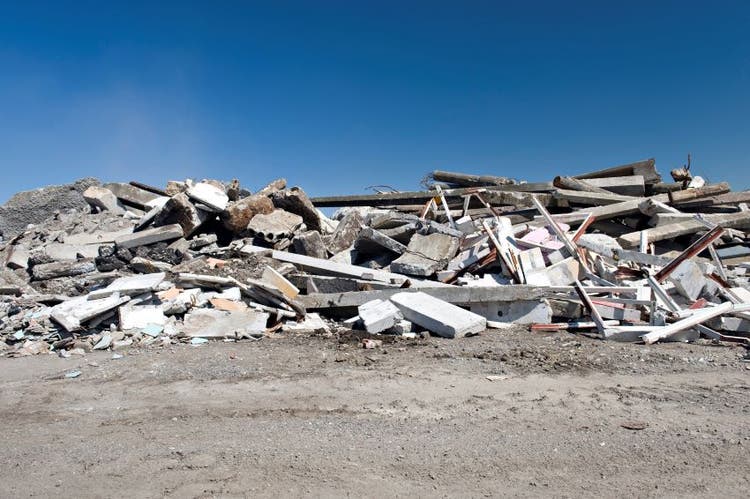
This is the only area of the analysis where Meta has chosen to be opaque. The word “chosen” is deliberately employed because to know that 91% of datacentre construction waste is diverted from landfill, the company must know exactly how much it has generated overall.
Also, this category of waste is carefully defined as “waste materials generated during the construction, renovation, and demolition of buildings and roads.” This is therefore only a subcategory of Meta’s overall waste generation, so more waste is being excluded from the analysis.
Meta also attributes 31,634 mtCO2e to the ‘waste generated in operations’ category of its Scope 3 reporting, so why not just publish overall tonnage?
The only waste target that Meta has published relates to office waste, which is likely to be much smaller as an overall proportion of waste. It isn’t a demanding target – a 50% reduction on office waste from a base year of 2019 – but even that is meaningless if it can’t be tracked and Meta held accountable for it.
Meta falls back on tactics employed by many of the other companies in our analysis, which is to use words to describe efforts to reduce waste but provide no data to back them up.
For example, Meta describes how it reduces e-waste by reducing, reusing and refurbishing as many datacentre components as possible and extending life. In addition, all its operational datacentres are LEED gold certified.
All of which is great, but data would be far more informative and useful for holding Meta to account.
The Meta/hyperscale accountability paradox
Meta turned out to be the most surprising company in this year's analysis, and also the most contradictory.
On emissions reporting, it’s peerless. No other company in this series publishes data by individual datacentre or names its specific carbon credit instruments. Meta also stands alone in making a strategic decision to reduce reliance on carbon credits, rather than deploying credits to try and offset a rising emissions profile.
That said, the emissions trajectory isn’t exactly comfortable reading. Location-based emissions increased by more than 2 million mtCO2e in 2024. Scope 3 capital goods emissions are rising sharply as Meta's AI infrastructure build-out accelerates, so the gap between net zero ambition and the current trajectory is as real as it is for all the other hyperscalers.
On water, the picture is more complicated. Consumption is modest compared to Google's extraordinary outlier figure, and a WUE of 0.19 is very respectable, if not the absolute best in class. But the 748 megalitres consumed from areas of high-water stress in 2024, the community complaints and now EPA investigation show that despite topline numbers looking pretty good for a company of Meta’s size, its datacentre location choices have had a negative impact on surrounding areas. Unsurprisingly, information about this is absent from Meta’s ESG report.
As is any tangible information in waste volumes, On this category of analysis, the transparency that defines Meta's emissions reporting simply disappears. A company that knows precisely how much construction and electronic waste it generates has chosen not to report it.
Furthermore, Meta is not above the kind of presentational choices I’ve criticised in other companies within the wider analysis. Its sustainability highlights page features the words ‘15 GW of clean energy’ in large, bold font. But 15GW is a cumulative figure of contracted renewable capacity, not a single year's addition. Meta doesn’t explicitly claim otherwise, but the presentation is selective, and, I would argue, bordering on misleading.
Nonetheless, Meta remains the most transparent company in this entire analysis. It shows more of its working, in more detail, with more methodological transparency than any hyperscaler, neocloud or AI-native challenger examined in this series.
More unexpected still is that Meta does so despite not having to answer to a base of enterprise customers wanting to understand more about the environmental impact of the services they use.
Another way of looking at it is that the hyperscalers (and increasingly neocloud and AI-native cloud companies) IT leaders contract AI and cloud services from produce less information for their customers and prospective customers than a large social media platform.
If Meta can do this without being asked, perhaps it’s time we all increased the pressure to do likewise on the companies competing for our infrastructure budgets.