Is AI a bubble? IT leaders have their say
Most think not, but there are some red flags

In our latest research into IT trends we asked a simple question: is AI a bubble? The question was deliberately simple to elicit a top-of-mind response, an indicator of IT leaders’ broad impressions of the state of AI rather than a deep dive into the details.
Given all the talk of impending doom, on the face of it the results seem quite positive for AI. Twenty-seven percent believe that AI is indeed a bubble, but almost twice that number (50%) think the opposite; 23% were unsure.
If there is a bubble it has two dimensions: over-leveraged finances and a failure to deliver on promises, threatening another AI winter. Obviously, they are related, but they’re not the same. On both counts there are causes for concern.
That the funding deals underpinning the current datacentre build-out frenzy look precarious is undeniable. Hedge fund manager Michael Burry, of The Big Short fame, announced last year that he is now betting against the industry, while some pension funds are starting to move away from US tech stocks.
That pronouncements by Sam Altman and Elon Musk about amazing capabilities just around the corner should be taken with a cybertruckload of salt is also clear. But that doesn’t mean that AI will not evolve to become more generally useful and even revolutionary over the coming months and years. Even if the financial bubble bursts that could still happen.
Among 38 respondents who believe AI to be a bubble, the lack of a clear business model was the primary red flag. Apart from Nvidia, almost every player is losing money on AI, with many struggling to differentiate their offerings or to get customers to pay anything close to the point where they might turn a profit.
“The valuations are too high,” noted a CITO in a retail and distribution company.
“It’s a very confusing market that really needs to consolidate and simplify,” said an IT portfolio manager at a utilities company.
“At some point the market will correct as the actual value of the business will be reflected in the share price. Some of the players will exit the market,” added a business applications manager in a property services company.
Big tech has other income streams that should enable it to weather any downturn, but questions remain about the financial sustainability of the GenAI model itself.
Unlike traditional enterprise software, AI does not offer clear economies of scale. Once built, software can be distributed at near‑zero marginal cost; in contrast, with foundation models the more they grow the more expensive they get. Countering this, models are constantly being optimised and improved, but workloads are growing faster than efficiencies can be realised with the result that profitability is receding over the horizon.
Turning to business use cases, 55% of the doubters were seeing few tangible productivity benefits, a finding echoed by a number of recent large-scale studies that have shown AI’s business value to be elusive.
Datacentre construction bottlenecks (34%) and suspicious-looking funding activity (34%) were also causes for scepticism.
“There definitely are tangible productivity benefits, just not in all areas where people are trying to introduce AI,” said a software director in a technology consultancy, neatly encapsulating the problem.
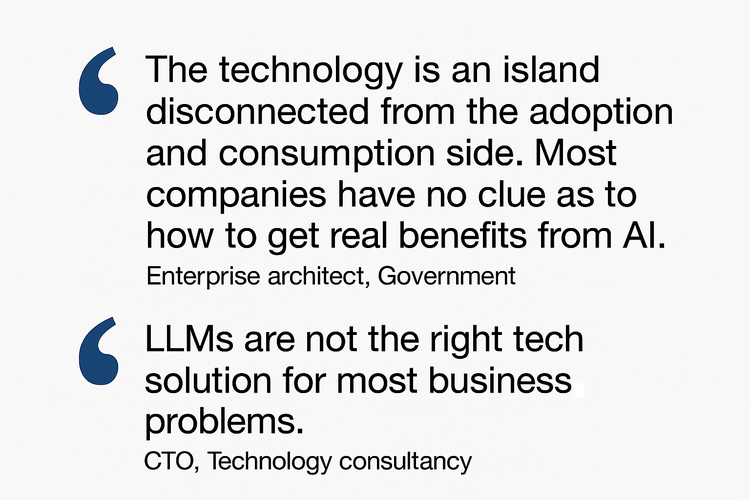
“The technology is an island disconnected from the adoption and consumption side. Most companies have no clue as to how to get real benefits from AI,” offered an enterprise architect in government.
“LLMs are not the right tech solution for most business problems,” added the CTO of another tech consultancy.
Bubble or not, the current situation could continue for some time yet before any market correction arrives. Half (50%) of those who see AI as a bubble think there is a good chance it will burst in 2026, whereas 24% feel it could carry on for longer.
“IMHO 2027 will be the fall-out year, and from the wreckage hopefully something useful will emerge,” said the operations manager at a leisure services company.
In the next article from our 2026 Tech Trends research, we’ll be looking at how organisations are using AI for coding, how IT leaders see it altering the structure of the workforce, the jobs most likely to be affected, agentic rollouts and some successful use cases of GenAI.