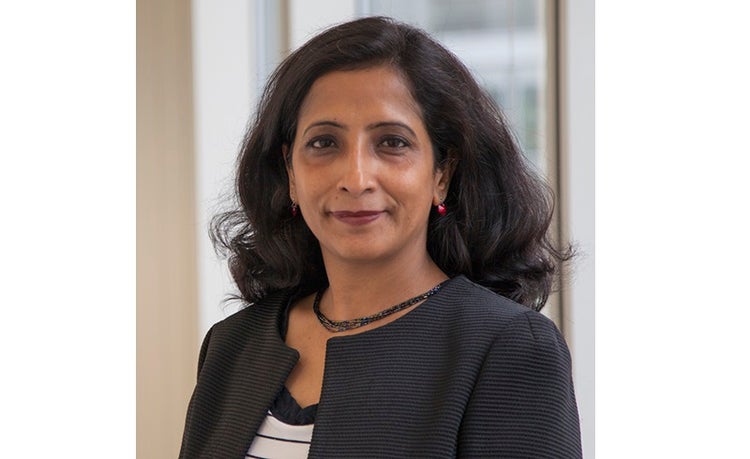
Supriti Singh
Part of the IT Leaders 100 - a list of the most influential IT leaders in the UK in 2026.
Supriti is the Chief Information Officer for the UKIMEA region at Arup. She is responsible for driving transformation that delivers value by harnessing the power of digital to help solve some of the toughest problems in the built environment.
Born in India, Supriti is an Electrical Engineering graduate with over 30 years' experience across a wide range of sectors. She has a passion for leading, developing, and motivating global diverse teams.
Supriti joined Arup in Oct 2018, prior to which she has been the CIO for TIP Trailer Services & General Electric (GE) Capital Business (Equipment Services, Europe,) where she drove digital transformation programs across multiple countries.
What's the most exciting part of your current role?
Being at the centre of rapid technological disruption, particularly the pace at which start-ups and established technology companies are exploring and applying AI in diverse ways.
AI is shaping thinking across almost every dimension - people, processes, productivity, simplification, efficiency, ethics, data, models, compute, networks, energy consumption, renewables, and even the location of datacentres. I find it especially compelling that AI is not just a technology shift, but a fundamental transformation in how organisations operate and make decisions.
In my current role, we are actively working on an AI strategy that takes a responsible, organisation-wide approach to unlocking value while ensuring ethical and sustainable use.
What motivates me is the opportunity to position AI as an enabler for people rather than a replacement. By embedding AI thoughtfully, we can optimise operations, reduce risk, and significantly enhance both employee and customer experience.
Being part of this journey - where strategy meets real-world impact - is what I find most energising and rewarding.
What do you do in week one of a new project to avoid pain in month six?
I use week one of a project to establish a strong foundation to create clarity and control early, preventing scope creep, technical rework, late surprises, and governance breakdowns later. My key activities during this week are as follows: -
- Align on purpose and success by agreeing the problem statement, desired outcomes, success metrics, and review cadence with sponsors and key stakeholders, and core project team members. This ensures everyone starts with a shared understanding.
- Articulate scope boundaries and change control by clearly defining what is in and out of scope, along with key deliverables, assumptions, and a process for managing change requests.
- Capture and prioritise core requirements, focusing on critical business and user needs early to minimise rework later.
- Set the technical direction while planning for security, compliance, environments.
- Establish roles, governance, and ways of working, including RACI, decision-making processes, escalation paths, and communication cadence.
In addition, I also identify risks, assumptions, and dependencies through a RAID log and define mitigation actions.
Finally, I outline a realistic plan with milestones and ensure robust documentation standards are in place
What’s the part of your estate you most want to simplify in 2026?
We are a curious and forward-looking team, always keen to explore and adopt new technologies to enhance how we work. However, this enthusiasm has led to our software estate evolving in an inconsistent manner over time.
In 2026, our focus is to simplify and rationalise the software estate - bringing greater consistency, reducing complexity, and ensuring our technology choices are aligned, scalable, and fit for purpose.
Excluding smartphones, what piece of technology could you not live without and why?
The internet - accessed through devices like my laptop, smart speaker, iPad, and TV. It is less about a single device and more about the internet connectivity that enables everything I do.
I rely on it daily for a wide range of activities. For example, I use it to follow guided yoga sessions, stream music and movies, and stay connected with friends and family. It also supports practical aspects of life - ordering online, finding recipes while cooking, and managing day-to-day tasks efficiently.
From a productivity perspective, the internet - primarily via my laptop and smartphone - is essential for accessing information, working, collaborating, and staying organised. Devices like Alexa and my iPad complement this by making interactions more seamless and convenient.
What stands out is how I use the internet as a foundational utility, similar to electricity. It integrates different parts of my life - health, entertainment, social connection, and productivity - into one connected ecosystem. Without it, both efficiency and convenience would be significantly reduced
What excites you most about the future of IT?
The incredible opportunity it offers to drive better outcomes for our clients and truly transform how we work. We are at the edge of a new digital era where technologies like AI, quantum computing, digital twins and hyper-automation are not just emerging - they are already changing the game. I am genuinely energised by the chance to adopt these innovations and use them to help deliver our company's strategy in smarter, faster, and more impactful ways.
What really inspires me is the potential to apply this next wave of technology across the real world - in the infrastructure we build, the homes we live in, the hospitals and offices we rely on and even the places we go for entertainment. We can use future of IT not just to improve efficiency, but to create more sustainable, inclusive, and intelligent environments.
As a digital leader, I find it incredibly rewarding to see how IT empowers people through continuous learning, better collaboration, or unlocking new ideas. For me, helping to build those agile, curious, and future-focused teams is one of the most exciting parts of the journey.
What talent are you quietly proud of that would never show up on LinkedIn?
My ability to interact effectively with people is a strength that extends across both my professional and personal life.
In my professional environment, I am approachable and collaborative. I make a conscious effort to put people at ease during interactions, which encourages openness and helps teams align more quickly to achieve shared objectives.
In my personal life, I genuinely enjoy socialising and bringing people together. I am passionate about cooking and often host large gatherings at home of friends and family, preparing a variety of vegetarian and non-vegetarian dishes myself.
What’s your most-used keyboard shortcut or command that you wish everyone knew?
During the course of the day, I often find that multiple windows are open across my desktop, which can make it time-consuming to locate a specific document or email that I need to work on.
In such situations, I use the Windows key + M keyboard shortcut to instantly minimise all open windows and dialog boxes, revealing the desktop. This allows me to quickly access and organise the required window, improving efficiency and focus.