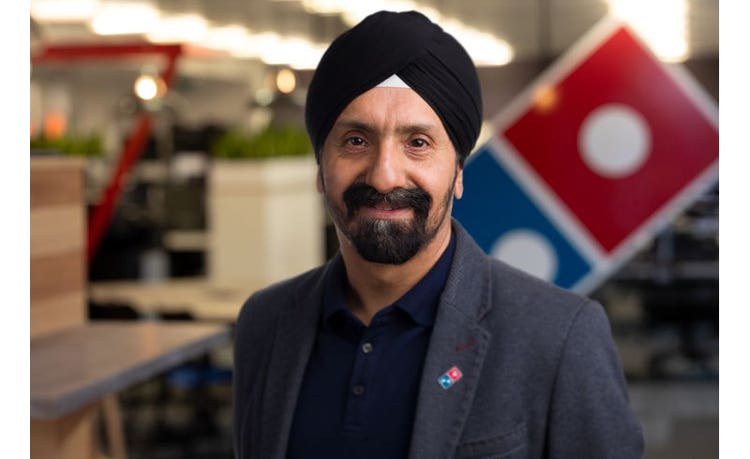
Sody Kahlon
Part of the IT Leaders 100 - a list of the most influential IT leaders in the UK in 2026.
Sody leads the technology team at Domino's Pizza UK&I, delivering and operating digital and retail solutions that support over £1.5bn in annual sales across 1,400 stores. Previously, he held senior technology and software engineering leadership roles at Ladbrokes, Dell Technologies, Siemens, and Hitachi.
Sody has a strong track record in technology transformation, agile delivery, organisational change, and leading high-performing internal and global partner teams to design, deliver, and operate large-scale retail and digital platforms.
What's the most exciting part of your current role?
To lead in IT, you need grit! The resilience to stay calm when things go off-plan, when production incidents consume the night, or when unexpected priorities suddenly take over. I enjoy facing those challenges head-on and cutting through the hype, complexity, and chaos to calmly work with my team and solve problems that deliver real business outcomes, that's hugely exciting!
Learning how to bring people and technology together to drive growth, modernise platforms, accelerate processes, and improve service and cyber resilience is also incredibly rewarding. Even more so when you can see the visible impact on franchisees, customers, and the wider company.
A big part of what excites me is my teams. To build them, support them, mentor them and bask in their intellect. It's an incredibly proud moment to see your child excel, and because we spend so much of our time with our teams, they become like family too, creating that same sense of pride when they thrive in their roles and are recognised for their achievements.
I am extremely blessed and fortunate to sit at the intersection of technology, people, and meaningful change where the decisions I make today genuinely shape how the organisation operates tomorrow.
What do you do in week one of a new project to avoid pain in month six?
Treat significant projects and programmes like a start-up. Expect failure, plan to pivot and take measured risks (safe-to-fails). I start by focussing on making sure the fundamentals are clear; stakeholders, Finance, delivery teams, partners, and vendors alike. This means aligning on project objectives, expected business outcomes, timelines, milestones, budgets, and when returns are realistically expected by the Finance teams.
I also make it a priority to validate scope early, and just as importantly, what's out of scope. Assumptions are often where projects drift, so ensuring alignment across all stakeholders from the outset is critical. The same is true for dependencies (incoming and outgoing), and ensuring all dependent teams and partners are primed and aligned to consolidated plans.
Then I like to run collaborative risk workshops to brainstorm and identify what could go wrong and agree mitigation plans early. Looking back at lessons learned from previous deliveries forms a key input to this.
For larger initiatives, we may even establish contingency plans from day one, for example, running with dual partners with shared responsibilities in case the primary partner encounters challenges.
Clear ownership is another major focus. I ensure RACIs are established early so accountability never becomes blurred.
What’s the part of your estate you most want to simplify in 2026?
This year I launched our new eCommerce backend platform, replacing a 15+ year legacy monolith responsible for processing £1.6bn in sales and over 70 million orders annually. The programme took 3.5 years, involved 150 team members across 10 partners in 5 countries, and has now successfully cut over our core customer channels.
In 2026, the simplification focus is reducing the remaining operational complexity around that estate. This includes the phased decommissioning of the legacy platform, reducing reliance on third-party digital frameworks by bringing common capabilities in-house, and simplifying integrations with aggregator partners such as Uber Eats and Just Eat through a common middleware layer rather than multiple point-to-point integrations.
Automation also plays a major role in simplification. Automated testing now delivers over 85% coverage, reducing manual effort and improving release confidence, while agentic AI is being introduced across support, SRE, and operational processes.
For me, simplification is about creating simpler data driven reports, and a leaner, more resilient, technology estate that enables faster change safely.
Excluding smartphones, what piece of technology could you not live without and why?
GPS technology, without question. It has completely transformed how we travel, navigate, and plan our lives with precision. From avoiding traffic and hazards to enabling real-time logistics, efficient supply chains and emergency responses, it's one of those technologies that quietly underpins modern life in ways we just take for granted.
What makes it most important to me, though, is the freedom and reassurance it can provide on a personal level. My father has dementia, and he wears a GPS-enabled safety necklace. Without it, even simple family outings could become stressful and anxiety-inducing for everyone involved. Knowing we can quickly locate him if he becomes disoriented gives both him and our family greater confidence, independence, and peace of mind.
For me, that's when technology is at its best. Not when it's flashy or on hype curves, but when it solves real human problems in a simple and meaningful way.
What excites you most about the future of IT?
The pace and its unpredictability. Today's hype can quickly become tomorrow's game-changer, life-changer, or just a passing fad.
AI and automation are obviously transforming the landscape. Watching how they can remove complexity, accelerate decision-making, improve resilience, and free people from repetitive operational tasks is incredibly exciting.
This year alone, AI has enabled me to modernise and reduce technical debt in ways that simply weren't feasible a few years ago without significant investment. I can now genuinely see how IT teams can deliver outcomes at a pace that wasn't previously possible.
I'm also excited by how data, observability, and intelligent automation are reshaping technology operations. Predictive operations, self-healing platforms, and more resilient architectures have huge potential to improve both customer experience and operational stability.
Equally important is technology's impact on humanity. From healthcare breakthroughs, improving the quality of life for the impaired or even opening new frontiers beyond our planet. For me, the excitement is less about individual technologies and more about their potential to improve organisations, society, and ultimately people's lives.
What talent are you quietly proud of that would never show up on LinkedIn?
In my younger years and whilst building my career, I wrote, produced, directed, and acted in theatre shows that toured across the UK, various festivals, and internationally. What started as a creative outlet ended up teaching me many of the skills I still use in IT leadership today.
Theatre forces you to work with very different personalities, solve problems quickly, adapt constantly, and stay calm under pressure, especially when there is more drama happening backstage than on-stage or moments before the curtain rises.
Ironically, managing major technology programmes and production incidents isn't that different from live theatre. There's always unpredictability, strong personalities, tight deadlines, and occasionally chaos backstage, but the audience should never see the panic.
This experience taught me resilience, communication, creativity, and how to lead calmly through pressure without creating additional drama. Those are skills I value enormously, even if they never appear on a CV.
What’s your most-used keyboard shortcut or command that you wish everyone knew?
Ctrl+Z — undo. Not just on a keyboard, but in IT generally. Having the ability to reverse a decision or an action is hugely liberating. Some of the best decisions come from recognising early that something isn't working and having the confidence to reverse course quickly before a small issue becomes a major incident. Whether it's a deployment, a project decision, or an overcomplicated process, the ability to pause, reassess, and "undo" without ego is hugely underrated.
Technically though, I'd also nominate Ctrl+Shift+T, reopening the browser tab you accidentally closed moments before realising it contained the one critical dashboard, document, or production log you desperately needed!