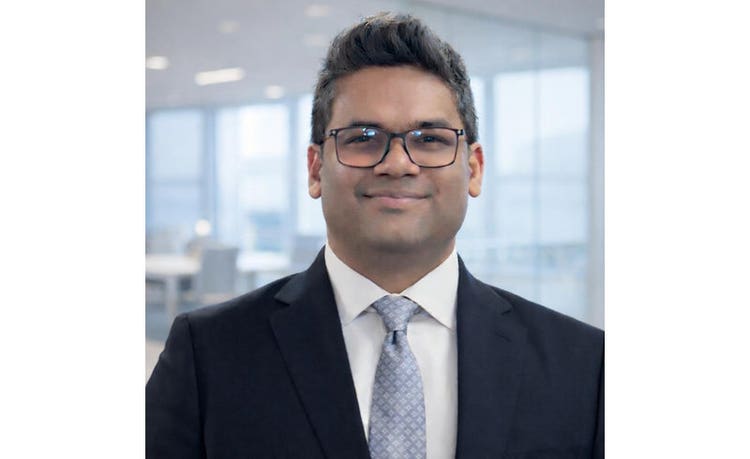
Sangeeth Manoharan
Part of the IT Leaders 100 - a list of the most influential IT leaders in the UK in 2026.
Sangeeth is Head of Artificial Intelligence at Marston Holdings, where he leads the deployment of AI within highly regulated, large-scale operational environments, focusing on moving solutions from experimentation into production systems that deliver measurable impact. He has delivered award-winning AI projects and specialises in building scalable, reliable, and real-world AI applications.
Sangeeth has been recognised as one of Computing's Top 25 AI Leaders and contributes to the wider AI ecosystem through involvement with the All-Party Parliamentary Group on Artificial Intelligence and participation in AI standards development with the British Standards Institution.
What's the most exciting part of your current role?
The most exciting part of my role is taking AI beyond experimentation and embedding it into real operational environments where it delivers tangible impact.
Working at scale means dealing with complexity, integrating AI into existing systems, ensuring reliability, and driving adoption across teams and that's where the real challenge and opportunity lie.
What I find particularly rewarding is seeing AI move from a concept to something that meaningfully improves decision-making, efficiency, and service delivery. It's not just about building models, but about creating systems that work in the real world and continue to evolve over time.
Alongside this, being involved in broader discussions around AI standards and policy adds another dimension. It's an opportunity to help shape how AI is deployed responsibly and at scale, which I believe is critical as the technology becomes more embedded in everyday operations.
What do you do in week one of a new project to avoid pain in month six?
In week one, I focus on aligning on three things: the problem we are solving, how success will be measured, and how the solution will operate in the real world.
A lot of AI projects fail because they move too quickly into building without fully understanding the operational context. So early on, I spend time with stakeholders to define clear outcomes, identify constraints, and map how the solution will integrate with existing systems and processes. This includes data readiness, ownership, governance, and how decisions will actually be made using the output.
I also prioritise defining what "production-ready" looks like from the outset, not just a working model, but something that is scalable, reliable, and maintainable over time. That means thinking early about monitoring, performance, and adoption, not leaving it as an afterthought.
By doing this upfront, you avoid the common scenario where something works in isolation but fails when exposed to real-world complexity six months down the line.
What’s the part of your estate you most want to simplify in 2026?
The biggest opportunity to simplify is the layer between data, decision-making, and operational workflows.
In many organisations, that layer has evolved organically with multiple systems, manual interventions, and fragmented processes sitting between insight and action. In 2026, the focus is on reducing that complexity by embedding AI more directly into core workflows, so decisions can be made faster, more consistently, and with greater transparency.
That means moving away from disconnected tools and towards more integrated, system-level thinking where data, models, and processes are aligned.
Simplification in this context isn't just about reducing systems, it's about creating clarity. When the flow from data to decision is streamlined, it not only improves efficiency but also increases trust and adoption across the organisation.
Excluding smartphones, what piece of technology could you not live without and why?
AI glasses!!! They're the clearest glimpse of how we'll interact with technology in the future.
What excites me is the shift from accessing information to having it seamlessly integrated into your environment. Instead of stopping to search or interpret, you can stay in context while intelligence works alongside you, augmenting decisions, capturing ideas, and reducing friction in real time.
It's early, but it fundamentally changes the relationship between people and systems. Technology moves from something we use, to something that operates with us, continuously, and almost invisibly.
That direction where intelligence is ambient, embedded, and always available is where I see the biggest transformation happening.
What excites you most about the future of IT?
What excites me most is the shift from IT as a support function to IT as an active driver of decision-making and outcomes.
We're moving into a world where systems don't just process information, they understand context, make recommendations, and increasingly take action. AI is accelerating that shift, but the real transformation is in how organisations operate as a result. Decision-making becomes faster, more consistent, and embedded directly into workflows rather than sitting outside them.
What's particularly interesting is that the challenge is no longer just technological. It's about designing systems that are trusted, explainable, and aligned with how people actually work.
The organisations that get this right won't just be more efficient they'll operate in a fundamentally different way. That transition from systems of record to systems of action is what makes the future of IT genuinely exciting.
What talent are you quietly proud of that would never show up on LinkedIn?
I'm very good at finding the best thing to order on a menu, quickly.
Whether it's a new restaurant or somewhere I've never been before, I tend to scan the menu, spot the patterns, and almost always land on the right choice. It's a mix of instinct, curiosity, and probably overthinking it slightly.
It's not exactly a career skill, but it's surprisingly transferable reading signals, making decisions with limited information, and committing to them confidently.
What’s your most-used keyboard shortcut or command that you wish everyone knew?
"Undo" —> Cmd+Z. It sounds simple, but it's surprisingly powerful.
It gives you the freedom to try things quickly without overthinking, because you know you can always step back if needed.
That mindset applies beyond just using a keyboard. The ability to move fast, test ideas, and course-correct is often more valuable than getting everything perfect the first time.