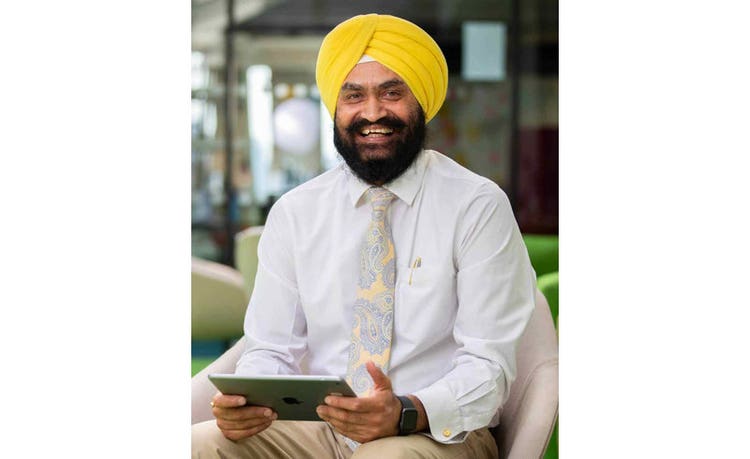
Dr Ravinder Singh
Part of the IT Leaders 100 - a list of the most influential IT leaders in the UK in 2026.
Dr. Ravinder Singh is a leader in digital transformation, managing portfolios up to £1.5 billion for entities like the World Bank, UK Cabinet Office, India, Investment Banks, and Big-4 consultancies. Named a Top 100 UK IT Leader 2025, he is a global authority on generative AI, cybersecurity, and governance.
As a National AI Awards Judge (2025/2026) and ISO 27001 Auditor, Ravinder champions ethical innovation. An accomplished author of 15 research papers, holder of two copyrights, and National Awards, Dr. Singh combines technical mastery with a commitment to mentorship, coaching the next generation of civil service leaders and serving as Visiting Faculty at global universities.
What's the most exciting part of your current role?
The most exhilarating part of my role is architecting the "Digital Bridge" between cutting-edge AI experimentation and mission-critical public service. As the Digital Champion for the Commercial & Contract Management Capability Programme (CCMCP), I lead the vision to establish the UK's premier commercial function, transitioning "black box" concepts into transparent, ethical tools that enhance millions of lives.
I find immense fulfilment in spearheading the Emerging Tech and Innovation Strategy, specifically developing the "Emerging Tech Register" and the "Future Forward Look" quadrant. These frameworks map technology maturity against national impact, moving AI from theory to infrastructure. Whether I am integrating the Government Commercial College with the Government Skills Campus or re-procuring million-pound platforms via G-Cloud, I am delivering tangible efficiency - including £50,000 annual savings through system consolidation.
Ultimately, the excitement lies in the duality of my work: delivering complex, large-scale technical integrations while shaping global discourse as a keynote speaker at forums like the AI Summit.
Being recognised as a Top 100 IT Leader validates this mission to build a smarter, more sustainable, and technologically sovereign government.
What do you do in week one of a new project to avoid pain in month six?
I implement "Governance by Design" and rigorous stakeholder alignment. In week one, I establish a common data standard and a "Future Forward" impact quadrant. Most projects fail in month six due to shadow AI or misaligned expectations; I avoid this by identifying every cross-functional stakeholder and leading an Action Learning Set for civil service fast stream immediately.
By setting the ethical and technical benchmarks - such as ISO 27001 standards - on day one, we ensure the project is secure by design and scalable, preventing the technical debt that usually cripples late-stage delivery.
Crucially, I initiate an active RAID (Risks, Assumptions, Issues, and Dependencies) log management process. By identifying dependencies and potential bottlenecks during the first 40 hours, I transform reactive firefighting into proactive mitigation.
This disciplined fusion of rigorous requirement alignment, stakeholder transparency, and continuous risk management ensures that the momentum generated in week one carries the project successfully through its most complex delivery phases.
What’s the part of your estate you most want to simplify in 2026?
In 2026, my focus is on simplifying the interoperability of legacy data silos through a unified AI orchestration layer. Public sector estates are often fragmented by decades of disparate systems. I want to replace "integration spaghetti" with Model-Driven Business Process Engineering and Architecture.
By abstracting the complexity of legacy infrastructure into a clean, LLM-accessible data fabric, we can empower departments to make real-time, data-driven decisions without needing to navigate a labyrinth of antiquated middleware.
Excluding smartphones, what piece of technology could you not live without and why?
I would have to say low-latency, collaborative cloud whiteboarding tools. While I lead high-tech learning management systems and AI initiatives, the human-in-the-loop starts with a visual logic flow. These platforms allow me to co-author complex enterprise architectures in real-time.
In my world, clarity is the greatest currency; being able to visually "untangle" a £1.5bn transformation programme with global stakeholders is essential for the strategic alignment that precedes any line of code.
What excites you most about the future of IT?
The tectonic shift from "IT as a Service" to "IT as a Sovereign Intelligence." We are moving beyond mere tools into an era of agentic AI that handles the administrative heavy lifting of the state, liberating civil servants to focus on high-value, human-centric policy and empathy.
The core of this evolution lies in the convergence of responsible and explainable AI. By moving away from black box systems toward transparent frameworks, we ensure that every automated decision is auditable, ethical, and aligned with public trust. This is particularly transformative for the Learning Management Systems; I am inspired by the potential for emotional and behavioural analysis to personalise the learner journey. By understanding how learners interact with content, we can tailor support to individual needs, significantly improving accreditation outcomes.
Furthermore, the prospect of sustainable AI - leveraging emerging tech to solve the climate crisis while maintaining technological sovereignty - is what drives me. We are finally entering an era where technology doesn't just process data; it mirrors our best human values at an infinite scale, creating a government that is more intuitive, accountable, and resilient.
What talent are you quietly proud of that would never show up on LinkedIn?
Beyond my technical certifications and £1.5bn portfolios, my real pride lies in my trained ear for the unspoken subtext within high-stakes environments. While LinkedIn captures my strategic roadmaps for quantum computing and agentic AI, blockchain, RPA, IoT, it rarely shows the "emotional debugging" required to move the needle in global digital transformation. I can often sense the specific anxiety or cultural barrier stalling a project long before it is articulated.
Furthermore, I am deeply proud of my work as an executive and life coach. I have dedicated significant time to influencing and motivating young professionals, guiding them through the complexities of their early careers. By providing dedicated coaching, mentoring, and counselling, I've helped numerous individuals navigate professional challenges and find their strategic voice.
This blend of high-level technical foresight and a genuine commitment to human development is what I believe creates a lasting legacy in our industry - one that is measured not just in systems delivered, but in the confidence and success of the people I've championed.
What’s your most-used keyboard shortcut or command that you wish everyone knew?
It has to be Windows + V (Clipboard History). In the world of digital consulting and multi-government reporting, I am constantly synthesising data from disparate research papers, audits and strategies. Having a rolling history of my last 20 copied items- rather than just the last one - is a simple force multiplier for productivity. It is the micro-habit version of the data integration I champion on a macro-scale: keeping all your essential information accessible in one place.