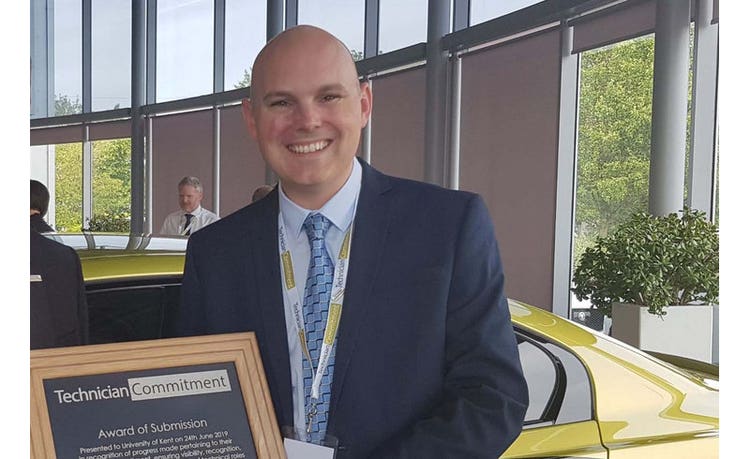
Paul Sinnock
Part of the IT Leaders 100 - a list of the most influential IT leaders in the UK in 2026.
I am Director of IT Services at the University of Kent, where I lead the strategic development and delivery of secure, resilient and customer-focused digital services. With over 25 years' experience in IT — including 23 years in Higher Education — I bring a strong track record of modernising operating models and delivering sustainable digital transformation.
I oversee enterprise systems, infrastructure, cyber security and service delivery, ensuring technology enables our institutional ambitions
I am passionate about building high-performing, collaborative teams, championing product-centric thinking and data-informed decision-making to deliver measurable value and an outstanding digital experience for staff and students.
What's the most exciting part of your current role?
As the Director of IT Services at the University of Kent, I see the most exciting part of my role as being the ultimate enabler for people, both within my department and across the wider institution. I'm not just managing systems; I'm managing the potential of everyone who uses them.
For my IT staff, the thrill comes from shifting our culture from "reactive ticket-takers" to "strategic partners." My focus is on removing the roadblocks that stifle their creativity. I'm here to provide the vision and the professional development they need to thrive, ensuring they aren't just keeping the lights on, but are actually pioneering the next digital solutions.
For the organisational staff—the academics, researchers, and administrators—my goal is to make technology an invisible superpower. I'm excited by the challenge of translating complex infrastructure into simple, reliable tools that enables our teaching, research and civic ambitions.
By empowering my team to be at their best, I am directly empowering the entire university to achieve its mission. I find my success in theirs; when the tech works so well that people forget it's there, I know I've done my job as a leader.
What do you do in week one of a new project to avoid pain in month six?
It's about ensuring the right people are in the right seats and that everyone—from my technical team to the Vice-Chancellor's office—is on the same page.
First, I focus on Strategic Discovery. I sit down with my team to define exactly what "success" looks like and, more importantly, what we won't do. By setting these boundaries early, I stop "scope creep" from burning my staff out later.
Second, I prioritise stakeholder engagement. I find the people across the university who will actually use the system—lecturers, researchers, and admins—and bring them into the project. By making them co-designers in week one, I turn potential critics into partners who will support us when things get tough.
Finally, I focus on team building. I don't just assign tasks I build the right team. I match roles to my staff's strengths and identify where we need to plug skill gaps. We agree on how we'll handle setbacks and who makes the final calls. I establish a transparent reporting framework that translates technical milestones into clear, high-level updates for the Board and stakeholders.
By building trust, engagememt and structure on day one, I ensure the project stays solid when the mid-project pressure peaks.
What’s the part of your estate you most want to simplify in 2026?
With the creation of the "super-university" through the merger of the University Kent and the University of Greenwich, I have a once-in-a-generation opportunity to move away from fragmented, legacy systems and build unified, tier-one digital platforms.
My focus is on integration. Instead of managing two separate versions of everything—from VLEs to identity management—we will architect a single, scalable ecosystem based on a platform approach, that delivers the best of both organisations. This isn't just about saving costs; it's about providing a seamless "Digital Front Door" for nearly 50,000 students and staff across Canterbury, Medway, and London region.
For our customers, this means a frictionless experience where their credentials and data flow effortlessly between campuses and organisations. By consolidating our estate into a streamlined, high-performance platform, we aren't just merging two universities—we are creating a modern, resilient blueprint for the entire higher education sector to follow.
Not only that but through this change we are creating a multi-brand ready environment so that as more organisations join our group, we won't just be handing them a login—we'll be welcoming them into a modern digital environment, delivered by a supportive, expert community.
Excluding smartphones, what piece of technology could you not live without and why?
Aside from my phone, the one piece of tech I can't live without is my smartwatch. It's the perfect tool for balancing a high-pressure job with the headspace I need to stay healthy and focused.
In the office, it's my discreet assistant. During long meetings, I can stay on top of urgent alerts with a quick glance at my wrist. It keeps me connected to my team without me having to constantly pull out a phone and disconnect from the people I'm actually sitting with. It helps me stay present while making sure I don't miss an update.
But the real value happens when I hit the pool. Swimming is my reset. It's the one place where I can truly unplug and refocus. My watch acts as a silent coach, tracking my laps and distance. Seeing that progress keeps me motivated and gives me a sense of achievement that's completely separate from the workplace.
By the time I finish my session, the data on my wrist shows I've hit my goals, and my head is clear enough to tackle the next challenge. It's the one device that looks after my work and my wellbeing at the same time.
What excites you most about the future of IT?
What excites me most about the future of IT is the shift from fixing technology to fueling human potential. We are finally moving into an era where technology isn't a hurdle to jump over, but a silent partner that makes everything easier.
As I lead the merger between Kent and Greenwich, I'm thrilled by the prospect of hyper-personalisation. We are building a "super-university" where the digital estate actually learns. A system that recognises a student needs support before they even ask, or a platform that automatically connects researchers from different campuses the moment their work aligns.
I'm also excited about augmented creativity. By using AI and automation to handle the boring, repetitive "keep the lights on" tasks, I can finally give my staff the gift of time. This allows our experts to stop being firefighters and start being innovators, focusing on projects that genuinely create positive change our organisation and our customers.
Looking past the office, what excites me most is how IT will fundamentally reshape the world for my children. Through my role I feel I am helping build a future where technology isn't just a tool they have to master, but an extension of their own potential.
What talent are you quietly proud of that would never show up on LinkedIn?
What I'm quietly most proud of—and what you'll never find on my LinkedIn—is my ability to build teams create meaningful relationships and invest in people. I could not be successful without my colleagues.
While my profile lists technical strategies and large-scale mergers, my real passion is the human work that happens behind the scenes. I believe my greatest talent is nurturing talent in others. There is nothing more rewarding than taking a fragmented group and turning them into a high-performing team with a clear sense of direction.
For me, leadership isn't about having all the answers; it's about building the confidence of those around me. I take the time to listen, spot hidden potential, and provide the support people need to step up and lead. I want to create a culture where every voice is heard and every expertise is valued.
When my staff feel empowered to take risks or challenge the status quo, I know I've succeeded. At the end of the day, the most sophisticated platforms in the world are useless without a confident, united team to run them. My job is to build the teams who can create and lead the IT future.
What’s your most-used keyboard shortcut or command that you wish everyone knew?
The one command I wish everyone used is Windows + Shift + S. It's the Screen Snipping tool. As a visual person I believe a picture can paint a thousand words.
When I'm trying to explain a complex system error or a confusing data flow, I don't write a long description that might be misunderstood. Instead, I grab a specific part of my screen, highlight the issue, and send it instantly. It turns a "this isn't working" message into a "here is exactly what I'm seeing" solution.
I believe by making our communication more visual, we can simplify the message and improve the outcome. It's a tiny command, but as an analogy for my leadership style it drives the culture I want: one where we cut through the noise, reduce complexity, and ensure that everyone—from the technical staff to the board—is sighted.