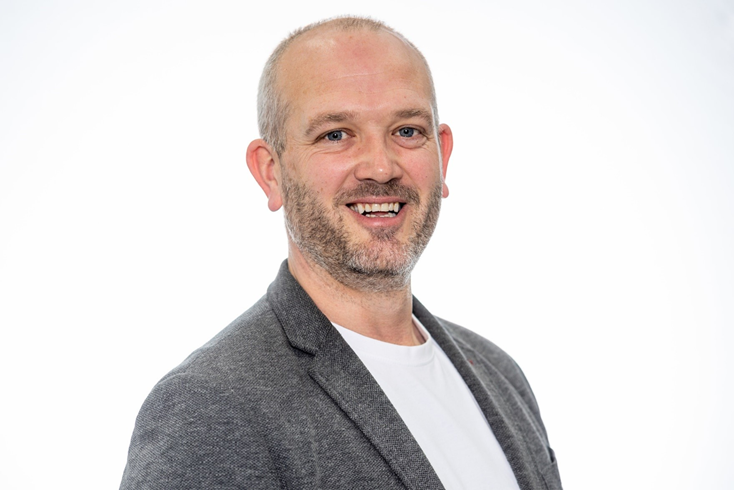
Matt Sharp
Part of the IT Leaders 100 - a list of the most influential IT leaders in the UK in 2026.
Matt Sharp is Chief Digital Officer for RLB, Founder of RLB Digital, a Chartered Fellow of the BCS and sits on the Construction Industry Council of the UK to represent Chartered IT Professionals.
Matt is an evangelist for the strategic influence and value of digital and data across the lifecycle of the construction industry. He is a champion for the development, professionalism, and recognition of digital and data talent in the sector.
What's the most exciting part of your current role?
The level of innovation and reinvention it allows. Advances in AI are opening up opportunities to fundamentally rethink how our services operate, not just automate what we already do.
We can redesign processes end to end, improve decision making, and free people up to focus on higher value work. The pace of change is also energising. The technology is evolving so quickly that I am constantly learning, testing assumptions and updating my thinking. That keeps the role fresh and challenging, and it forces me to stay close to both the technology and the business.
What I particularly value is working alongside subject matter experts to turn emerging capabilities into something practical and useful. It's not about technology for its own sake; it's about applying new tools in ways that genuinely improve outcomes, productivity and quality. Being at the point where new ideas move from possibility to reality - and seeing real impact as a result - is what makes the role so compelling.
What do you do in week one of a new project to avoid pain in month six?
I focus on getting absolute clarity on who the solution is for, why it matters, and how change will actually happen. I start by understanding the target users and customers, their real needs, and the journey they must take to adopt the change. Technology only creates value if it fits how people work and makes their lives easier.
I make sure the right stakeholders are identified and engaged early:
- A clear sponsor who owns the outcomes and can make decisions
- A champion who will drive momentum
- An intelligent customer who can translate business goals into practical technology requirements
- End users who can shape what "good" looks like in day - to - day use
I also plan the transition from day one. That means building change and adoption into the project, not treating it as an afterthought. Training, communications, support and ownership are designed early, alongside the solution.
Doing this in week one avoids painful rework, resistance, and missed benefits in month six - because most failures are about people and decisions, not technology.
What’s the part of your estate you most want to simplify in 2026?
The data landscape that underpins how we deliver services to clients on projects. We operate across multiple disciplines, sectors and global regions, all within an industry that is highly fragmented and inconsistent in how data is structured, shared and reused. Too much effort is spent translating, reconciling and reworking information rather than using it to deliver better outcomes.
Our focus is to drive our industry far more strongly in the use of open, industry - led data standards that support the design, build and operation of assets. Doing so will reduce complexity, improve interoperability between systems, and make it easier for teams and partners to work together.
Simplifying the way our data is understood, created and exchanged will also unlock far greater value from AI. Clean, consistent and well - governed data is the foundation for automation, insight and decision support. If we get the data right, everything built on top of it becomes faster, cheaper and more reliable.
Excluding smartphones, what piece of technology could you not live without and why?
Video on demand, whether through streaming platforms, YouTube or short form services like TikTok. I use video constantly across entertainment, learning and work. It's my primary way of absorbing new ideas, staying current with technology trends, and deepening my understanding of complex topics. Being able to hear experts explain concepts, see examples, and watch real world demonstrations is far more effective for me than text alone.
It has also completely transformed otherwise dead time. My train commute is no longer just about getting from A to B; it has become valuable time for learning, discovery and relaxation. I can catch up on industry thinking, explore new tools, or switch off with entertainment depending on the day.
Video on demand fits how I naturally learn and think. It's immediate, flexible and endlessly varied, which makes it indispensable both professionally and personally.
What excites you most about the future of IT?
The continued shift in its role and recognition. IT is no longer a backoffice support function that enables the business; it increasingly is the business. Digital platforms, data and AI now sit at the centre of how organisations create value, serve clients and compete. That places IT professionals at the heart of strategy, not just delivery. Decisions about architecture, data, security and automation are business decisions, not technical afterthoughts.
As a result, the profession itself is maturing. There is growing recognition that strong IT leadership requires commercial awareness, ethical judgement and deep understanding of people and change, not just technical expertise. This evolution is creating more influence, better collaboration between technology and the rest of the organisation, and clearer accountability for outcomes.
For those working in IT, it's an opportunity to shape the future of how organisations operate - and to be recognised as essential to that future. In this context, I get extremely excited about developing the next generations of "IT" talent that will be the business leaders of the future.
What talent are you quietly proud of that would never show up on LinkedIn?
Gardening, a skill that never appears on LinkedIn but runs deep in my family. On my mother's side, gardening was more than a hobby - it was a profession. My great‑grandfather was head gardener on a private estate, my grandfather owned and ran a commercial plant nursery, and my mother always had an instinctive understanding of plants. I like to think some of that has been passed down. Every year, my daffodil border is a lovely reminder of a link with my mum.
What’s your most - used keyboard shortcut or command that you wish everyone knew?
Making use of the Copilot key in the new Copilot - enabled laptops. I have been making more and more use of Copilot across M365 and D365 - testing its capabilities in every task I perform.