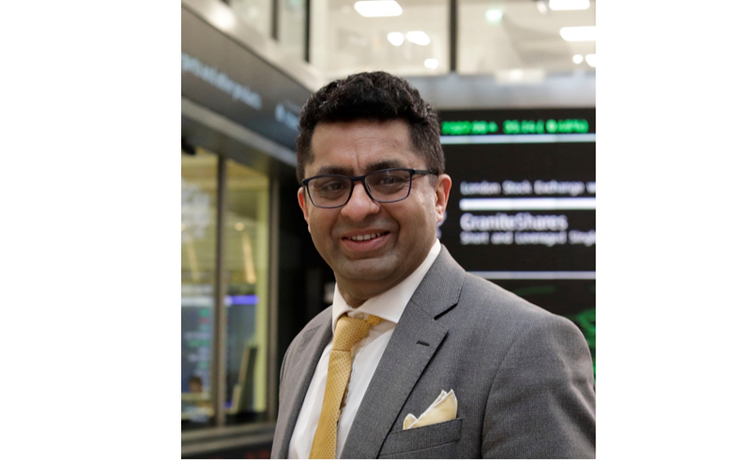
Manuj Sarpal
Part of the IT Leaders 100 - a list of the most influential IT leaders in the UK in 2026.
Manuj Sarpal is Chief Technology Officer at GraniteShares, an asset manager with over $10 billion in AUM. He leads the firm's AI-led transformation, embedding intelligent capabilities into investment and operational workflows in a practical and scalable way.
With over 25 years of experience in financial services, Manuj has built technology platforms supporting the full lifecycle of ETFs, from structuring and listings through to trading, settlement and operations. He has integrated market makers, brokers, custodians and swap counterparties. His focus is on using AI to improve decision making, simplify complexity and enhance scalability.
He holds an MBA from Bayes Business School and a Certificate in Quantitative Finance.
What's the most exciting part of your current role?
What I enjoy most is seeing how quickly things are changing, especially with AI starting to influence how decisions are made. It feels like we are moving away from just processing data to actually using it in a much more meaningful way.
A big part of my role is making sure this isn't just talked about, but actually used in day-to-day work. When you see teams move from manual effort to quicker, more informed decisions, it changes how they operate and how confident they feel.
I also enjoy the variety. One day it might be thinking about a new product structure, the next it's improving how data flows across the business. There is always something to simplify or improve.
It also feels like we are building for the future, not just fixing today's problems. The way technology is evolving is going to change how asset management works, and being part of that is genuinely interesting.
At the end of the day, I like taking something complex, making it simpler, and seeing it actually work in the business.
What do you do in week one of a new project to avoid pain in month six?
I try not to rush into building straight away. Week one is really about making sure we are solving the right problem.
I usually bring everyone into the same conversation early, so there is a shared understanding of what we are trying to achieve. A lot of issues later on come from small misunderstandings at the start.
I also look at where technology, including AI, genuinely adds value. Not everything needs it, and forcing it in can make things harder rather than easier.
We spend time on a simple design. Clear data, clear ownership, and keeping things as straightforward as possible. If something feels complicated early on, it almost always becomes a bigger issue later.
I also like to test ideas quickly. Even a basic version can highlight problems early.
For me, week one is about slowing things down just enough to avoid rework later. It saves a lot of time and frustration down the line.
What’s the part of your estate you most want to simplify in 2026?
The biggest area for me is data. As we have grown, more systems and processes have been added, which is natural, but it also means things can become harder to manage.
In some cases, the same data exists in multiple places, which creates confusion and extra work. My focus is to simplify that so there is a clearer and more consistent view across the business.
This becomes even more important as we use more AI. If the data is not clean or consistent, the outcomes are not reliable.
I also want to reduce the number of moving parts. Too many integrations and handoffs increase the chances of something going wrong.
The goal is to make things easier to scale. As the business grows, the platform should support that without adding more complexity each time.
It is really about making things simpler, clearer and easier to work with.
Excluding smartphones, what piece of technology could you not live without and why?
It would be my cloud based working environment. Most of what I do sits there, from analysing data to testing ideas and reviewing systems.
I find it important to be able to move quickly between thinking and doing. If I have an idea, I want to be able to explore it straight away rather than wait.
It also helps with decision making. You can look at information, test different angles and get a clearer view before making a call.
Another big benefit is collaboration. Teams can work on the same data and systems, which keeps things aligned and avoids confusion.
As we bring more intelligent tools into how we work, this environment becomes even more valuable. It gives you a place where everything connects.
For me, it is less about the technology itself and more about how it allows you to work faster and with more clarity.
What excites you most about the future of IT?
What excites me is how central technology is becoming to the business. It is no longer just supporting things in the background, it is shaping how decisions are made and how organisations move.
One shift I find particularly interesting is the move towards hybrid AI. In the same way hybrid cloud became the practical reality over time, I see AI evolving in a similar direction. Different models and tools will serve different purposes, and the real value comes from knowing how to combine them in a way that fits the business.
We are also starting to see systems that support thinking, not just processing. That has a big impact on how quickly and confidently decisions can be made, especially in areas like markets and risk.
At the same time, access to technology is becoming easier across the organisation. More people can engage with it directly, which creates a more dynamic and responsive environment.
For me, the future of IT is about making things more intuitive and useful. It should help people work smarter and focus on what matters, rather than adding complexity. That shift is what makes it genuinely exciting.
What talent are you quietly proud of that would never show up on LinkedIn?
I think it would be the ability to stay calm and bring clarity when things are not fully clear.
In a lot of situations, especially in fast moving environments, you do not have all the information. It is easy for things to become confusing or for people to pull in different directions.
I tend to step back, simplify what is actually important and help move things forward.
Listening plays a big part in that. Understanding different viewpoints helps you see the bigger picture.
It also helps when introducing new ideas, especially around AI. People can be unsure or hesitant, so explaining things in a simple and practical way makes a difference.
It is not something that is easy to describe as a skill, but it comes up often in day to day work.
Over time, it builds trust because people know there will be direction, even when things are uncertain.
What’s your most-used keyboard shortcut or command that you wish everyone knew?
If I had to pick one, it would actually be less about a traditional shortcut and more about the habit of using AI as a thinking partner through simple prompts.
I still use global search and quick navigation all the time, but what has really changed how I work is being able to quickly frame a question, test an idea or sense check something using AI in real time. It has become almost second nature.
The key is not just asking questions, but asking the right ones. A well framed prompt can save a significant amount of time and often surfaces angles you might not have considered.
I use it for everything from breaking down complex problems to reviewing approaches or even refining communication. It helps move from a blank page to a structured thought much faster.
What I wish more people understood is that this is not about replacing thinking, it is about improving it. When used well, it acts as a multiplier.
It is a small shift in habit, but it changes how quickly and effectively you can work, especially in a fast moving environment.