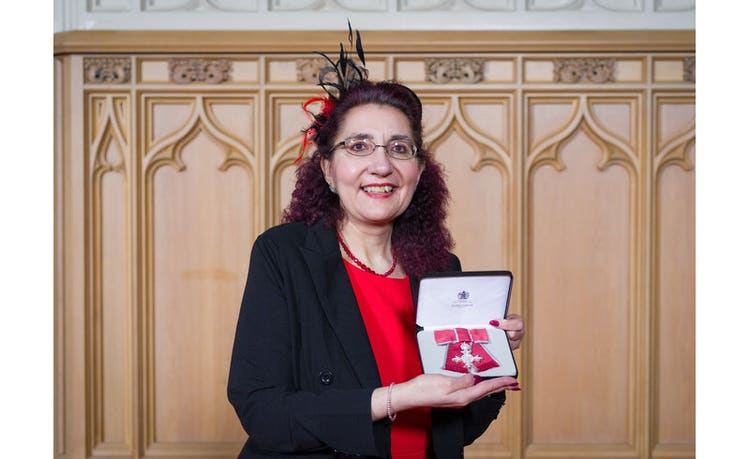
Lisa Ventura
Part of the IT Leaders 100 - a list of the most influential IT leaders in the UK in 2026.
Lisa Ventura MBE FCIIS is a cybersecurity specialist, author, and founder of the AI and Cyber Security Association. With over 20 years' experience, she works at the intersection of AI, cyber risk, and human behaviour.
Awarded an MBE for services to cyber security and a Fellow of the Chartered Institute of Information Security, Lisa is a recognised industry voice, shaping conversations on AI risk, resilience, and the future of security leadership.
What's the most exciting part of your current role?
The most exciting part of my role is not reacting to the future, it is helping shape it.
Through founding and scaling the AI and Cyber Security Association, I am working at the point where AI, cyber risk, and human behaviour collide. That is where the real decisions are being made, often without enough clarity or challenge.
In the past 12 months, I have brought together practitioners, industry leaders, and policymakers to tackle the practical realities of AI risk, not just the theory. That includes driving cross-sector conversations, publishing thought leadership, and contributing to industry dialogue at a time when many organisations are still trying to catch up.
What excites me most is influence. The ability to change how organisations think about risk before it becomes an incident.
Cybersecurity has spent too long being reactive. AI is accelerating that problem. My role gives me the opportunity to push the industry towards a more honest, proactive, and human-centred approach.
What do you do in week one of a new project to avoid pain in month six?
I remove ambiguity early, because ambiguity is what kills projects later.
In week one, I focus on three things: outcomes, risk, and accountability.
First, I define success in measurable terms. If a project cannot clearly articulate what success looks like, it is already at risk. Vague objectives lead to scope drift and wasted effort.
Second, I map failure points. Not just technical risks, but behavioural ones. Where will people misunderstand, disengage, or resist? Most project failure sits there, not in the technology.
Third, I establish ownership. Who is accountable when something goes wrong? If that is unclear at the start, it will be a problem at scale.
I also challenge assumptions early and directly. If something feels unclear in week one, it becomes expensive in month six.
This approach has consistently reduced rework, accelerated delivery, and avoided the kind of slow failure that many organisations normalise.
What’s the part of your estate you most want to simplify in 2026?
Decision-making complexity, particularly around AI.
Organisations are layering AI into already fragmented environments, often without clear ownership, governance, or understanding of downstream risk. The result is an illusion of control. Too many tools, too many overlapping capabilities, and no single view of risk.
That complexity slows response times, increases exposure, and creates confusion at leadership level. In some cases, organisations are making critical decisions based on outputs they do not fully understand.
Simplification is not about reducing capability. It is about restoring clarity.
In 2026, my focus is on driving clearer ownership, better governance, and more transparent decision-making around AI and cyber risk. If we do not simplify now, we are building environments that will become increasingly difficult to secure and manage.
Excluding smartphones, what piece of technology could you not live without and why?
My laptop, because it is where I do my thinking. It is the tool that enables everything from writing and research to strategy and collaboration.
Over the past year, it has been central to building an industry association, contributing to national-level conversations on AI and cyber risk, and authoring a book on the subject.
What matters is not the hardware, but what it allows. It is a space for creating ideas, challenging assumptions, and producing work that has real impact. In a world increasingly focused on consumption, it remains my primary tool for creation.
What excites you most about the future of IT?
The shift from technical leadership to decision leadership.
AI is forcing organisations to confront a difficult reality. Technology is no longer the limiting factor. Understanding, governance, and judgement are. That is where the opportunity sits. We are moving into a phase where IT leaders are not just implementing systems, they are shaping how organisations make decisions, manage risk, and define accountability.
What excites me is the chance to build systems that are not just powerful, but understandable, secure, and aligned with human behaviour.
The organisations that succeed will not be the ones with the most advanced technology. They will be the ones that can control, explain, and trust it.
What talent are you quietly proud of that would never show up on LinkedIn?
The ability to keep going when most people would stop.
Resilience is not something we talk about enough in this industry, but it underpins everything. Cybersecurity is high pressure, fast moving, and often unforgiving.
Over the course of my career, I have faced significant challenges, both professionally and personally. What I am quietly proud of is the ability to continue building, contributing, and leading regardless of those pressures.
That resilience also shows up in how I support others. I have spent years helping people build confidence and navigate self-doubt in an industry that does not always make that easy.
It is not something you can quantify, but it is one of the most important capabilities any leader can develop.
What’s your most-used keyboard shortcut or command that you wish everyone knew?
Ctrl + Shift + T. It reopens the last closed tab, and it probably saves me more time than any other shortcut.
It is a small thing, but it reflects a bigger point. Efficiency is often about simple habits, not complex tools.
In cybersecurity and IT, we tend to over-engineer solutions. Sometimes the most effective improvements are the simplest ones.