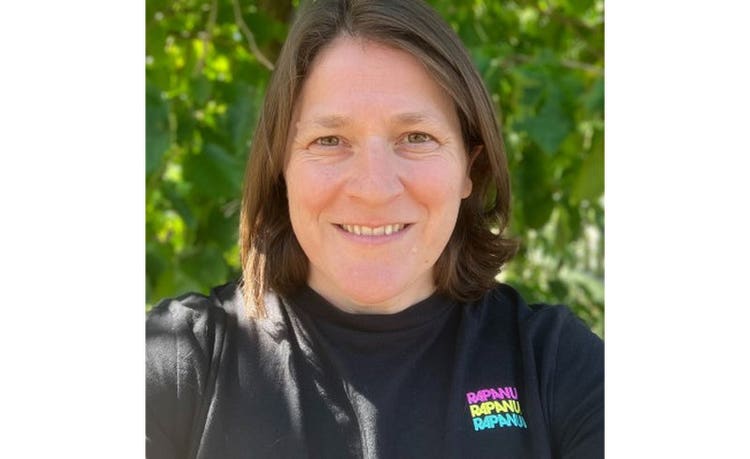
Jenny Wilson
Part of the IT Leaders 100 - a list of the most influential IT leaders in the UK in 2026.
Jenny is Chief Architect at Kingfisher plc, where she has spent eight years building the technological foundations that connect their European Technology landscape. With an academic background spanning Zoology, Evolutionary Anthropology, and Physiotherapy, she brings an unusually wide lens to enterprise architecture, one rooted in how complex systems actually adapt and survive.
A sponsor of Kingfisher's All4One network, a 2024 and 2025 Outstanding Woman in Tech nominee, and a passionate advocate for technology that serves people first, Jenny believes the best architecture is indistinguishable from good ecology - resilient, interconnected, and built to evolve.
What's the most exciting part of your current role?
Kingfisher's technology estate spans our Banners across Europe, B&Q, Screwfix, Castorama and Brico Dépôt, each with its own history, systems, and culture. The most exciting part of my role is building the architectural foundation that lets all of them move faster, together.
We're in the middle of genuine modernisation, not just replacing old systems, but rewiring how the organisation thinks about technology. That means shifting from rigid, monolithic structures toward something more adaptive. Systems and teams that can respond to change without everything grinding to a halt.
What makes this genuinely exciting is the people. Our technology community at Kingfisher is full of talented, motivated people who want to build things that matter. My job is to clear the path, set the direction, and make sure the good ideas, wherever they come from, actually get delivered.
Adaptability isn't a buzzword here. It's the design principle we're building around, because in retail, the organisations that survive aren't always the strongest. They're the ones that can change.
What do you do in week one of a new project to avoid pain in month six?
I listen before I draw anything. The temptation in architecture is to reach for a diagram too early, to impose a solution onto a problem you haven't fully understood. Week one is about resisting that.
I spend time mapping the real landscape: who actually owns what, where the informal dependencies live, what decisions have already been quietly made. Most month-six pain is traceable to something that was known in week one but never surfaced, an assumption baked in, a stakeholder not consulted, a constraint treated as flexible when it wasn't.
I also try to establish shared language early. Teams fail when they use the same words to mean different things: "done," "scalable," "approved." Getting explicit about definitions early sounds pedantic; it saves weeks later.
Finally, I ask what would have to be true for this to fail? Not to be pessimistic, but because the answer usually reveals the thing nobody wants to talk about. That conversation, held early and honestly, is almost always worth having. Month six is just week one's decisions arriving for payment.
What’s the part of your estate you most want to simplify in 2026?
Our monolithic core systems. Every large retailer carries them: vast, deeply embedded platforms that were built to last and succeeded perhaps too well. They're stable, often business-critical, and extraordinarily hard to change. Adding a new capability can mean navigating years of accumulated logic, with the risk that touching one thing breaks three others nobody knew were connected.
The challenge isn't just down to IT to fix as it isn't just a technical problem, really. It's organisational. Simplifying the estate means simplifying how we work, not just how we code.
In 2026, I want to make meaningful progress on decomposing these systems into smaller, independently deployable components - not wholesale replacement, which rarely works, but a disciplined pattern of carving out capability at the edges. Each piece we liberate becomes a system we can iterate on, test properly, and evolve without holding our breath.
The goal isn't elegance for its own sake. It's reducing the cost of change, because in our industry, the ability to move quickly isn't a luxury. It's a survival trait.
Excluding smartphones, what piece of technology could you not live without and why?
My Kindle. It's thirteen years old, battered, and I have absolutely no intention of replacing it. There's something quietly radical about a device that does one thing and does it without asking for anything back. No notifications, no algorithm nudging me toward outrage, no battery anxiety. Just books and the patience to let me finish them.
I read eclectically: technology, ecology, systems theory, climate fiction, evolutionary biology. The Kindle doesn't judge the mix. It just carries it all, weightlessly, in a bag I take everywhere.
But the deeper reason I couldn't live without it is that it protects something increasingly scarce: the ability to think in long form. Sustained reading is how I process complexity, stress-test ideas, and find unexpected connections between fields. Most of my best professional thinking has roots in something I read on that battered device on a train somewhere.
In a world that relentlessly fragments attention, having a tool explicitly designed to hold it feels almost countercultural. Thirteen years in, it remains the technology I'd choose last to give up.
What excites you most about the future of IT?
Accessibility. The genuine, structural kind, not as an afterthought, but as a design principle baked into how technology gets built.
For most of IT's history, the ability to participate has been gated behind technical fluency. You needed to know how to code, how to query, how to configure. That created enormous value, but it also concentrated it in particular teams, particular organisations, particular parts of the world.
What's changing now is that the interface between human intent and technical capability is becoming permeable. Increasingly, if you can articulate what you need, you can begin to build it. That shifts the question from who knows how to do this? to who has the best idea?
That excites me enormously not because it makes technologists redundant, but because it expands the circle of who gets to shape the future. The best solutions to complex problems rarely live in the teams closest to the technology. They live with the people who understand the problem most deeply.
IT has always had the potential to be a great equaliser. I think we're finally building the conditions for it to be one.
What talent are you quietly proud of that would never show up on LinkedIn?
I can find the signal in a room that's officially saying something else entirely.
In meetings where the stated conversation is one thing and the real conversation is another, I've developed a reliable instinct for what's actually going on, the constraint someone can't name, the fear underneath the objection, the unspoken alliance shaping the decision.
It's not cynicism. It's pattern recognition, honed over years of sitting at tables where the most important things went unsaid.
It makes me a better architect, because most technical failures are social failures first. A system design that ignores the political reality it has to survive in is just an expensive diagram. Understanding the human landscape matters as much as understanding the technical one.
It also makes me, I think, a more honest leader. If I can see what's really happening, I can address it, rather than politely managing the surface of things while the actual problem compounds quietly underneath.
It's not a skill that fits neatly into a competency framework. But it might be the one I use most.
What’s your most-used keyboard shortcut or command that you wish everyone knew?
Next time you are doing that Powerpoint presentation and you want the focus on you, or people are exploring an exciting rabbit hole, press B or W. The screen will go black or white accordingly and you can get their attention again!