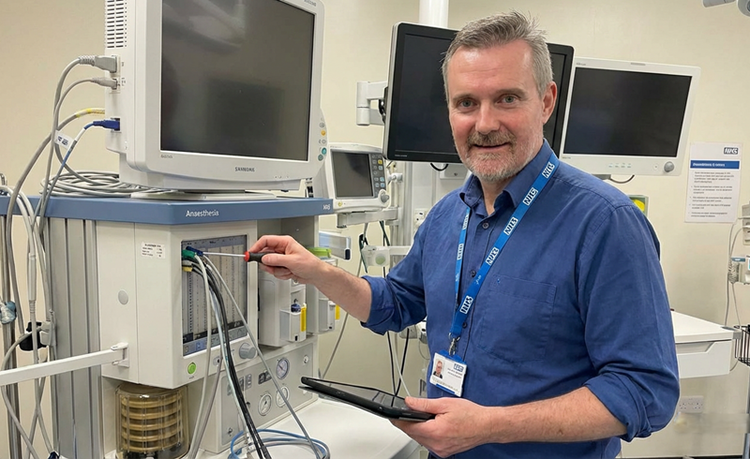
Jeffrey Wood
Part of the IT Leaders 100 - a list of the most influential IT leaders in the UK in 2026.
Jeffrey is the Deputy Director of ICT at The Princess Alexandra Hospital NHS Trust, where he focuses on developing people, simplifying technology and creating the conditions for teams to thrive.
Jeffrey is proud to champion diverse teams whose work has earned multiple awards and uses every opportunity to highlight the often‑unseen contribution of NHS digital professionals.
He is passionate about raising the profile of the NHS, sharing good practice across the sector, and showing what is possible when empowered teams work with clarity, purpose and a shared vision of putting clinicians back in front of patients.
What's the most exciting part of your current role?
Developing people – helping talented individuals grow into confident, empowered leaders who understand the purpose behind their work and feel proud of their impact.
In the NHS, where pressure is constant and resources are tight, investing in people is not a luxury; it is our most powerful tool for transformation. My vision of "putting clinicians back in front of patients" anchors this development, giving the team clarity about why their work matters and connecting every engineer, analyst, and manager to patient care. Watching the team shift from reactive firefighting to proactive reliability engineering has been deeply satisfying.
This year, progress has centred on strengthening wellbeing, psychological safety, and leadership capability. Expanding Mental Health First Aiders, creating safe spaces for honest conversations, celebrating small wins, and adopting the Leader–Leader approach have helped the team rediscover confidence, pride, and ownership.
Seeing individuals step forward and realise they can lead change – even in one of the world's most complex healthcare systems – is what motivates me daily. Technology is exciting, but real transformation happens through people.
What do you do in week one of a new project to avoid pain in month six?
I focus on understanding reality, not assumptions. Every successful project starts with a clear picture of the current state, the future state, and the real impact the change will have on people. Only when you understand those three things can you begin to win the hearts and minds of the stakeholders.
People naturally resist change, especially in the NHS where teams have spent years building workarounds to protect themselves from weaknesses in systems or processes. I ensure time is spent with end users to understand not just what they do, but why they do it that way. I ensure we map where the benefits of the project will be felt – and just as importantly, where any detriment will land. Being honest about both prevents the month six surprises that derail delivery.
I then anchor the project to our ICT vision and design principles, especially "putting clinicians back in front of patients." This ensures the work aligns with the Trust strategy and that stakeholders can see how the project moves us closer to that vision. When people understand the purpose, the impact, and the destination from week one, month six becomes progress – not pain.
What’s the part of your estate you most want to simplify in 2026?
The end-to-end clinical digital experience – the maze of logins, workflows, legacy devices and inconsistent interfaces that still slow clinicians down. We've made huge progress this year with observability, automation, 4G/5G resilience and reducing BSOD hours by 50%, but the next step is to simplify the estate clinicians actually touch.
For me, that means three things:
1. A smaller, cleaner, clinically aligned application estate. We've already reduced from 250+ systems to ~120, but 2026 is about going further: removing the last pockets of duplication, retiring legacy tools, and ensuring every system earns its place by contributing to our vision of putting clinicians back in front of patients.
2. A unified, predictable device experience. Legacy devices remain the biggest source of instability. I want to complete the refresh of the remaining high risk hardware so clinicians get a consistent, reliable experience wherever they work.
3. A seamless digital front door for patients. With the patient portal launching, we must simplify the estate that supports it: identity, messaging, appointments, results, and patient facing workflows. A clean, integrated patient experience reduces pressure on staff and improves access for our most digitally excluded communities.
Excluding smartphones, what piece of technology could you not live without and why?
My laptop – it's where strategy is shaped, where deep thinking happens, and where I stay connected to my team. It's the tool that lets me coach, develop, write, analyse, and lead with clarity. In the NHS, where every decision affects patient care, that ability to think and collaborate deeply is essential.
But that is too easy an answer. I believe, as a person centric leader, the technology I rely on most is professional social media, especially LinkedIn. It has become one of the most powerful platforms for sharing good practice, learning from peers, and amplifying the work of my team. In an NHS that often hides its digital innovation behind clinical headlines, LinkedIn allows me to bring our successes into the open – from reducing digital friction to improving staff wellbeing to tackling digital inequality in our communities.
It's also where I give back: sharing lessons, supporting other leaders, and contributing to the wider digital health conversation.
For me, social media isn't noise – it's a tool for connection, collaboration, and raising the profile of NHS digital teams who deserve to be seen.
What excites you most about the future of IT?
The shift from technology being something people use to something that quietly removes friction from their day. We're moving toward a world where IT becomes almost invisible – where clinicians don't think about systems, patients don't struggle with access, and teams aren't wasting time fighting the basics. Instead, technology will anticipate needs, automate routine tasks, and free people to focus on what truly matters.
The real excitement for me is how this future transforms people, not platforms. IT is becoming a catalyst for better leadership, better teamwork and better care. Tools like observability, automation, AI assisted workflows and digital experience monitoring are already giving clinicians time back; the next wave will give staff headspace back too – reducing burnout, simplifying work and improving wellbeing.
I love how IT is breaking down organisational walls. Platforms now allow NHS digital leaders to share good practice, learn from each other and raise the profile of teams who have historically been invisible. That collective learning is accelerating improvement across the sector.
Most of all, the future aligns perfectly with my vision: putting clinicians back in front of patients. Technology is finally becoming the enabler it was always meant to be.
What talent are you quietly proud of that would never show up on LinkedIn?
The ability to recognise the hidden struggles people carry, because I've carried some of them myself. Over the past few years I've navigated burnout, significant mental health challenges, and more recently a diagnosis of ADHD. None of that is something I would have chosen, but it has fundamentally changed the way I lead.
It has given me a deeper sensitivity to the signs people show when they're overwhelmed, masking, or simply running out of capacity. I can spot the quiet withdrawal, the overcompensating perfectionism, the sudden drop in confidence – because I've lived those moments too. That insight has helped me create psychologically safe spaces in the team, where people can speak honestly without fear of judgement or repercussion.
It's also shaped how I design work: clearer expectations, fewer assumptions, more structure, and a culture where asking for help is seen as strength, not weakness.
I'm proud of the resilience I've built, but even more proud of how it's helped me support others. It's a talent you won't find on my CV, but it's one that has made me a far better leader.
What’s your most-used keyboard shortcut or command that you wish everyone knew?
OneNote's Screen Clipping shortcut: Windows key + Shift + S.
It sounds simple, but it's become one of the most important tools in how I work. I use it constantly to capture ideas, emails, diagrams, meeting notes, and anything else that sparks a thought, and drop them straight into OneNote. With a poor memory – and now understanding more about my ADHD – this has become my way of creating a single, reliable "external brain" I can always return to.
Screen clipping lets me pull the important parts of my day into one organised, searchable place. It means I never lose the thread of an idea, I can build on thoughts over time, and I can keep context across the dozens of things I juggle as a digital leader in the NHS.
It's a tiny shortcut, but it enables clarity, reduces cognitive load, and helps me stay focused on what matters. For me, it's transformational.