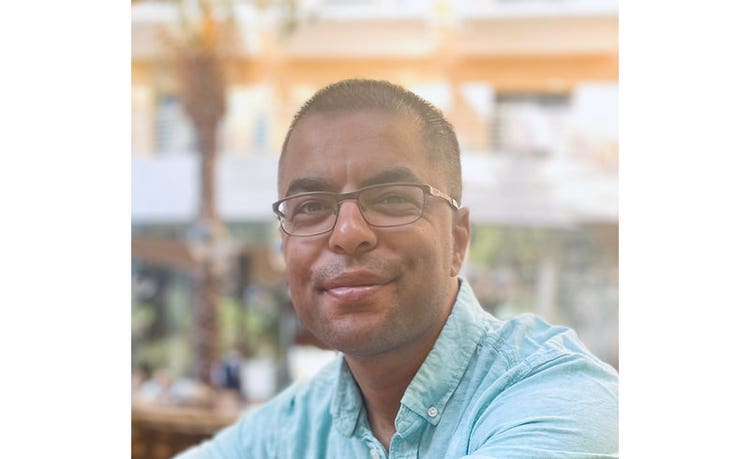
Hardeep Singh
Part of the IT Leaders 100 - a list of the most influential IT leaders in the UK in 2026.
Hardeep is the Deputy Director of Architecture and Standards at UKHSA, leading enterprise, data and solution architecture and providing matrix leadership across all architecture domains and platforms including security, cloud, CRM, ERP and integration. He owns UKHSA's Enterprise Architecture 3-year blueprint and shapes the agency's digital, data and technology strategies and governs the delivery of the roadmaps that underpin the UK's health security.
Known for bringing clarity to complexity, Hardeep specialises in building coherent, future ready architectures that enable teams to deliver at pace and scale through collaboration and cocreation.
What's the most exciting part of your current role?
Shaping the digital, data and technology foundations that directly strengthen the nation's health security. As UKHSA's Chief Architect, I get to connect strategy to delivery at scale translating complex public health ambitions into coherent enterprise, data and solution architecture that teams can actually execute.
I love the moment when a fragmented landscape becomes a clear, sequenced roadmap that everyone can rally behind. Whether it's modernising surveillance systems, enabling cross government data sharing, or simplifying our technology estate, I get to bring order to complexity and create the conditions for teams to deliver with confidence.
What energises me most is the impact, the architectural decisions we make today shape the UK's ability to detect, respond to and recover from future threats. It's rare to work in a role where good architecture can literally save lives and that sense of purpose drives me every day.
What do you do in week one of a new project to avoid pain in month six?
Week one is all about alignment, clarity and constraints. Before anyone writes a line of code or configures a platform, I make sure we've answered the three questions that prevent 90% of downstream pain:
- What problem are we solving and for whom? I strip away assumptions and get to the real user and business need.
- What are the architectural guardrails? I define the non-negotiables early: data standards, integration patterns, security posture, reuse opportunities and alignment to our enterprise roadmaps and business strategy.
- What does good look like in six months? I co create a shared definition of value, outcomes and measurable success.
I also map dependencies, surface risks that will mature later, and ensure product, engineering and architecture are genuinely co-owning the plan.
By the end of week one, everyone knows the direction, the constraints and the sequencing, which means month six is about delivery momentum, not firefighting.
What’s the part of your estate you most want to simplify in 2026?
In 2026, I want to simplify our data and surveillance landscape. Like many public sector organisations, UKHSA has inherited a large number of systems due to mergers that were built at pace during emergencies, each valuable but collectively complex.
My priority is to reduce duplication, converge patterns, and create a more coherent, governed ecosystem where data flows securely, consistently and predictably across the agency and with partners.
This means rationalising overlapping platforms, standardising integration approaches, strengthening metadata and catalogue capabilities, and moving towards a more modular, reusable architecture.
Simplifying this part of the estate isn't just a technical ambition, it's a strategic one. It will accelerate response times, improve data quality, reduce operational burden, and free teams to focus on innovation rather than maintenance.
In short fewer systems, clearer patterns, stronger foundations supported by collaboration and cocreation.
Excluding smartphones, what piece of technology could you not live without and why?
Noise cancelling headphones. They're my portable command centre. Whether I'm shaping strategy, reviewing architectural options, or preparing for a board session, they let me carve out focus in the middle of chaos. They're the one piece of tech that consistently boosts my clarity, creativity, and productivity and in a role where context switching is constant, that's invaluable.
What excites you most about the future of IT?
What excites me most is the shift from technology as an enabler to technology as a strategic partner.
We're entering an era where architecture, data and AI aren't back-office capabilities; they're central to how organisations think, operate and deliver value. The future belongs to organisations that can combine human judgement with machine intelligence, orchestrate complex ecosystems, and build adaptive, resilient platforms.
For public health, this is transformative. Real time data, predictive modelling, automated response capabilities and interoperable systems will fundamentally change how we protect the country.
The future of IT is not just faster or smarter, it's more meaningful.
What talent are you quietly proud of that would never show up on LinkedIn?
I have an unusual talent for turning chaos into clarity - not just technically, but emotionally.
In high pressure situations, I can walk into a room full of competing priorities, stressed teams and ambiguous problems, and within minutes create calm, structure and a shared sense of direction.
It's part facilitation, part systems thinking, part reading the room and it's often the difference between stalled progress and collective momentum. It's not a skill you can badge, but it's one I rely on every day.
And if all else fails, I can always play a mean Sweet Child O' Mine riff on the guitar which, sadly, still hasn't made it onto any competency framework.
What’s your most-used keyboard shortcut or command that you wish everyone knew?
Ctrl + Shift + T, the "bring back the tab you didn't mean to close" shortcut.
It's saved more architectural diagrams, strategy drafts and Teams links than I care to admit. It's the closest thing IT has to a time machine.