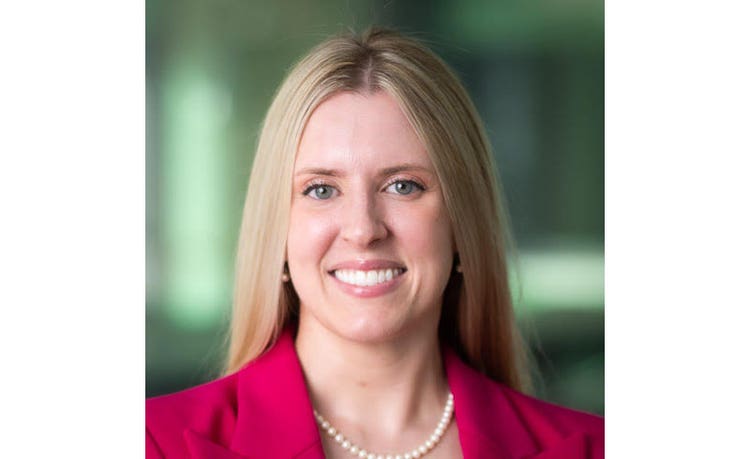
Clare Schramm Fergus
Part of the IT Leaders 100 - a list of the most influential IT leaders in the UK in 2026.
Clare Schramm Fergus is a senior platform engineering and enterprise technology leader with 20 years' experience delivering large‑scale AI, cloud and data platforms in highly regulated sectors. She has led global engineering organisations of up to 750 people and $200M P&Ls, building multi‑cloud platforms that safely industrialise AI.
Clare has shaped BT's award‑winning Network Cloud and driven AI‑enabled modernisation at Lloyds Banking Group. A recognised industry voice, she contributes regularly to publications and conferences on AI, sustainable infrastructure, and platform engineering.
What's the most exciting part of your current role?
Getting to rewire the pipes of the economy whilst the taps stay on. Running transaction banking systems at Lloyds means I'm responsible for the platforms that move money, manage liquidity, and are the largest clearer of sterling. I love the combination of deep engineering, strict regulatory constraints. and very tangible impact.
When we simplify a process, improve resilience, or safely embed AI into cash management, our clients feel it in their day‑to‑day operations. It's rare to work on systems that are both this mission‑critical and this ripe for modernisation.
What do you do in week one of a new project to avoid pain in month six?
I focus on designing the high‑level shape of the change. I define a simple target architecture and operating model including key domains, core platforms, critical integrations and who owns each.
I capture a one‑page guiding architecture diagram with a few measurable outcomes and non‑negotiable guardrails (things like risk, resilience, etc). Then I align senior stakeholders on that high‑level design and decision log, so when we hit month six, we're arguing about details inside a shared frame, not reinventing the big decisions under pressure.
What’s the part of your estate you most want to simplify in 2026?
Cash management and liquidity. Too much complexity hides in how we aggregate balances, forecast positions and move money between entities and currencies. I want a single, reliable, API‑driven view of cash and liquidity that risk, finance, and product teams all trust.
If we get that right, we remove a huge amount of operational friction and make it dramatically easier to embed smarter services, such as real‑time liquidity optimisation and AI‑driven forecasting.
Excluding smartphones, what piece of technology could you not live without and why?
My Loop noise‑cancelling earplugs. As someone who is neurodiverse, sound isn't just background for me, it can be the difference between focus and complete overload. Good earplugs let me create a predictable sensory environment whether I'm in an open‑plan office, on a crowded train or walking between meetings.
That ability to dial the world up or down on demand is what makes deep architectural work, careful governance thinking and high‑stakes conversations sustainable. It's a small piece of technology, but it's the anchor that lets me bring my best thinking to environments that weren't designed with brains like mine in mind.
What excites you most about the future of IT?
That we're finally reducing the time between idea and impact. With vibecoding becoming more mature and composable infrastructure, small teams can now build and evolve systems that used to require whole departments and multi‑year funding cycles.
One of my teams is experimenting with vibecoding for a new product launch and it has truly made a step-change in the team's velocity. It also changes who gets to participate: domain experts, not just technologists, can also shape the tools they use every day.
The leadership challenge is ensuring we pair that new creative power with strong engineering discipline and tradecraft, so we get velocity without losing safety, resilience or trust.
What talent are you quietly proud of that would never show up on LinkedIn?
I have a photographic memory. I can walk into a completely new organisation, sit through a few whiteboard sessions, and then weeks later recall the exact hand‑drawn architecture, the trade‑offs people debated, and who argued for which pattern.
It means I often end up as the unofficial programme historian because I remember why we made decisions, what we assumed, and what's changed since. In long transformation programmes, it quietly saves a lot of time, rework, and frustration.
What’s your most-used keyboard shortcut or command that you wish everyone knew?
A life‑changing one for me is Ctrl+Shift+T in the browser. I live in tabs and I constantly close the wrong one while jumping between docs, dashboards and terminals. Ctrl+Shift+T is a quiet safety net. It reopens the last closed tab, and you can hit it repeatedly to walk back through your tab history.
It sounds minor, but removing the anxiety of "did I just lose that page?" makes it much easier to work fast and stay in flow, especially when you're multitasking across incidents, code reviews and PowerPoint decks.