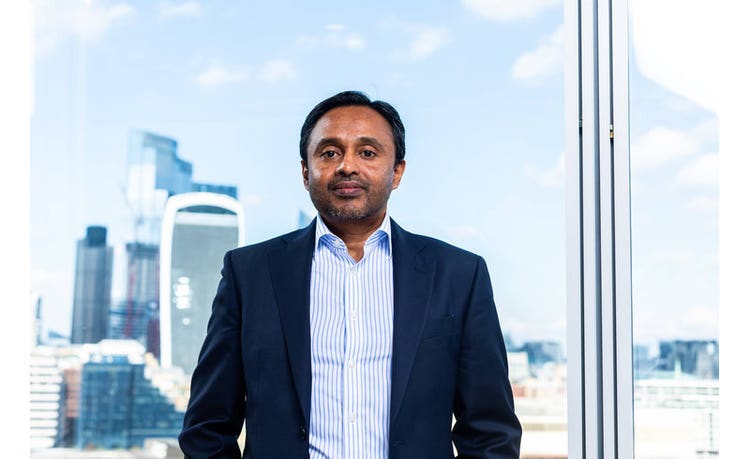
Cijo Joseph
Part of the IT Leaders 100 - a list of the most influential IT leaders in the UK in 2026.
Cijo Joseph is Chief Technology and Digital Officer at Mitie, where he leads enterprise technology, digital, data, and AI across one of the UK's largest facilities transformation businesses. He is known for combining operational excellence with disciplined innovation, recently delivering record service stability, over many millions in cost savings, and one of the UK's first production grade Agentic Mesh deployments. Cijo is a strong advocate for responsible AI, simplification of the technology estate, and inclusive leadership, serving as Executive Sponsor of CHORD, Mitie's network for cultural and racial diversity.
What's the most exciting part of your current role?
Operating at the point where technology stops being a support function and starts reshaping how the business works. From launching the AI in Mitie strategy to our top 250 leaders in 2025, to deploying agentic systems into live operations, the journey from vision to value has been exciting.
These systems aren't experiments. They're making decisions, improving accuracy and delivering measurable impact daily.
A defining milestone has been the launch of our first production‑grade Agentic Mesh. By creating a digital twin of Mitie's operations using a 5,000‑task process‑mining model and analysing over 3.5 million operational hours, we designed AI agents that match human accuracy in clearly defined scenarios. Delivering a two‑times run‑rate return within two years of investment has made the impact tangible.
What's also exciting is the breadth and pace of transformation. In a single year, we've embedded AI into platforms like Maximo, SuccessFactors and Coupa, scaled digital products for frontline colleagues and clients, launched the Mozaic360 AI data insight product, integrated the Marlowe acquisition and achieved record operational stability.
Most rewarding of all is seeing the team grow into this new era. Talented people solving meaningful problems, supported by strong governance and a culture of ownership, make the role genuinely exciting every day.
What do you do in week one of a new project to avoid pain in month six?
I focus deliberately on removing the points where transformation most often fails: misaligned stakeholders, weak change management, unclear ownership and poor adoption. My effort is spent addressing these risks before they take hold.
First, I make sure the business outcome is explicit and measurable. Not the deliverables, but the change in cost, risk, experience or capability the work must create. If that outcome cannot be clearly articulated, the project is not ready to begin.
Second, I establish single‑threaded ownership. One accountable business sponsor & technology leader with clear decision remits. Pace is lost when responsibility is diluted, and steering by committee is where momentum fades.
Third, I insist on early architectural alignment and security by design, treating cyber as cultural responsibility rather than technical control. Solutions are tested against reference architecture, platform standards and integration patterns at the design stage, not at go‑live. Partners are brought and held to the same standards as internal teams from day one.
Finally, risks and dependencies are surfaced immediately. Cyber, data, change adoption, communications and operational readiness are addressed in week one, not months later. Done well, the first week feels slower but by month six, delivery is calmer, predictable and far resilient.
What’s the part of your estate you most want to simplify in 2026?
Our frontline experience. Over time, we've built a strong Mitie Digital platform that enables us to integrate multiple acquisitions and stabilise our core estate. Those foundations are scalable and resilient, but the real experience of technology sits in the hands of our frontline colleagues. That's where simplification now matters most.
My focus is on reducing friction in the tools that shape day-to-day work: improving the engineer app, modernising scheduling for our planners, and creating more intuitive frontline journeys. We're positioning Mitie to become an agentic-first organisation through PRIO (Process Re Imagination and Optimisation), the most ambitious transformation programme we have undertaken.
Through PRIO, Mitie is investing £30m over the next two years to fundamentally rethink how work flows through the organisation. This is not incremental improvement; it is a redesign of how work gets done.
Rather than digitising existing processes, PRIO applies an agentic design mindset, assuming intelligent agents will increasingly manage routine decisions, hand offs and controls, while colleagues focus on judgement based, customer centric activity.
The prize is a best-in-class frontline experience, orchestrated through the Agentic Mesh platform. Delivering that simplicity and coherence at scale is where I intend to make decisive progress in 2026.
Excluding smartphones, what piece of technology could you not live without and why?
My reMarkable tablet. It has become central to how I think, plan and lead. In a world saturated with digital noise, it offers something increasingly rare: focus. By stripping away apps, alerts and constant interruptions, it creates a clean, paper like space where I can slow my thinking, work through complexity and shape ideas with real clarity.
It is also where my best work happens. Whether I am sketching an operating model, capturing insight from a board discussion, or refining a transformation roadmap, the reMarkable combines the freedom of handwriting with the discipline of digital organisation. Everything syncs, everything is searchable, and nothing disappears into notebooks or meeting packs.Most importantly, it supports the way I work: fast, iterative and visual. It encourages exploration without distraction and structure without rigidity. It travels everywhere with me and has become the one tool I consistently rely on to turn ideas into decisions, and decisions into action.
What excites you most about the future of IT?
We're entering an era where technology is no longer a collection of tools, but a network of intelligent, autonomous capabilities that can sense, decide and act. The rise of agentic AI is the clearest expression of this shift. For the first time, technology understands context, orchestrates end-to-end workflows and delivers outcomes with a level of accuracy and consistency beyond traditional automation. This moves IT from enabling efficiency to enabling genuinely self-optimising enterprises.
What excites me is how these capabilities converge in practice. At Mitie, AI agents, digital twins, automation and data platforms come together as a single, adaptive ecosystem. Applying data driven approaches such as retrieval augmented generation with large language models turns IT into a continuously learning insight engine, improving operations, enhancing the colleague experience and unlocking new business models.
Yet the most powerful impact is what this transformation means for people. As routine and repetitive work is automated, human capability is freed to focus on creativity, judgement and innovation. Technology stops replacing effort and starts amplifying talent.
That's why the future of IT is not only intelligent and autonomous, but fundamentally human-centred. Building systems that make work better, not just faster, is what makes this moment in technology so compelling.
What talent are you quietly proud of that would never show up on LinkedIn?
A talent I am quietly proud of, and one that would never appear on LinkedIn, is my ability to really see things, both in people and in situations. It is the same instinct that draws me to painting and to spending long periods simply looking at art. I am not trying to reproduce what is obvious on the surface. I am trying to notice mood, tension and light, the details others often overlook.
That instinct shows up every day in my leadership. It allows me to notice what is not being said in a meeting, sense when a team needs clarity rather than space, and recognise early signals of risk or opportunity long before they appear on a dashboard. It is a quiet capability, but it has shaped how I lead. It helps me stay calm in complex moments, frame issues clearly, and create the conditions for good decisions to emerge.
In senior and board environments, judgement and perspective matter just as much as technical expertise. It is not something I would list as a competency, but it strongly defines how I show up as a leader, especially when the stakes are high.
What’s your most-used keyboard shortcut or command that you wish everyone knew?
Ctrl + F is the most underrated superpower of the digital age. Most people use it to find a word in a document. I use the mindset behind it to find meaning.
When faced with a 50-page PDF or a sprawling transcript, I instinctively cut through the noise to locate the signal. Where the shortcut finds text, I look for intent and insight.
I apply the same approach everywhere, from web research to reports, quickly identifying what matters without reading everything end to end.