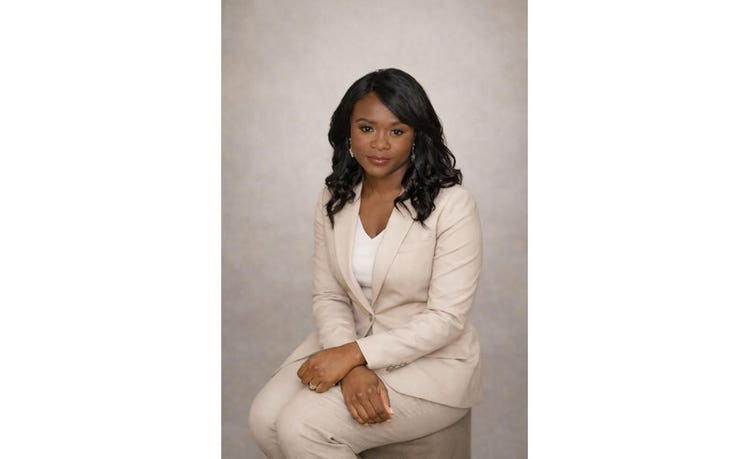
Bamidele Farinre
Part of the IT Leaders 100 - a list of the most influential IT leaders in the UK in 2026.
Bamidele Farinre is an author, educator, and multi-award-winning STEM leader whose work spans sci-tech, leadership, education and social justice. Through her advocacy and writing, she transforms personal challenges into powerful narratives of resilience and purpose. Her book, The Mentor's Journey: From Learning to Leading, explores the transformative power of mentorship in shaping confident, values-driven leaders.
As a global mentor and "STEMpreneur," Bamidele is dedicated to equipping emerging professionals with the tools to lead with courage. Whether through speaking, workshops, or her "No Ceiling" philosophy, she bridges the gap between education and the real world, ensuring innovation is inclusive and kind.
What's the most exciting part of your current role?
The most exhilarating aspect of my work is sitting at the intersection of clinical precision, agile transformation and national technology policy. My role allows me to translate complex technical requirements into strategic frameworks that ensure innovation is both high-performing and ethically sound.
The highlight of my current landscape is contributing to a flagship project for the All-Party Parliamentary Group on Diversity and Inclusion in STEM. Having my proposal, "Equity, Diversity, and Inclusion in Artificial Intelligence," selected as a national initiative is incredibly rewarding. It provides a platform to influence how the UK governs AI in critical sectors like healthcare, hiring, and education.
Equally exciting is applying Agile and Scrum methodologies to traditionally rigid environments, building future-ready teams that pivot at the speed of modern technology. I am energised by using my visibility, whether as a Global Advisor for the Young Africa Enterprise Project or as a UK United Nations ambassador, to advocate for a fairer STEM industry.
Ensuring the next generation of IT leaders is as diverse as the society we serve is what truly drives my leadership today.
What do you do in week one of a new project to avoid pain in month six?
I establish a "Quality by Design" foundation, a principle I honed while delivering 14 Mobile Processing Units for the DHSC. To avoid pain in month six, I focus on three non-negotiables: extreme mission clarity, psychological safety, and a rigorous "Definition of Done".
I align the team on the "why" rather than just the "what". During the COVID-19 rapid response, building a team of 130+ staff in a high-pressure environment taught me that month-six failures are almost always the result of month-one communication gaps.
I implement clear governance and communication cadences immediately, ensuring every stakeholder understands their role and the escalation paths.
As a Scrum Master and mentor, I also insist that quality and compliance checks are embedded into every sprint from day one. I treat technical and operational debt as a risk to be managed, not a problem to be deferred. This proactive approach ensures that when the project inevitably scales or hits unforeseen turbulence, the infrastructure is resilient enough to handle the pressure without compromising on integrity or delivery timelines. It is about building a culture where we are honest about risks early, so we don't have to be apologetic about failures later.
What’s the part of your estate you most want to simplify in 2026?
The complex intersection where high-level policy meets practical, ground-level execution. On a personal and leadership level, I am focused on simplifying my "portfolio of impact."
My work with the All-Party Parliamentary Group on Diversity and Inclusion in STEM has shown me that complexity often acts as a barrier to equity. I want to strip away the bureaucratic noise that prevents national AI safety frameworks from being easily understood and implemented by technical teams.
For me, simplification is a mechanical necessity for inclusion; it ensures that the standards we set are accessible and actionable for everyone.
This drive is rooted in my "No Ceiling" philosophy. Having transitioned from a student once told I lacked the potential for science to a national policy contributor and multi-award-winning STEM leader, I've spent my career breaking through artificial limits. Simplification is about removing the friction that creates these ceilings. By streamlining my portfolio from global advisory roles to parliamentary submissions, I am focusing more clearly on my mission: ensuring that technology serves the greater good without leaving anyone behind.
I want to replace complex, gatekeeping structures with transparent, equitable pathways that allow for limitless innovation.
Excluding smartphones, what piece of technology could you not live without and why?
I'd be lost without my "survival trio": my tablet, noise-cancelling headphones, and smartwatch. As a working mum who's always on the move, these aren't just gadgets, they're what keep me grounded while I'm juggling a million different roles.
My tablet is essentially my portable office. Because I'm constantly jumping between school runs, community meetings for BAMS Space, and work, I need something as flexible as my schedule. With my stylus, I can quickly map out a plan or scribble down a sudden brainwave for a policy submission, turning a messy idea into something real before the moment passes.
My noise-cancelling headphones are my sanity saver. They give me a tiny pocket of peace to focus deeply on important documents or prep for a broadcast, no matter how much chaos is happening around me.
Finally, my smartwatch is my constant companion. It's compact, wearable, and handles the quick alerts I'd usually check on my phone, but it also acts as a gentle reminder to breathe and look after myself. Together, they help me manage the school run, the chores, and my professional vision, making sure there's "no ceiling" to what I can get done in a day.
What excites you most about the future of IT?
How it is becoming the ultimate bridge for human potential. Looking back just a decade, the pace of change is staggering. We have moved from simple digitisation to a world where robotics, the metaverse, and personalised medicine are fundamentally reshaping what it means to be human.
However, the real magic isn't just technical brilliance; it is how IT is responding to a massive shift in our demographics and workforce. Our communities are demanding tech that truly "sees" them. I am energised by the move toward an intentional, ethical IT landscape where risk assessment is the foundation, not an afterthought.
As a STEM leader and advocate, I believe we must ensure that as AI and automation advance, we aren't just scaling efficiency but also equity. My work with the APPG on AI equity is driven by this mission: making sure the future of IT is built with people, not just for them. I am inspired by a digital world that is safe, inclusive, and designed to ensure no one is left behind, regardless of their background. That is a future worth building.
What talent are you quietly proud of that would never show up on LinkedIn?
Beyond the STEM leader, it is my rhythm and exploration. My LinkedIn profile showcase strategist and scientist, but in my own time, I am a composer and a singer. Music is a family affair for us; it's the language we use to connect, laugh, and let off steam. There is something incredibly soul-cleansing about sitting down to compose a piece of music or getting lost in a melody, it's my personal "reboot" button. It's where I go to release the pressure of a high-stakes day and just be present.
I'm also quietly proud of my love for travelling. To me, exploring new places isn't just about a holiday; it's about keeping myself grounded. It forces me to step out of my professional bubble and see the world through a different lens.
Whether I'm singing at home with my family or navigating a new city, these moments are my sanctuary. They give me the mental space to recharge and return to my work with a fresh perspective. We all need that separate world that has nothing to do with deadlines, a place where we can just be ourselves, hit the "restart" button, and find the joy in the "in-between" moments of life.
What’s your most-used keyboard shortcut or command that you wish everyone knew?
Mine is the Alt + Tab (or Command + Tab). It sounds simple, but for someone like me who is always juggling five different things at once, it's my absolute "get out of jail free" card.
My brain doesn't work in a straight line, and neither does my day. At any given moment, I've got a half-finished report open, a long thread of messages from my team, and probably a grocery list or a school email lurking in the background. This shortcut is the only way I can "hop" between these different worlds without losing my flow.
I wish everyone used it because it stops that frustrating moment of clicking around, getting lost in twenty open tabs, and forgetting what you were even looking for in the first place. It's what keeps me fast and responsive.
Whether I'm quickly switching back to a document to catch a stray thought before I forget it, or toggling away from a spreadsheet to answer a quick question, it's the one tool that helps me keep up with the pace of my own head. It's not about being a tech wizard; it's just about staying sane when you're trying to do everything at once!