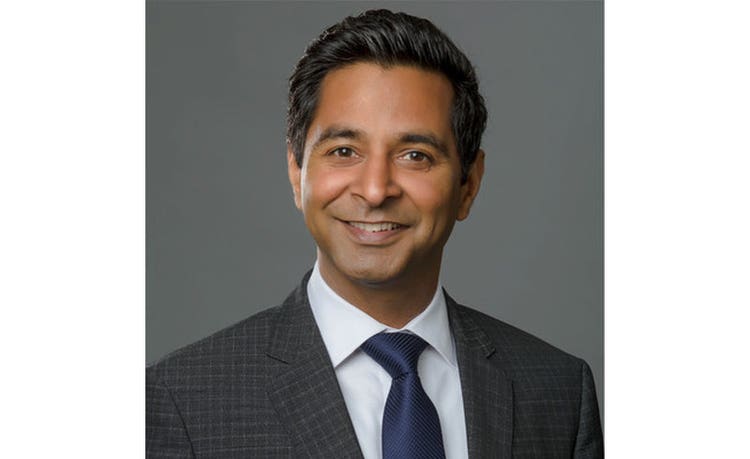
Ankur Anand
Part of the IT Leaders 100 - a list of the most influential IT leaders in the UK in 2026.
Ankur Anand is Group CIO & Member of the ExCo at Harvey Nash (parent group Nash Squared), a private equity-backed global technology and talent consultancy. He leads technology, data, AI, and cyber security with an uncompromising focus on commercial outcomes.
Specialising in platform strategy, AI-driven productivity, data foundations, and M&A integration, Ankur focuses on turning complexity into operating leverage that improves margin, decision quality, and execution speed.
What's the most exciting part of your current role?
Less technology. More impact. The most exciting part of my role is that technology decisions now have unavoidable commercial impact. There is no hiding behind roadmaps or transformation narratives. Every platform choice shows up in margin, speed, risk, or customer experience.
I value that clarity because it forces sharper thinking, faster decisions, and fewer compromise architectures. I see my role less as chief technologist and more as a capability builder. I focus on developing people who can operate confidently in that environment: understand trade‑offs, make decisions with incomplete information, and own outcomes.
Peter Drucker wrote that "the best way to predict the future is to create it," but that only works when teams are trusted to act, not wait. When people understand consequences and are given space to exercise judgement, technology stops being a dependency and starts to scale. That is when IT leadership becomes accountable in the same way as every other executive function.
What do you do in week one of a new project to avoid pain in month six?
I eliminate false alignment. In week one, I insist on an explicit trade‑off between speed, cost, and scope. If a team claims all three, the project stops. We also agree who benefits if it succeeds and who feels the cost if it fails. That single conversation does more risk reduction than months of delivery artefacts.
This approach is heavily influenced by Thinking in Bets by Annie Duke. Most late‑stage project pain comes from pretending uncertainty does not exist. Naming it early normalises better decisions later.
In my experience, month‑six issues are rarely technical. They are internal, political, or economic problems that no one was brave enough to surface in week one.
What’s the part of your estate you most want to simplify in 2026?
Decision-making latency. Technology estates rarely fail because of too many systems; they fail because insight moves slower than the business.
My focus in 2026 is simplifying how data becomes action: reducing handoffs, dashboards without insights, and insights and analysis that arrives too late. Fewer layers between signal and response matter more than fewer applications.
Excluding smartphones, what piece of technology could you not live without and why?
My Airpod Max. The podcasts and classical Indian music give me space when commuting or while going for a walk. Whether I am thinking, reading, travelling, or just resetting between conversations, the ability to shut out noise helps me slow my mind down and be more intentional. In roles like mine, there is constant input: messages, opinions, urgency. Headphones create a boundary that lets me focus on what actually matters, or sometimes on nothing at all. That quiet thinking time is where better judgement usually starts.
What excites you most about the future of IT?
That some IT roles will disappear, and better ones will replace them. AI and automation will remove large parts of traditional IT work, and that is healthy. It forces leaders to stop defending activity and start defending impact.
The future of IT belongs to people who can set economic direction, design leverage, and make hard decisions about what to stop. What excites me most is helping people make that shift. The winners will not be those who cling to tools, legacy processes, or familiar ways of thinking, but those who deliberately reskill into judgement, systems thinking, and commercial awareness.
The challenge is not access to new skills, but creating the confidence and permission to let go of old ones. Everything else will be automated, outsourced, or commoditised.
The future of IT is not about preserving roles or processes, but redesigning both so people stay valuable.
What talent are you quietly proud of that would never show up on LinkedIn?
Knowing when to push forward and when to stop is as important as knowing what to build. I am comfortable ending initiatives that no longer justify their cost, popularity, or attention, even when momentum is high. That discipline protects focus, avoids sunk cost thinking, and creates space for better ideas to emerge.
Innovation, for me, is not constant novelty. It is knowing when not to open a blank page. Reusing what already works, scaling proven patterns, and applying judgement before enthusiasm is quieter than launching something new, but it is how organisations make durable progress without exhausting people or budgets.
What’s your most-used keyboard shortcut or command that you wish everyone knew?
Ctrl+C and Ctrl+V. Not because I am lazy, but because I am ruthless about scale. If something works, I copy it. If it works really well, I paste it everywhere: frameworks, operating models, decision patterns, even phrasing.
Reinventing from scratch is expensive and usually ego‑driven. James Clear talks in Atomic Habits about success being the accumulation of small, repeatable advantages. Copying intelligently is how platforms compound value and how teams move faster without burning out.
It is the most boring shortcut on the keyboard, and probably the most powerful.