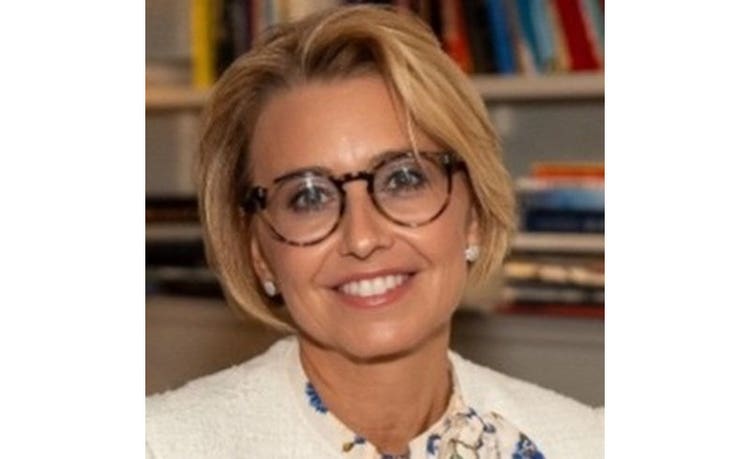
Alexandra Foster
Part of the IT Leaders 100 - a list of the most influential IT leaders in the UK in 2026.
Alexandra Foster leads Fujitsu's Banking, Financial Services, Insurance and Professional Services business, helping regulated organisations turn AI, quantum, cloud and cybersecurity into resilient, trusted outcomes. Formerly Managing Director of BT's Division X, Alex led innovation across 5G, IoT and edge computing, after beginning her career in investment banking.
Previously recognised in Computing's IT Leaders 100 and Innovate Finance's Women in FinTech Powerlist, Alexandra co-chairs Fujitsu's FuturHer network, supports fintech, university and emerging technology communities, and is known for making complex technology usable, commercially relevant and inclusive by design.
What's the most exciting part of your current role?
The most exciting part of my current role is pace, and the responsibility of making it sustainable. Every generation of leaders says they are living through unprecedented change. I'm usually wary of that line, but this moment does feel different. Not because technology change is new; financial services have always adapted. What has changed is the clock speed. Clients are being asked to adopt AI, prepare for the risks and opportunities of quantum, strengthen resilience, improve customer experience and stay trusted, all at the same time.
The exciting part of my role is helping make that speed sustainable. I spend a lot of time in the unglamorous middle, taking ideas from impressive demos into regulated, legacy estates where they have to work on Monday morning.
For me, AI and quantum are most compelling when they start to solve real problems: earlier fraud detection, better risk modelling, stronger operational resilience and better outcomes for customers and colleagues. Being first is interesting. Building something trusted enough to last is better.
What do you do in week one of a new project to avoid pain in month six?
I focus on building one team across the whole ecosystem, not a collection of workstreams defending their own corners. We align on the outcome, the value we are creating or protecting, the customer and operational impact, who can make decisions, who owns the data, what is out of scope, and which risks we may be quietly underplaying.
I also like a pre-mortem: pretend it is month six and the project has become painful, what did we avoid saying at the start? I also like to use a habit inspired by the book Will It Make The Boat Go Faster? Keep asking what went well, what did not, and what we can do better next time.
The leadership’s job is to make it safe to surface truths early, then turn them into ownership, governance, controls and rhythm. Projects rarely fail suddenly. They send warnings through vague objectives, heroic assumptions, hidden dependencies, weak adoption plans and drifting decisions. Week one is about trust, pace and accountability, before optimism becomes expensive.
What’s the part of your estate you most want to simplify in 2026?
The AI estate, particularly the path from experimentation into production.
AI has moved at extraordinary speed. Across large organisations, copilots, models, dashboards and proofs of concept have grown quickly, often for very good reasons. The opportunity now is to turn that energy into repeatable capability.
For me, simplification means clearer routes to production, stronger data foundations, common patterns for security, model governance and responsible use, and clearer ownership from business outcome through to operational support. I would rather see fewer AI capabilities that are trusted, adopted and measurable than a long list of impressive experiments that are hard to reuse.
This is not about slowing innovation. It is about making innovation easier to scale, integrate, govern, measure and improve it safely, repeatedly and at pace.
Excluding smartphones, what piece of technology could you not live without and why?
At home, my children would probably say I could not live without the robot vacuum, the indoor herb grower or whichever gadget had mysteriously appeared on my Christmas list! But honestly, I think the technology I would miss most now is my AI shopping agent. I use it for very human things: weekly shops, forgotten birthdays, university requests, Christmas lists and the dreaded, “Mum, I need it tomorrow!” I could not live without it because it gives me time and headspace back, not just another app to manage. It has also made me less patient with technology that only presents more information. The best agents reduce the cognitive admin between intent and action. They understand the need, compare options, surface trade-offs and, with the right controls, take the next safe step. That is useful at home, but powerful in enterprise. The best technology gives time back, and sometimes stops me buying shoes or glitter at 11pm!
What excites you most about the future of IT?
IT is escaping its old boundaries. It is no longer just software, systems and service levels. It is becoming the connective tissue between business, infrastructure, science and people.
I am especially excited by quantum, not as a distant science project, but as something moving into serious business conversation. I am lucky to work in an organisation where quantum, AI and high-performance computing are being explored day by day, with hybrid approaches that could tackle problems too complex, too slow or too energy intensive for today's systems.
The real opportunity is convergence: AI, quantum, cyber, data, sustainable compute and space-enabled infrastructure coming together. In financial services, that could change how we model risk, detect fraud, understand climate exposure, optimise capital and strengthen resilience.
The leadership challenge is the exciting part too: bringing scientists, engineers, business teams, risk colleagues and regulators into the same room, then turning possibility into trusted capability.
What talent are you quietly proud of that would never show up on LinkedIn?
My tap dancing qualification or deadlifting habit could make a respectable bid, but the talent I am most proud of is my dyslexia, dyslexic pattern spotting, and becoming more open about it. I can miss a typo in a sentence and still spot the hidden flaw in a strategy, operating model or transformation plan.
Dyslexia has taught me to look for patterns, contradictions, shortcuts and connections that are not always obvious if you approach a problem in a perfectly linear way. For years, I saw it as something to compensate for. Now I see it as part of my leadership toolkit. It helps me simplify complexity, ask different questions and reframe problems so people can act.
Dyslexia has also made inclusion very practical for me. The right culture and the right technology do not just make people more productive, they stop people wasting energy hiding how they think. That matters to me, especially for the next generation.
What’s your most-used keyboard shortcut or command that you wish everyone knew?
Windows key + H. Built-in voice typing for emails, docs and AI prompts. Brilliant for dyslexia, fast thinking and turning messy ideas into useful output before I over-edit them.