Lest we forget: A century of tanks, drones and the technology of war
The use of open technologies in warfare does not make the openness itself the problem
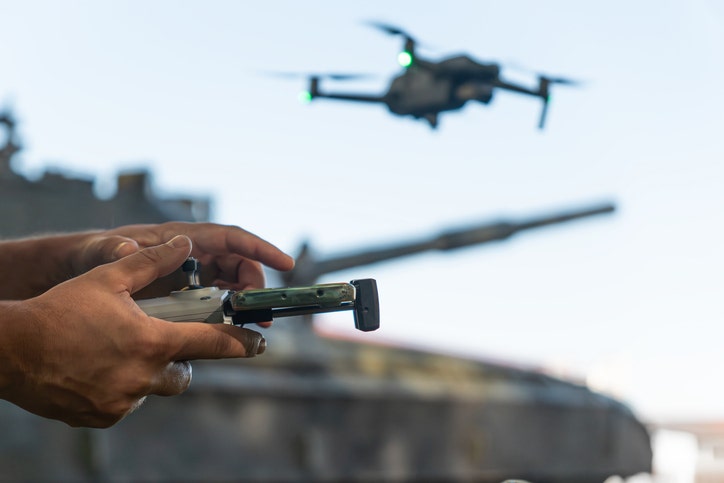
This Armistice Day, CEO of OpenUK Amanda Brock argues that it is more important to regulate behaviour than technology.
This week marked Armistice Day, 11th November, when we wear poppies to commemorate the dead of the First and Second World Wars. We remember that they made the ultimate sacrifice for our freedom. Last Sunday, I was home in Crieff and saw the Remembrance parade. Wreaths were laid, as they were across the country, but it was the horses accompanying the procession that particularly stayed with me.
Over the summer, I saw War Horse at the National Theatre. It's a deeply moving story of a young man who enlists underage to find his beloved horse, Joey, after the horse is sold to the cavalry in the First World War. The contrast between the human relationships at the heart of the story and the increasingly technical and devastating reality of war was poignant. When British foot soldiers advanced at the Somme in July 1916, they faced machine-gun fire. By September, the British had introduced tanks into battle for the first time, in part to overcome the defences that had inflicted such heavy losses on them.
As told in the play, that began the technologisation of war. This process is one that has evolved over 100 years. Perhaps realistically it dates back to munitions and ammunition being developed. The turning point for the British forces as told in the play, what tipped the battle of the Somme, was the tank being rolled out by the British military, seeing the evolution of technology to fight technology.
A century later, warfare is still fought, but less through boots on the ground and increasingly shaped by technology, from drones and cyberattacks to AI-enabled intelligence and autonomous systems.
Ukraine has demonstrated how drones can change the balance of military power. Meanwhile, planes undertake emergency landings across Europe and fridges in the food supply chain are turned off – potentially by nation states. This disruption reminds us that the consequences of modern technological threats extend well beyond the battlefield.
In considering AI policy and regulation, we need to recognise the environment in which these technologies operate. Innovation can create both enormous opportunities and significant risks. The challenge is how to address those risks without unnecessarily restricting the technologies themselves.
Nick Clegg, now at Hiro Capital, has spoken this week about the disconnect between Big Tech, politics, and the willingness of these companies to express political opinion.
The same is true in reverse. A Baroness commented to me that she was shocked by how political - with a small p - tech is. That’s because the decisions on a word in a regulation is the difference between a loss and a billion-dollar revenue stream.
Neither sufficiently understands the other's world to make decisions that impact on the other. Yet decisions about technology increasingly shape almost every aspect of our lives and the delivery of our basic services. Hardly surprising when every aspect of our daily lives is reliant on technology today.
There is only one certainty in this digital world: we can only go forward, not back.
Of course, there’s much debate as to whether we regulate the underlying technology or how it is used. A bread knife can slice a loaf or be used as a weapon. We don't prohibit bread knives because they can cause harm; instead, we regulate harmful behaviour. The same distinction matters when considering general purpose technologies like AI. Generally we regulate use cases, and attempts to regulate coding per se would not be wise. We look to greater regulation in particular areas - regulated sectors - and that is appropriate.
The assumption that open source is inherently less secure persists, despite the evidence that security depends on far more than whether innovation is open or closed. Both forms have different challenges. Frankly, all technology has security challenges, and we need to consider what those are and how they are securely managed for a particular use case.
The Ukranians built drones on Arduino to use them in large-scale attacks. We see much of today’s warfare in Ukraine and in Iran being driven by technology. Ukraine's use of open source technologies in drone development illustrates how innovation can be adapted to meet urgent military needs. But the use of open technologies in warfare does not make the openness itself the problem. We need to distinguish between the technology, the people developing it and the purposes for which it is deployed.
What matters is how technology is developed, maintained, and deployed. Openness can support scrutiny that enables trust, but it is not a substitute for good security practice. The last conversation I had with Sir Alex Younger, former head of MI6, ended with him saying, with a smile, “May the open source be with you.” That followed a long discussion on why open source is not detrimental to security.
Regulators are challenged by complex technologies that evolve quickly. Those who understand the technologies are generally nowhere near the regulatory process.
Trust in AI remains a challenge in the West, and sensible regulation and policy has an important role to play in building it.
We must focus on addressing demonstrable risks, ensuring accountability and understanding how technologies are used, rather than treating innovation or openness as threats in themselves. To do this we need more of the right people in the room, bringing real technical understanding and building assurance.
In this world of geopolitical uncertainty good technological understanding in our policy has never mattered more.
Lest we forget.