AI may cut legal costs, but who carries the risk?
Legal AI has exposed a growing governance gap
The appearance of new technologies has always prompted the same reactions amongst the business community.
For every early adopter who dashes headlong to embrace it, there have been others who prefer to carefully weigh up the pros and cons before deciding on the right course of action.
The same is true, of course, when it comes to the legal profession.
Many lawyers recognise AI's ability to act almost as a digital assistant, creating an outline of court documents or contracts for them then to complete; but as with other industries, the degree of appetite varies considerably on the size of business and the resources they can devote to the technology.
Yet the decision whether to use AI is not solely based on cost. There may be beneficial impacts on current workflows, but there might also be lengthy procurement and integration processes.
The legal profession also has other tensions that may temper any enthusiasm.
The most notable concerns involve our obligations to both clients and regulators for solicitors and barristers: the Solicitors Regulation Authority (SRA) and Bar Standards Board (BSB).

Regulators walking the AI tightrope
The UK government has made it clear that it expects both SRA and BSB to encourage the uptake of AI in the legal sector. It is a position supported by one of the most senior judges in England and Wales, Sir Geoffrey Vos, Master of the Rolls for the past five years. In a speech last month, he described how "lawyers and judges have no choice but [to] wholeheartedly" adopt AI in order to improve access to justice.
The SRA has done its best to maintain what, from the outside, is a delicate balance between regulating and facilitating. However, in recent weeks, it has felt compelled to publish a warning notice on the importance of the responsible use of AI. That followed 42 different reports of "potential misuse" of the technology in the 12 months to July this year.
The Authority detailed how these incidents included the kind of ‘hallucinations’ or unsubstantiated, AI-generated references that have turned up in a number of court submissions, and suspicions that client data had been uploaded to platforms without the sufficiently robust terms and conditions to handle such confidential material.
As if to demonstrate a willingness to take a hard line on the issue, we have since seen a registered foreign lawyer struck off for misuse of AI in a case heard by the Solicitors' Disciplinary Tribunal.
The situation is a challenge for regulators and lawyers alike. Move with the times or risk being left behind by competitors. Move with too much haste and risk significant damage.
Due diligence cannot be one and done
As it stands, law firms wanting to adopt AI must complete a full review of the model they intend to use, and keep a record of that assessment.
One obvious headache is the fact AI tools regularly add new functionality, meaning that the task of assessment and recording does not just take the three or four months needed to complete the necessary due diligence (plus time to demo, trial, integrate, and train staff) but becomes an ongoing task.
Furthermore, the guidance that applies to that process has been in place since November 2019 - three years before generative AI platforms such as ChatGPT were made available.
Once more, rules have been outstripped by the pace of the new technological reality.
Nevertheless, the SRA's warning notice might at least give law firms extra reason to think about possible AI adoption.
Oversight comes at a cost
The SRA's guidance requires lawyers to apply the government's principles for AI use, which include having 'meaningful human control' over AI systems: in other words, someone checking outputs to ensure that they are accurate. If they don't, it could amount to negligence, depending on the AI tool being used and how it was deployed.
That necessary human touch, of course, doesn't make the adoption of technology regarded by some as a way of saving money any cheaper.
It is already making for interesting conversations, with clients asking lawyers using AI to reduce their fees. In addition, some clients are effectively asking lawyers to proofread documents they have generated themselves using the likes of ChatGPT in the hope of keeping bills down. In doing so, they disregard recognise lawyers' inherent skills and ignore the limitations of the technology.
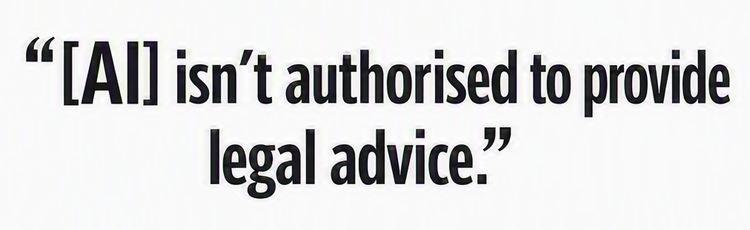
In one recent assessment I undertook on behalf of a legal client, I detected Microsoft Copilot offering to draft a “legally robust clause”, even though it isn’t authorised to provide legal advice. When I questioned it, Copilot replied that it would learn.
Such a failing was arguably just as serious as the fictional case references the SRA highlighted in a number of court submissions. This came down to how AI models are being trained.
The issues of fees and implementation costs are not the only financial considerations.
Professional liability insurance is expensive. If a law firm adopts AI without adhering to the rules on governance, it may find that it's not covered in the event of a problem arising.
The UK's legal regulators expect the profession to comply with the rules currently in place based on their deep understanding of AI tech, but provide no specific guidance on what level of understanding is required and when to outsource it – or to whom.
Lawyers need clearer standards
I believe that, in part, the answer lies in greater collaboration or consultation between the regulators, lawyers and their technology partners to establish a clear standard of assessment.
That information should emphasise the importance for practitioners in every legal discipline to take note, given AI's capacity to impact multiple practice areas.
Such guidance about precisely what is required would breed confidence that lawyers are complying with the rules and acting in the best interests of their clients.
It would also support firms wanting to capitalise on what AI can offer them and the individuals for whom they act, while helping remove the current uncertainty about the potential for regulatory breaches should they get it wrong.