UK needs tougher powers over high-risk technology vendors, says RUSI
Report calls for stronger powers to identify and exclude risky technology suppliers

A new report from Royal United Services Institute (RUSI) argues that the UK and much of Europe still lack a coherent strategy for managing so-called "high-risk" technology suppliers across critical national infrastructure (CNI), despite years of effort to remove Huawei from mobile networks.
Focusing particularly on the risk posed by Chinese ICT suppliers such as Huawei, the report by the defence and security thinktank notes the difference in approaches between the UK, Spain and Germany, which the authors put down to an EU policy of allowing each country to decide its own approach as well as the absence of a clear definition of “high-risk vendor”.
While the UK will have removed all Huawei equipment from its 5G Radio Access Network (RAN) infrastructure by the end of 2027, 59% of all 5G RAN spend in Germany is forecast to be with Huawei.
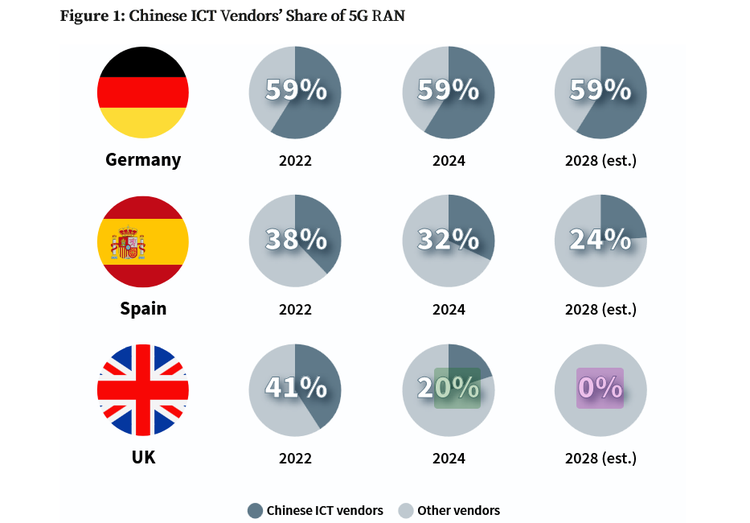
RUSI warns of a growing two-tier security model
But while the UK’s seven-year multibillion pound plan to remove the Chinese vendor is seen as an effective measure to reduce the cyber risk, the report concludes that the picture is very different outside of telecoms and government, including energy, water, transport and healthcare, where controls are much weaker.
A public sector cybersecurity consultant interviewed for the report said: “huge swathes of the public sector are underpinned by vendors that I would class as high risk one way or another.”
According to the RUSI report: “For UK policy, the main conclusion is that there remains a significant gap in its approach to high-risk vendors outside telecoms and the public sector. The mechanisms it has developed do not yet amount to a coherent cross-sector framework.”
Procurement rules could become the model for critical infrastructure
The authors recommend that the UK expand legislation further to better protect critical national infrastructure using criteria similar to those developed under the Procurement Act 2023, which strengthened the government's ability to exclude suppliers on national security grounds.
They also suggest that government bodies including DCMS and the NCSC should work together develop dedicated guidance on foreign control and influence, claiming that existing frameworks do not specifically address ownership-related risk.
A major theme of the RUSI report is that is that technology buying decisions should no longer be treated as purely commercial exercises driven by cost, performance and features. The authors argue governments increasingly need to consider foreign state influence; supply-chain dependence; geopolitical risk, and strategic resilience.
Such considerations could be included in the Cyber Security and Resilience Bill, which is currently making its way through Parliament, or in secondary legislation, the authors suggest.
A provision to allow the identification of high-risk vendors was debated in the House of Lords in September.
Why governments struggle to remove risky suppliers
Banning high-risk vendors before they are installed in critical national infrastructure (CNI) will be much less costly than removing them after the fact.
Even when governments want to remove potentially risky vendors, they frequently lack the information needed to identify where the products are installed.
Last year the National Audit Office released a highly critical report that gave 63 out of 228 legacy government IT systems a critical “red rating”.
“The government does not have a detailed understanding of the resilience of its legacy IT systems,” it said.
The NAO put this down largely to a lack of cybersecurity skills within government.
Dependency concerns extend to US hyperscalers
The report also notes differences in attitudes towards US cloud giants.
Interviewees from Germany and Spain told the researchers they increasingly view dependency on AWS, Microsoft and other US firms as a strategic vulnerability, whereas this is less of a concern in the UK.
The authors warn against conflating US and Chinese dependence, arguing that European countries need to create a framework capable of distinguishing between the differing geopolitical and security risks posed each.