New dashboard estimates energy consumption of Claude, GPT and Gemini
CLEER benchmark sheds light on AI’s hidden energy and carbon footprint
AI providers like Google, OpenAI and Anthropic don’t publish detailed energy‑use data for their models, viewing it as commercially sensitive operational information. Moreover, there is currently little in the way of legislation to force disclosure, and few standards or methodologies exist to measure energy consumption.
Hugging Face’s AI Energy Score initiative is an attempt to establish comparable energy efficiency ratings for open AI models, but until now there has been no equivalent for closed proprietary models like Claude, Gemini and GPT.
Now the Sustainable AI Group (SAIG) - a research and advisory firm launched earlier this year by Dr Sasha Luccioni, formerly AI and climate lead at Hugging Face, and Boris Gamazaychikov, formerly head of AI sustainability at Salesforce - has developed a way to help customers compare the energy use of closed models by comparing them with open models of similar capability that have been tested experimentally.
The CLEER (Closed-model Latent Energy Estimation Range) dataset scores closed models on estimates of per-token energy use and publishes the results on a dashboard, together with estimates of consumption for a typical chat and agentic session. These figures are also translated into carbon emissions estimates, while water consumption metrics are planned for a future release.
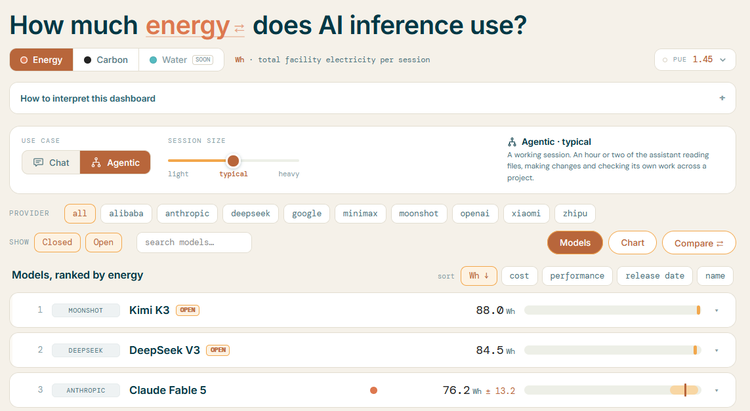
In fact, two open weights models are the most energy intensive, among those tested. Over a typical 1-2 hour agentic session Kimi 3 and DeepSeek v3 use 88 Watt hours (Wh) and 84.5 Wh, respectively.
Openness alone has no bearing on energy use, and price is an unreliable indicator. In about one in five head-to-head comparisons, the cheaper model had the higher estimated energy consumption.
Just below Kimi and DeepSeek comes the most energy-intensive closed model, Anthropic’s Claude Fable 5, which burns through roughly 76.2 Wh in a typical agentic session, equivalent to 183 seconds of air-fryer use.
Frontier models are the hungriest and agentic use consumes more energy
Frontier models consume far more energy than smaller LLMs during a typical task. Within the same model family - such as Claude or GPT LLMs - SAIG found that more capable variants including Opus, Pro and Sol use nearly four times as much energy on average as their lighter counterparts Haiku, Flash and Terra.
The difference between the largest and smallest models is stark. Claude Fable 5 uses more than 30 times as much energy per token as GPT-5 nano, the most energy-efficient model in the agentic ranking.
For the same model, a typical agentic session used 27 times more energy than a typical chat session.
Of course, larger models are generally more capable, so this is not a like-for-like comparison, and several other variables and caveats need to be taken into account.
As such, CLEER remains a work in progress. SAIG is working with organisations including ecommerce giant Etsy to refine the methodology, while also inviting feedback from developers, suggested corrections and additional data for analysis.
A view into the black box
The aim is to provide visibility into the black box of AI energy consumption so organisations can make more informed decisions when routing workloads to particular models, while also encouraging greater transparency from vendors.
“If companies better understand the environmental impacts of the models they deploy, sustainability can become another dimension of their decision-making, alongside performance, speed, and price,” SAIG says.
“We hope that this can pave the way for more disclosures from model developers, enabling customers to measure and manage these growing impacts and creating meaningful demand for more sustainable AI.”