Intel slashes 4,000 roles
More than half in Oregon, where Intel is one of the biggest private employers

Intel has cut approximately 4,000 positions across the USA, including 2,392 jobs in Oregon, home to the company's largest US operations.
The Oregon job losses, revealed in a Worker Adjustment and Retraining Notification (WARN) filing late Friday, account for nearly 12% of Intel's 20,000-person workforce in the state, marking one of the largest tech-related job cuts in Oregon's history.
While Intel has previously reduced headcount through buyouts and voluntary exits over the past year, resulting in some 3,000 job losses, this latest round includes no early retirement or buyout options. Instead, Intel is enacting direct dismissals, impacting workers across its Aloha (192 jobs) and Hillsboro (2,200 jobs) sites.
The job cuts officially began earlier in the week but were confirmed with hard figures on Friday evening.
Engineers and technicians bear the brunt
Intel executives had earlier claimed that the company's restructuring this year would target "mid-level managers" as part of an effort to flatten organisational layers and refocus on engineering talent.
However, the actual job cuts tell a different story.
In Oregon alone, they include:
- 325 Module Equipment Technicians
- 302 Module Development Engineers
- 126 Module Engineers
- 88 Process Integration Development Engineers
In total, only 190 employees with "Manager" in their job titles, 8% of the Oregon layoffs, were among those let go, contradicting the company's messaging.
These managerial roles spanned software, hardware and operational functions.
The job cuts, nearly 4,000 across the USA, affect sites in California, Arizona and Texas in addition to Oregon.
The company has also begun trimming staff at its operations in Israel, where it laid off Remote Operations Center (ROC) technicians, first-line supervisors and mid-level managers, phasing out positions tied to manual oversight and shift supervision.
ROC technicians, who remotely manage semiconductor production tools and workflows, are being replaced by automated systems, a move that reflects Intel's global push to digitise fab operations and reduce human involvement.
In contrast to previous mass layoff announcements, Intel is adopting a decentralised workforce reduction strategy, entrusting individual departments with meeting internal financial targets.
As a result, job losses are being rolled out quietly and incrementally, rather than through centralised restructuring plans.
The dismissals come at a difficult time for Intel, which once stood as the undisputed leader in chip innovation but has struggled in recent years to adapt to the rapid rise of AI-driven demand.
The company’s market cap now stands just over $100 million, down about a third from this time last year.
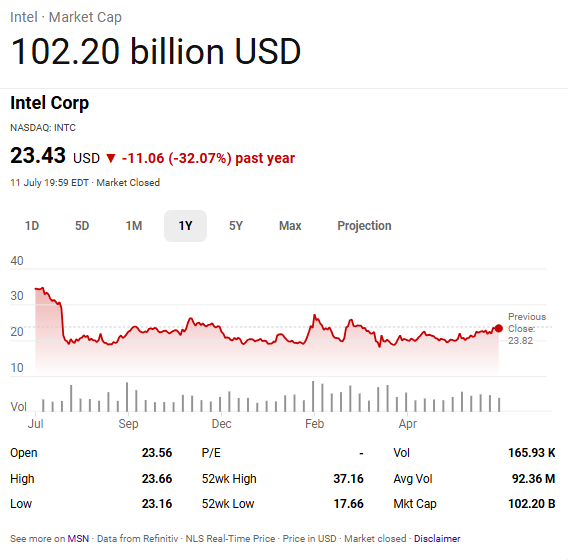
Just a day before Intel revealed its latest job cuts, Nvidia became the world's first chipmaker to surpass a $4 trillion market valuation, thanks to its dominance in AI processors.
In a companywide address last week, Intel CEO Lip-Bu Tan reportedly told employees, "We are not in the top 10 semiconductor companies."
Roughly two dozen of the Oregon job cuts disclosed on Friday affected positions directly tied to AI.
Earlier this month, it emerged that Intel is outsourcing its global marketing operation to Accenture and will use more generative AI in support.