Revolution in the hotel industry: AI as an invisible manager
Hey Lou relies on a combination of human warmth and technical precision
AI is revolutionising a traditionally human-first industry. Here, Computing Deutschland**’s Kerstin Stief look behind the scenes of an AI-based hotel operation and discuss the new balance between AI and service.**
AI development is accelerating rapidly. While AI itself is not new, advanced storage and compute capacities have enabled its widespread use. One such application is 9OS, a hotel operating system with a focus on artificial intelligence, specifically agent-based technology (Agentic AI).
The hotel operating concept was developed by, among others, Martin Kemmer, an experienced serial entrepreneur in the systems economy hotel industry. With over 25 innovations, from digital solutions to sustainable real estate, he has had a significant impact on the sector’s shape.
As managing director of Place Value GmbH and it4me GmbH, Martin is a pioneer in digitalisation, sustainability and AI applications in the hotel industry. His more recent projects include Hey Lou Hotels and 9dots, which he founded together with his brothers Sebastian and Thomas, as well as Daniela Schade.
Hey Lou is the first hotel operating concept based on the proprietary 9OS hotel operating system. With 9dots, Kemmer wants to make the Hey Lou Hotels concept accessible to other hotels as well.

In an interview with Computing Deutschland, Martin tells the whole story:
“The development of 9dots wasn't a spontaneous venture, but rather the result of a long, multi-year journey. As early as 2016/2017, initial steps were taken in the hospitality and AI sector, initially using IBM Watson. Even then, the goal was to implement hotel management systems via AI – although artificial intelligence at that time wasn't yet synonymous with today's LLM models.
“Back then, the technology hadn't progressed that far; Watson already offered advanced approaches, but the complete systems weren't yet ready for widespread use.”
A decisive shift occurred in 2022 and 2023 with the advent of ChatGPT and other LLMs. For the first time, seamless communication with machines was possible, simplifying the human-machine interface and enabling hotel management via the 9dots operating concept.
The hotel's processes – that is, the IT processes and operational procedures – became increasingly agent-based, although the initial term was "Orchestration of ML Processes." Later, "Agentic AI” became established, but the underlying principle remained the same: the LLM serves as the system's output module.
The concept was initially implemented successfully for the Hey Lou Hotels brand, and the combination of human and digital interaction proved remarkably successful: The first Hey Lou Hotels achieved the same or even higher revenues with at least the same level of guest satisfaction (NPS and CSAT score), while simultaneously reducing costs.
This is due to the AI-based management of the hotel, facilitated by Salesforce’s Agentforce, among other things. The system handles all decision-making processes, while the human remains as the output unit, greeting the guest with a smile.
For IT decision-makers, the model can be compared to the classic Input-Process-Output scheme: Previously, the input was the keyboard, the process was handled by the CPU, and the output was the monitor. Today, the input is the guest themselves, the process is managed by the AI or the agentic system 9OS, and the output is the human employee who personally interacts with the guest.
9dots and the Hey Lou Hotels exemplify the successful fusion of technology and human hospitality, powered by an innovative, AI-based operating system. 9OS integrates over 100 leading tools and platforms into a shared infrastructure. Booking, marketing, purchasing, HR – in 9OS, all systems form a cohesive digital unit.
Salesforce, which has played a central role in both back-end and front-end guest-related processes since Hey Lou's inception, is a key technology partner.

Liesel Klokkers is Head of Solution Engineering at Salesforce and has been working intensively with artificial intelligence for over two decades. Among other things, she is responsible for the planning and implementation of AI projects and, tells us about the progress of agentic AI, where the greatest added value lies, and how the interaction between humans and AI agents can work optimally.
We wanted to know what Liesel believes distinguishes agentic AI from generative AI:
“This independent way of working is what fundamentally differentiates agentic AI from generative AI. While large language models still form the basis, numerous additional technologies are used to enable the development of high-performance agents.
“Salesforce offers multiple elements to help here: roles, applications, complete process mapping, internal and external structured and unstructured data, as well as established communication channels for all service, marketing, sales, and commerce applications.
“A particular feature is the metadata layer, which describes processes, applications, and interfaces, and facilitates their use by agents.
“It is important that the role of an agent is clearly defined - analogous to a digital employee. Access rights, responsibilities, and available data sources are precisely defined. To act competently, an agent needs relevant data, knowledge, and contextual information, as well as clearly defined actions and decision boundaries. Guardrails ensure an agent hands over tasks to human employees at certain points. Furthermore, the agent communicates with colleagues via various channels, such as chat or voice.
“Development is progressing toward fully fledged agentic AI, which performs tasks independently based on existing knowledge. An AI agent either receives an explicit instruction or is triggered by an event, and has its own reasoning engine to independently derive and execute the necessary tasks.
“Initially, the focus was on predictive AI. With the advent of LLMs, Salesforce recognised how these technologies could be leveraged. The next step was the integration of generative AI into its products, which makes it possible, for example, to summarise or create emails - a significant advancement, especially in customer service. Complex customer inquiries or help articles can be efficiently processed and summarised; corresponding applications have been integrated into our applications.”
A key aspect is the availability and quality of the data. A solid data foundation is essential for obtaining informed and reliable answers from a Learning Management Model (LML) and minimising hallucinations. How does Salesforce ensure data quality so that the AI can work with it efficiently? What specific security requirements have been considered?
Liesel explains: “In recent years, the proportion of unstructured data - for example, from social media conversations, web tracking data, and PDF documents such as operating manuals - has increased significantly. This information needs to be integrated into relevant applications, as certain use cases would otherwise be impossible.
“Our approach is not to provide an additional data lake, but rather to create a layer within our architecture with Data360 that consolidates a wide variety of data sources without copying them. This zero-copy principle enables the federated consolidation and provision of data to our platform, allowing all agents and AI models to access it.
“To successfully implement their business requirements with AI, customer data residing in a wide range of systems needs to be made available. If, for example, a data lake is already in place, it can be easily connected. A graphical interface allows the data to be mapped to internal objects and then used - significantly more efficiently than developing individual interfaces.
“With Data360, we provide a data activation layer that makes existing data sources usable and integrates them into the platform. This opens up a wide range of possibilities. New application possibilities and added value, such as using machine data for maintenance planning or process optimisation.
“Within Salesforce, it is particularly important that stored data is anonymised and that the LLM does not use or share it for independent learning. This is a crucial point with regard to trust and security.”
What does a concrete use case for Agentic AI look like for Hey Lou and 9dots?
Martin outlines a typical scenario in a common hotel situation: “Guests occasionally notice that, for example, the bedside lamp in their hotel room isn't working. The guest first checks all the switches in the room themselves, but the lamp remains out. Our system then offers various ways to report the issue – for example, via chat, at reception, or through other communication channels.
“Subsequently, an AI agent automatically initiates a process that spans multiple systems, thus enabling efficient troubleshooting. The ERP system first checks whether a replacement bulb is available; if not, an order is triggered – this aspect is not included here. If the bulb is in stock, the HR management tool (e.g., Workday) determines which facility manager is currently on duty in the building.
“The task is only assigned to available employees, and the responsible employee receives a digital task list as well as any necessary supporting information, such as instructions for changing a lightbulb. At the same time, less urgent tasks are temporarily hidden, with an Eisenhower Matrix used for prioritisation. Urgent, guest-oriented tasks take priority.
“After completing a task, the employee reports its completion in the system. The room is then checked: Depending on the employee's status and trust score, the room is marked as dirty, clean, or inspected, and the guest receives confirmation via their chosen channel, such as WhatsApp: 'Your room is now clean.’
“This example illustrates at a high level how agent-based orchestration of diverse systems can lead to an optimised service chain.”
How is this being received by guests?
Martin explains that Hey Lou, with its 9dots hotel operating concept, has already won over entirely new target groups: “Previously, around 60% of front-office tasks were handled in the back office, meaning outside of direct guest contact. At Hey Lou, however, almost all work – around 98% – is done directly with the guest.
“Our approach ensures that staff interact with guests much more than in other hotels. This allows one person to provide as much guest contact as two and a half employees in comparable establishments. Guest interaction is therefore significantly more intensive and faster. Guests benefit from this because they can easily contact us via message if they have any problems, instead of having to endure long waiting times.
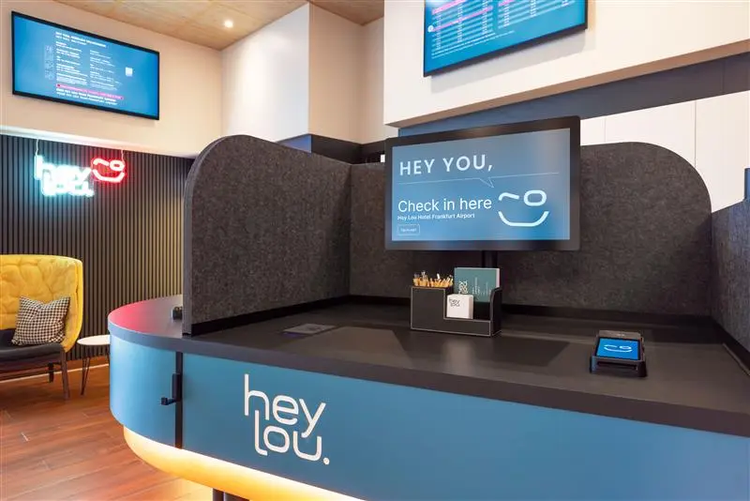
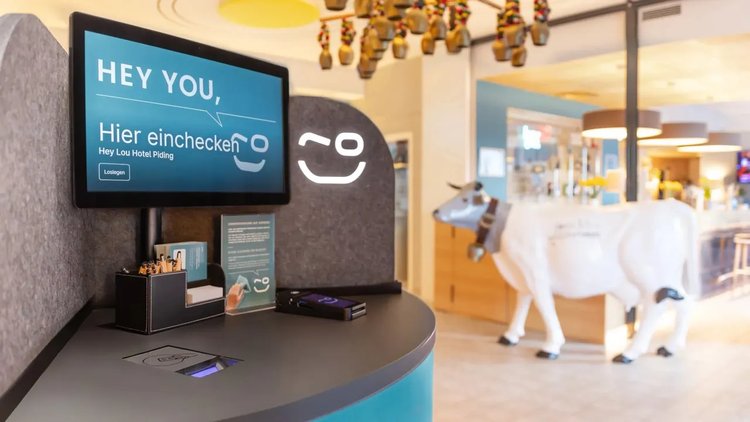
“Another significant advantage is evident in the check-in process: Unlike traditional hotels, which often have long queues during peak times, our Welcome Desk allows eight people to check in simultaneously. Check-in takes an average of just two minutes, meaning the entire hotel can be checked in within an hour. This significantly minimises waiting times and creates considerable added value for our guests.”
Martin explains how this works in practice: “We developed the Welcome Desk; more precisely, it was designed by my brother Thomas. Visually, it resembles a grand piano: where the keys would normally be, there's a person standing, while the terminals are located next to them.
“Using a Wallet Key, guests can check in completely contactlessly online – without any interaction with hotel staff. The choice of the Wallet Key for smartphones (regardless of the operating system) was deliberate, as we, as an international hotel, welcome guests from various countries who don't always have direct internet access. The Wallet Key allows guests to enter their rooms as soon as they have internet access, without relying on roaming or having to access a website.”
If a guest’s phone is not available, or they prefer a physical card, there is an option for that as well; and there is always a staff member at the desk ready to help, too.
Many companies are expressing concerns about the possibility that artificial intelligence could replace human workers. At the same time, almost all report a shortage of qualified personnel. What is the situation at Hey Lou or the hotels that are already using 9OS? What will the next steps be? For example, is the use of humanoid robots in reception or the use of cleaning and inspection robots planned?
Martin laughs, but quickly becomes serious again: “At the beginning of our use of robotics - not to be confused with humanoid robots, whose use and appropriateness require a separate discussion - our employees were rather hesitant about the new technology. Now, however, there is a real competition to see who gets to use a robot next. These machines cover an average of 25km per week, which represents a significant relief.
“Our operational structure has fundamentally changed: It is clear that traditional positions such as hotel director or general manager, as well as management units, have become less relevant. Instead, we need skilled professionals who actively embody hospitality.
“The number of employees has decreased significantly. Previously, we employed around 29 to 30 people; now we have seven. Nevertheless, the teams benefit from a more pleasant working environment, more intensive guest interaction, and improved collaboration. Job satisfaction has measurably increased.
“The use of robots for transport tasks has helped reduce monotonous work in areas such as the dishwashing area and kitchen. This area of work offers little incentive, and so the collaboration between humans and machines creates the foundation for future-proof solutions.”
Liesel adds: “Our current observations show that agents are not simply created in isolation or on an ad-hoc basis, but rather bring about a fundamental transformation within the company. A clear distinction is being made between tasks that can be taken over by digital employees and those that remain the domain of human staff – as Martin also described.
“Certain tasks can be performed efficiently by AI, while, for example, emotional aspects such as warmth and a smile towards guests will always remain the domain of humans. Many other tasks must be distributed accordingly.
“Martin's example already illustrates this from the user's perspective. Internally, the understanding of roles will also change; In the future, there will be less need for dedicated coders, as large language models can increasingly take over this task. Our agents can be created using an Agent Builder, which has a language interface. This allows for task-specific agent configuration while ensuring complete transparency regarding their functionality.
“However, it remains essential to have a deep understanding of the requirements and processes of each agent to maintain control. Responsibility remains with humans, while routine tasks are supported by AI. We are currently in a phase where the next steps on this path are being initiated.”
This article originally appeared on Computing Deutschland
In the second part of this interview we’ll cover the integration of Agentic AI in the hotel industry, data protection, and the balance between technological progress and customer centricity.