South Essex councils are making the IoT pay
The unglamorous project saving time and money

From the outside local government can look like a tangled mishmash of responsibility and bureaucracy, with a light sprinkling of money to fund everything from bin collections to social care.
To be fair, it looks pretty similar on the inside, too; but some local authorities work together to make the whole greater than the sum of the parts.
There is a drive in the public sector "to always to do more with less," says Carol Thomas, Director of Digital and IT at Southend City Council - an understandable approach when you're spending taxpayers' money.
That's why the six major south Essex councils - Basildon, Brentwood, Castle Point, Rochford, Southend-on-Sea and Thurrock - together with Essex County pooled resources as a body known as South Essex Councils, or SEC.
Working with implementation partner Abzorb and using grant funding, SEC built a shared LoRaWAN platform to run IoT services across the region, avoiding duplicated infrastructure costs.
For councils, the IoT is most useful when it removes time-consuming manual work like bin monitoring or mould detection. However, it can be prohibitively expensive, especially when layering modern services on top of decades of messy, incompatible, underfunded IT. Handily, SEC was ahead of the game on that front.
Turning council buildings into network infrastructure
The LoRaWAN platform uses a brand-new region-wide fibre network, partly built for smart city technologies like these, bypassing the need for expensive new infrastructure for each use case.
Abzorb was also able to save money on the gateways, the hubs connecting IoT sensors and devices to the internet. The entire network runs from just 44 such sites, down from the 60 originally planned and almost all mounted on council-owned buildings. That meant the whole project came in £40,000 under budget and reaches 98% outdoor coverage across south Essex.
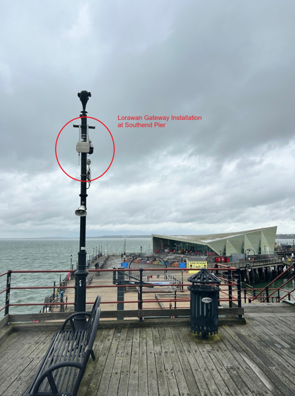
This approach "takes away a lot of the complexity," says Dean Al-Sened, head of public sector and enterprise at Abzorb, although the project still had its challenges.
"We're talking about some fairly old buildings," Dean continues. "We tried to avoid listed buildings where we could, but at the same time, we're installing gateways at height, so [there are] health and safety considerations."
And with seven different local authorities involved, there were "seven sets of health and safety rules [and] seven sets of planning consents" before Abzorb could even start moving on the installation.
That also means multiple sets of data, which is currently largely managed locally – Southend Council not caring when Basildon's bins are getting full, for example. Wider sharing is planned for specific use cases like highways data, where a regional platform could help authorities plan beyond their own estates.
Small sensors, big savings
Now that the network is in place, the councils are exploring a huge variety of use cases.
"We're starting to use it for things like early intervention [and] prevention to save costs down the line or avoid costs – things like flood detection [and] water levels," says Carol.
"One of the councils wants to use it for poo bin levels. Damp and mould [tracking in council-owned properties]. Vehicle volumes passing some of the sensors. Footfall levels. There's some really interesting things being tested at the moment."
Before the network was live, most of this was being measured manually: a person would need to visit each site and assess damp and mould, flood risk and even, yes, the level of dog poo in the bins. Passing this off to sensors saves time, money and nasal passages.
Even where councils were already monitoring elements digitally, like footfall, "they're not retrieving that information in any sort of meaningful or real time way," says Dean.
"It was a sort of prosaic, manual system to take that data from wherever the footfall is being counted. What LoRaWAN enables you to do is effectively take that information real time, report on it, ingest it, and then build some other sort of automation and decision-making apparatus around that."
These use cases are just the start; new applications can be tested relatively cheaply by connecting new sensors, then councils can scale the ones that prove useful.
An example is monitoring water temperature to track the risk of Legionella's bacteria, which can cause Legionnaires' disease. To minimise this risk, councils are legally required to track the temperature of any tap they own that might be available to the public: a huge use of time and resources. A £60 IoT sensor that can do the same and automatically issue a compliance certificate would pay for itself within the year.
These sensors - in bins, libraries or council houses - may not be attention-grabbing and won't solve local government's funding problems; but if they help direct stretched resources to where they are actually needed, when they are needed and with less waste, then they are doing exactly what public sector technology should do.