Big Dave the robot grabs goods and attention at Iron Mountain
But the data is an even bigger story
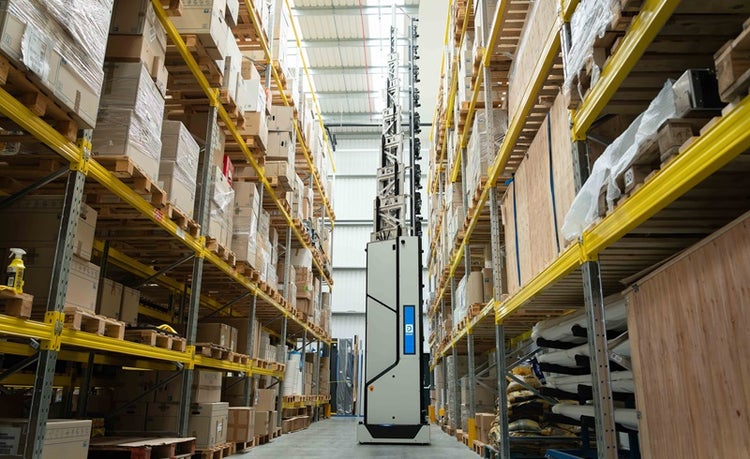
The 18-metre robots in Iron Mountain's warehouses are attention-grabbing, but it's the digital twins and analytics they enable that deliver the real value.
Somewhere in a busy warehouse, a loaded pallet is slowly bowing under its own weight. In the past, that would have gone unnoticed until the inevitable crack and collapse; but in this warehouse Big Dave, an 18-metre-tall robot, spots the problem long before anyone could have seen it from the warehouse floor.
The warehouse in question is owned and operated by Iron Mountain: originally known for storing high-value data and paperwork, now spinning up a growing logistics business.
Maria Torrent-March, who leads that side of the business in Europe, says Iron Mountain consciously chose not to pursue the "traditional route" for stock management in the long term.
That approach relies on staff manually checking and monitoring each pallet through cycle counts and perpetual inventory. It is labour-intensive, needs skilled workers who are hard to find, costs more to run and, Maria says, can give "a skewed view" of inventory.
Automating inventory checks
Instead, Iron Mountain looked for a technical solution, and that's where Big Dave comes in – or rather its creator, Dexory: a data and robotics company focused on the warehousing and logistics sector.
Iron Mountain says Dexory's autonomous warehouse robots have increased inventory accuracy from 97% to more than 99.9%, reduced inventory errors by more than a quarter and are expected to pay for themselves within two years.
The robots, each reaching 18m tall, scan the racking with barcode-reading cameras, high-resolution imaging and LiDAR sensors that span their full height, and navigate purely on what they see, with no markers or lines on the floor.
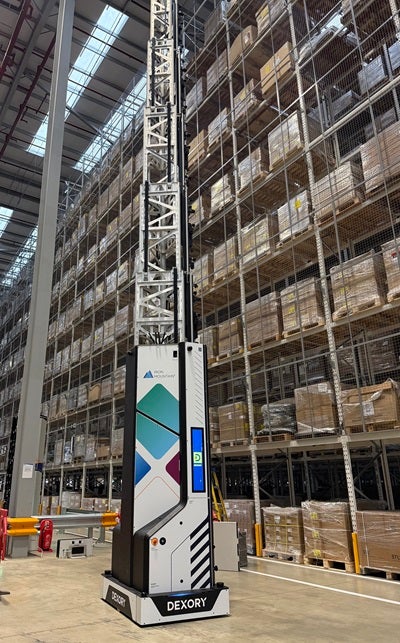
Machine learning extracts information from the images, while the LiDAR builds a detailed 3D picture of each rack and how much of it is occupied.
The looming robots are eye-catching, but they're not the limit of what Dexory does. The real magic happens after the robots are done capturing inventory information.
Pre-empting pallet failure
"That data is instantly digitised into our digital twin platforms, where we compare and contrast it with a lot of other digital data points," says Dexory co-founder Oana Jinga.
From there Dexory provides "a lot of different insights" into how users can improve their operations, such as stock integrity, quantities and conditions, as well as the optimisation of different warehouse resources.
That can include pallet scanning, optimal picking routes and more efficient storage planning to fill up what Maria calls the "fresh air": the space around pallets that don't fully occupy the racking, which shows where storage can be optimised.
This is all done ahead of time, meaning Iron Mountain can correct potential errors before they impact operations.
The same applies to health and safety: the scans can show pallets at risk of cracking under their load, so they can be removed, swapped or re-wrapped before they snap or collapse. That problem is hard to spot from the floor when the racking is 18 metres high.
From 97% to more than 99.9% accuracy
Maria says the robots have increased accuracy from 97% to "above 99.9%,", effectively cutting the error rate from around 3% to under 0.1%. At the same time, inventory errors are down by more than a quarter. The bots are also saving Iron Mountain enough money that they will pay for themselves within two years.
Iron Mountain began with four robots and now has one in every UK warehouse, with expansion into the USA and potentially the Middle East under way.
Maria says Big Dave and his cohorts are freeing up staff time by taking over manual, repetitive checks and enabling workers to build new skills.
"We talk a lot about advances in technology, AI, young people, and is it a threat, is it not," says Maria.
"From my own experience, it has always been beneficial... It's about giving the possibility to your people to improve their skills and to then open up new jobs and a new challenge for them.
"Everybody has embraced it in our teams. They love the robot, they call it by name. But as well, they love how much easier their life is."
Automation ROI: Do the maths first
Despite her enthusiasm, Maria urges other IT leaders to consider whether robotics – or any automation – is right for their specific use case before investing.
Her advice is blunt: however attractive a robot may be, "just do your maths, right? Do the ROI, [do] the calculations."
Her second tip is to start with the problem rather than the product: "What is the thing that hurts your operation the most? What is the thing that will benefit you the most? Then try to find the technology to answer that question."
Physical robotics might be a rare use case, but the path Maria advises is one many leaders will be familiar with: identify the problem, establish the measurable benefit, calculate ROI – then, and only then, find the right technology.