SAP should offer some apps for free, says user group head
UKISUG chair Conor Riordan on SAP, AI and strategy
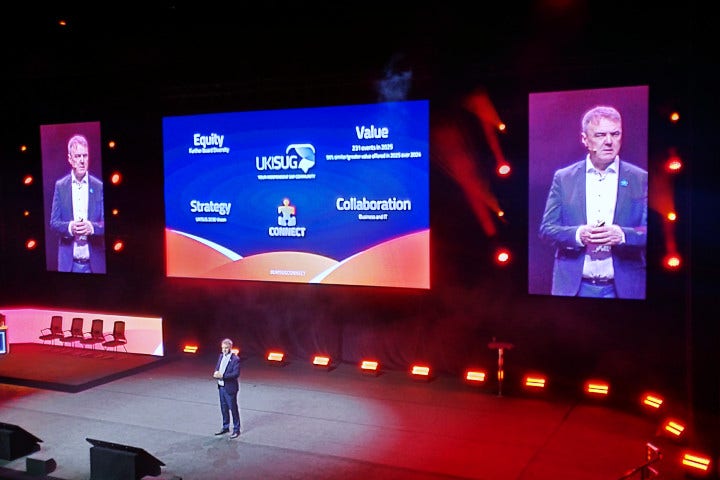
SAP has listened to customers on cloud migration, but it could still be clearer on communicating the 'why', and it should use some apps as loss-leaders, says UK and Ireland SAP User Group chair Conor Riordan.
The atmosphere at this year's UK and Ireland SAP User Group's (UKISUG's) annual Connect event in Birmingham felt notably less fractious than two years ago, when the German ERP giant was accused by some of forcing customers to march to its own tune.
SAP has softened its approach and is now more accepting of customers' preferences, Riordan told Computing. In particular, SAP is more supportive towards those currently using on-premises versions of ECC who want to move to S4/HANA in the private cloud of choice, rather than public cloud or SAP managed options. For example, SAP has eliminated the time-lag between updates to public cloud and private cloud systems.
"If you're on private cloud, you don't have to wait a year to get the innovations, you get them at the same pace public cloud. That's a big shift, without them specifically saying it. That's a recognition that both environments are here to stay," Riordan explained.
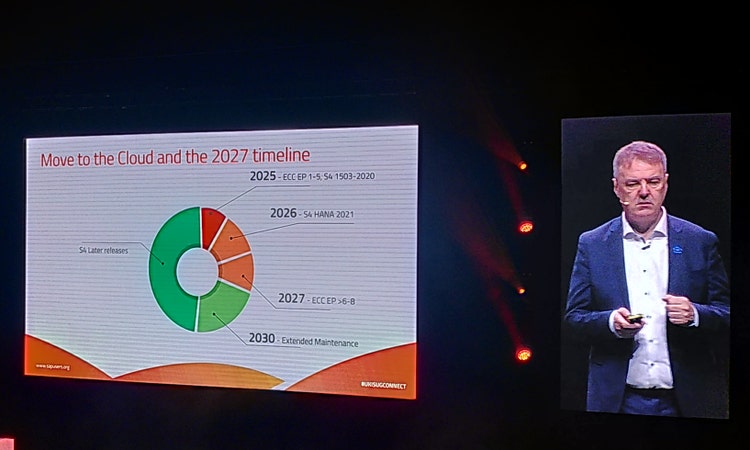
That’s a plus, but many customers are facing imminent hard deadlines as SAP withdraws maintenance support for legacy versions of ECC - the original on-premises ERP - and early versions of its replacement S4/HANA. SAP is unlikely to budge on these.
- At the end of this year, ECC 6 customers with enhancement packs (EP) 5 and below, and S4/HANA 1503-2020 will no longer be supported with updates.
- At the end of next year S4/HANA 2021 will not be supported.
- And by 2027 ECC 6 customers with EP 6 - 8 will need to have made the move to S4/HANA, opt for SAP extended maintenance support (for a fee) until 2030, or go with a third-party service provider.
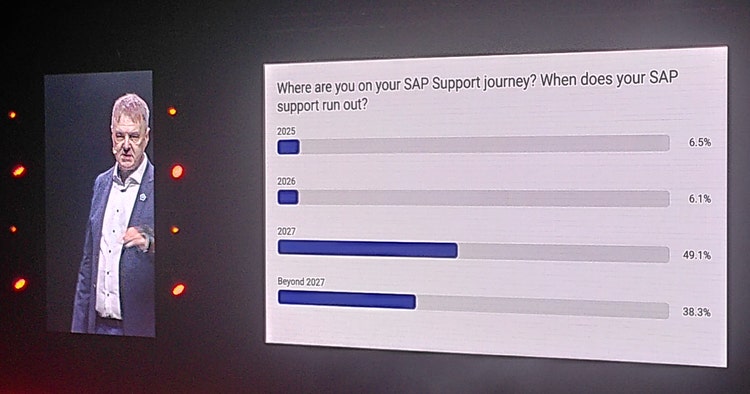
A live poll among UKISUG delegates found that for 6.5% support will cease at the end of this year, with 6.1% saying their maintenance contract ends in 2026. Meanwhile, research from SAP Global User Groups has 51% now on S4/HANA - up from 33% the previous year, but still a major gap to bridge.
With these dates coming up fast it's a tricky time for some SAP customers, Riordan stated. To confuse things further SAP is currently negotiating with the EU on the issue of back-maintenance. All is not as clear as it could be, but legacy customers need to make a decision very soon, be that to upgrade by 2027, to sweat datacentre assets and take extended maintenance (at a 2% cost uplift, up to 2030 for must customers), or something else.
"You're going to have to do something,” Riordan said, using an analogy. “I often say it's like, trading in your car. You've got a 12-year-old car, and you go, 'it's costing me nothing', but at some point you've got to trade it in, and once you’ve traded in you go 'this new car's great, I should have traded years ago’."
SAP comms - Room for further improvement
In line with its softer attitude to customer choice of deployment environments, SAP has altered its Rise programme from an upgrade and move to a SAP-managed environment to a methodology for migrating legacy ECC customers to public or private cloud environments.
So, it’s a different service, but the name hasn’t changed. Riordan was critical of this decision from a comms angle (Grow, now a service for net-new ERP customers seeking standardised processes has also changed). Customers are confused, he said.
It is not that SAP is not putting in the effort to communicate: "They're trying, they communicate every day, and they're getting better." Rather, the changes that customers are being asked to take on board are extensive, complex and multifaceted.
Plus, with the new cloud-centric, minimal-customisation “clean core” model the main audience is not the same as it once was: it’s now the business rather than the techies. Case in point, 48% of Global SAP User Group members don't really know what SAP's flagship Business Suite is or how it differs from S4/HANA. Riordan reached for another automotive analogy.
"It's like you want to buy a car, and the guy trying to sell you the car is the guy from the service centre, and he opens up the hood and takes you into the engine and explains to you how all the bits and pieces work. Where are the apps? What value do they bring? How do you sell the business case? How do you sell the dream?"
Most customers are not AI-ready
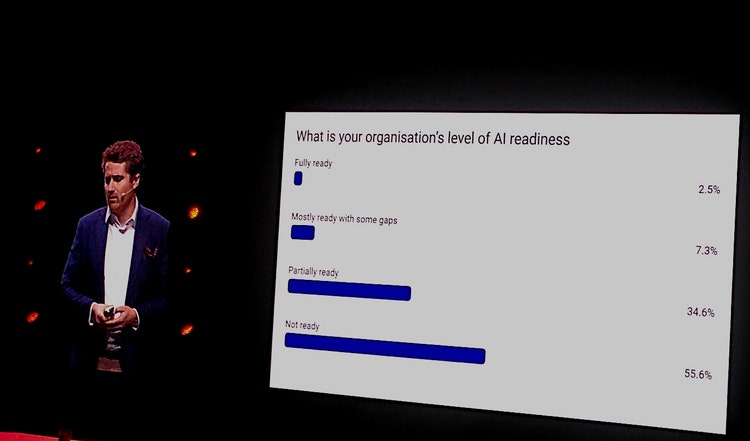
When it comes to the business case, AI looms large. But there’s a gulf between what tech companies are selling and the organisational readiness of their customers. A straw poll of UKISUG Connect delegates saw just 2.5% saying they are fully ready; 55.6% said the opposite with the rest somewhere in between.
SAP's main offering in the AI space is a copilot called Joule, which it is integrating across its suite of tools. It's a solid enough tool, said Riordan, but it's not available to all customers, and organisations are still working out how it fits into the big picture.
"Companies are also trying to figure out the orchestration strategy. Okay, well, do we use Microsoft Copilot? Do we use Joule? Do we orchestrate Joule sub-agents with Copilot? You could have multiple solutions."
He particularly urged resellers not to oversell agentic AI, since implementation is extremely complex for all but the simplest use cases, with IT teams under pressure to deliver something that is presently impossible.
That said, Riordan is supportive of SAP's overall AI strategy, believing the company to be in a good position to shrug off any bubble-burst shockwaves.
"They've built out Business Data Cloud, so they've got the semantic layer in with the data model. That's a huge win, because companies now don't have to build it all themselves. They got the integration with Snowflake and Databricks. Most companies that have invested already in building these big data lakes are probably doing it on Snowflake or Databricks, so that's clever, and it's a big win because you're collaborating with them not competing. And their agents are pre-trained if you use their data model. So, the fundamentals are there, and they have a better shot than most.”
But most organisations are not yet in a position to take advantage of AI, he reiterated.
"I think what's going to be challenging is figuring out within an organisation where their processes are not standard. How will these agents work when the process itself is poor? But if companies invest in cleaning up their processes, I think these agents will be quite successful."
SAP should give away some apps for free
Broadly speaking, Riordan is supportive of SAP’s direction of travel. However, he had some suggestions for improvements in communication and support, and, intriguingly, an idea around loss leaders.
In uncertain times, the demand for nice-to-haves - such as SAP acquisitions Signavio, a process modelling application tool, and training app WalkMe - is inevitably reduced. Since these applications help users to select and use SAP's core products effectively, why not offer them for free?
"When you think about these tools, what are they trying to do? They're trying to drive productivity, they're trying to drive business value, they're trying to drive you to buy new products. So to me, they're actually selling tools. There's an agent now within Signavio that will go in and find the parts of your process where there's opportunity to optimise. And it'll tell you what SAP products you should use to optimise it. If I have this tool that can tell a customer, ‘Hey, you need to do A, B and C, and here's the software to do it’, why wouldn't I give it away for free?"
That may be why he doesn't work for SAP, he laughed. "They'd be saying, why are you giving away our software for nothing?"