UK Defence must adopt AI fast or risk falling behind, warns Chief of Defence Staff
“If we don’t, we’ll lose”
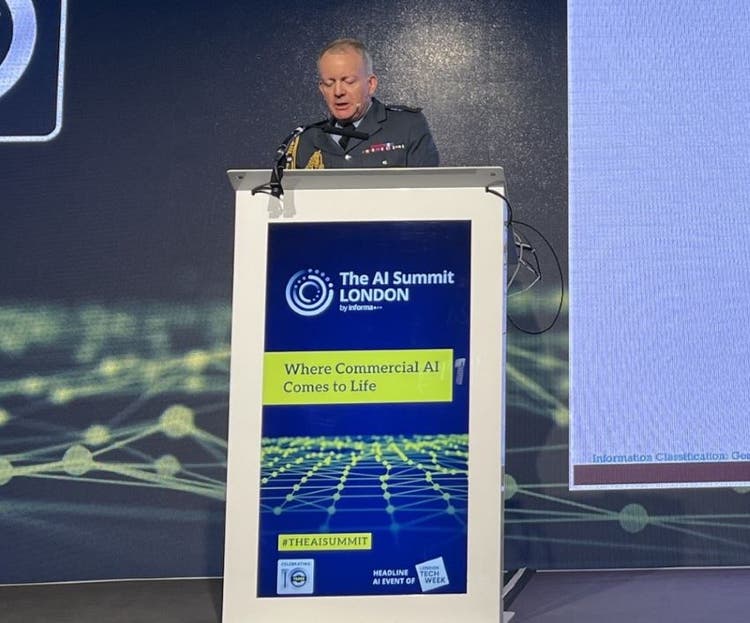
Air Chief Marshal Sir Richard Knighton, UK Chief of Defence Staff delivered a keynote speech to The AI Summit 2026 with the mission to “to make the case that one of the areas where AI will have a truly transformative effect and impact will be Defence.”
One of the most striking themes of the speech was the speed at which AI capabilities are advancing. The Chief of Defence Staff highlighted the evolution from GPT-1 in 2018, which possessed limited capabilities, to today's models that are in some cases performing PhD level tasks.
“There is no question that the progress over the past few years has been breathtaking,” the CDS said. “
He referenced Anthropic’s Fable, and warned that many organisations, including parts of government and defence, still underestimate the pace of model development.
“We must be ready to update our assumptions about what AI can do as rapidly as it is advancing, Sir Richard said. “That means every six months. Operational plans and military tactics are all products of intelligence. If we can keep pace with the frontier and exploit new models and changes as they are updated every six months or quicker, then we will have a clear advantage in future.
“If we don’t, we’ll lose.”
Better, faster decisions
Military success has long depended on making faster, better decisions than an adversary.
"Many of today's AI models already have the potential to accelerate the military decision-making cycle to machine speed."
The CDS pointed out that modern conflict generates overwhelming amounts of data - from satellite imagery and electronic signals to logistics feeds and battlefield reports. “The challenge in modern warfare is no longer simply a lack of information,” Sir Richard said. “Increasingly, it's information overload.”
AI systems can analyse multiple data streams simultaneously, identify patterns and anomalies, and suggest potential courses of action.
"They can help commanders understand not only what is happening now, but what might happen next."
AI can speed up innovation cycles
The second major opportunity presented by AI centres on research, development and capability delivery.
“As the war in Ukraine has demonstrated, and we know from history, being able to iterate rapidly and adapt the capability you are fielding to meet the very real threats you are facing is key to victory. We are not there yet in the UK, and we have the humility, I think, to know it.
“AI presents a step change in our ability to adapt, not just to complete routine software updates or patches, so our tech stays relevant, but also to speed up the pace of the development of new capabilities.”
Defence procurement has traditionally been characterised by long investment cycles involving years of research, testing and deployment. Sir Richard pointed to emerging examples such as at the Whittle Laboratory in Cambridge, where AI systems can conduct experiments, analyse results and accelerate engineering development.
Is it fully autonomous scientific discovery? No. But these systems are compressing innovation timelines dramatically.
Real world examples
The CDS also acknowledged that, as was the case across London Tech Week events generally, that there was a lot of futures talk. However, he was keen to share, where he could, some examples of applied use of AI in military frontline commands.
“In the Air Force, for example, Project Recap is ingesting data from front-line combat air platforms into a single data repository and applying AI models from many different sectors, including, for example, Fintech, which allows them to detect anomalies and make our platforms more survivable, more lethal, and able to defeat the most sophisticated threats.
“In the Army, Project Asgard, right now is helping soldiers make faster decisions, saving crucial time in combat operations through the use of AI agents and targeted LLMs, and it's being proved and developed by our soldiers in Estonia today.
“In the Navy, we're conducting trials at sea in our experimental vessel via XV Patrick Blackett using AI to enable fully autonomous navigation and decision making in uncrewed vessels by fusing sensor data and offering the ability to act without any human input. This is the foundational capability for growing a hybrid navy.
“And in cyber specialist operations plan we're using AI to enhance the effectiveness of our military intelligence services, where our analysts are currently bottlenecked by legacy processes and tools. This is cutting identification and response times down from weeks to hours.”
Ethical concerns
The examples cited by Sir Richard, whilst impressive, are relatively small scale. Many consider this no bad thing, concerned as they are by some of the implications of scaling up the use of AI in military decision making. But Knighton sought to reassure people concerned about this scenario.
“As we take this work forward, we remain absolutely clear in defence about the responsible use of AI. We will not compromise on this. The policy remains that humans, not machines, are accountable for decisions, especially when they relate to the application of lethal force. Defence will continue to ensure that there is a context-appropriate human involvement in the development of all AI-enabled systems.
“Our policy means that we will always ensure there is clear human accountability for any decision about the application of lethal force. Such decisions must be assured and taken with the correct legal and policy framework.”
At the same time, Sir Richard warned that adversaries won’t operate under the same ethical constraints, and there is plenty of evidence already in the public realm which bears him out on that. He continued:
“We should expect our adversaries to use AI in ways which are illegal, irresponsible, and unethical. That's why we must control access to the most capable models developed in the West and stay ahead of our adversaries in AI development.”
In addition to questions of governance and ethics, our defenders face a similar problem to any other business, which is that small-scale pilot projects are everywhere, but scaling pockets of innovation into enterprise-wide adoption is really challenging. It also takes time – not a commodity we have in abundance when it comes to matters of national security.
“Escalate, don’t percolate”
The CDS used this opportunity to highlight the work of a Rapid AI Delivery Task Force, called Task Force RAID, to rapidly and responsibly deploy operational artificial intelligence enabled capabilities to the UK's armed forces at pace.
“We've empowered the task force to cut through the usual bureaucracy and layers to deliver at the speed of relevance,” Sir Richard continued. “As I say to the team, escalate, don't percolate.”
The task force is making measurable progress and the CDS has concentrated its efforts on four priority operational challenges:
AI-enabled intelligence processing: Traditional intelligence analysis is too resource-intensive to handle the growing volume, speed, and complexity of data. The task force is deploying AI tools to process information more efficiently and accurately, overcoming limitations posed by legacy systems.
Electromagnetic environment awareness: Modern military operations depend on understanding and operating within contested electromagnetic environments. The task force is developing systems that provide a comprehensive picture of the electromagnetic battlespace, improving the ability to detect and counter adversary activity.
Automated operational planning: Military planning remains slow and manpower-heavy, with headquarters growing significantly over recent decades. The task force is using AI and multi-agent technologies to streamline planning processes, shifting from people-supported technology to technology-enabled decision-making.
AI-powered drone swarms: Existing force structures cannot generate sufficient scale against increasingly autonomous adversaries. The task force is advancing the use of autonomous drone swarms to deliver greater mass, agility, and effectiveness in contested environments.
This is all about making material difference to the operational outcomes.
Task Force RAID represents an important first step towards accelerating AI adoption in defence, creating momentum, attracting interest, and hopefully delivering tangible results. The CDS concluded his speech by acknowledging that lasting transformation will require change across the entire organisation. Achieving this will not be easy, but it begins with a clear vision and ensuring personnel have access to the right tools and capabilities.
To support this effort, Defence's senior leadership team issued a department-wide memorandum outlining its ambitions and expectations for AI adoption across Defence last week, and this will be reinforced by a refreshed Defence AI strategy, due to be published later this year, which will set out the actions needed to embed AI at scale.