The great recalibration of the labour market
AI competence is becoming a prerequisite for employment

From growth mania to ‘AI-driven efficiency’: IT managers are facing a paradigm shift. Whilst tech giants such as Meta and Block are making massive job cuts, it is no longer just about cost savings. It is about a radical restructuring of the workforce. Those who do not use the new tools must go – that seems to be the new mantra.
In the first quarter of 2026, between 70,000 and 80,000 jobs were cut in the tech sector. RationalFX estimates 78,557 redundancies worldwide in the first three months (Jan–Mar). Most of the redundancies took place in the US.
Unlike the waves of previous years, the driving force this time is different: the promises of AIare now being translated directly into workforce planning.
Hard reset at Block
At the end of February 2026, Jack Dorsey announced that Block would be cutting over 4,000 jobs – from over 10,000 to just under 6,000 employees (i.e. almost half). In his communications, including via X (formerly Twitter), he made it clear that this is not a reactive step in response to market weakness.
Jack Dorsey writes on X:
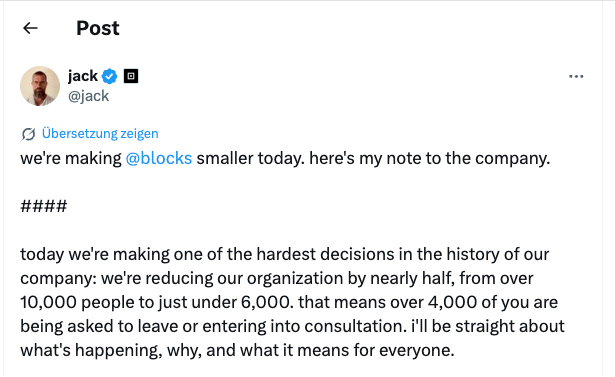
For Dorsey, the reduction is a strategic objective. His message to staff and the accompanying shareholder letters underscore his philosophy of “small, highly talented teams”.
At the time of the announcement, Block’s business was profitable. Gross profits had risen 24% year-on-year in the fourth quarter of 2025.
Investors welcomed the announced efficiency gains and cost cuts; share prices rose by double digits following Dorsey’s announcement.
However, employees remaining at Block speak of a drastically increased workload and a dismal mood, as the promised relief from AI tools is not yet noticeable in practice.
Meta and the shift in capital
Just two months later, Mark Zuckerberg followed suit. On 23rd April 2026, Meta announced it would cut 10% of its workforce (around 8,000 jobs). The cuts are set to begin on 20th May. In addition, 6,000 vacant positions will not be filled – with the company citing efficiency and the need to fund substantial AI investments.
Meta is reinvesting the savings from salaries directly into AI infrastructure – a clear shift from human capital to computing power.
The latest announcement follows a series of mass redundancies: in November 2022, the company underwent its first major round of job cuts in its history. Meta made around 11,000 employees redundant (approximately 13% of the workforce).
At the time, Zuckerberg cited miscalculations during the pandemic and excessive investment in the metaverse as the reasons. In March 2023, a further 10,000 jobs were cut as part of the “Year of Efficiency” declared by Zuckerberg.
In January 2026, the group cut around 1,000 jobs in the Reality Labs (VR/AR) division. This was followed in March by around 700 redundancies in areas such as recruitment and sales.
Unlike at Block, Meta’s share price fell slightly following the announcement in April. Investors viewed the combination of redundancies and extremely high capital expenditure on AI infrastructure with scepticism. Many analysts nevertheless stand by their buy recommendations and see the long-term potential.
Reskill or Leave
Accenture is taking a tough line on the role of AI tools. CEO Julie Sweet made it clear: anyone unwilling or unable to retrain in AI will leave the company. At the same time, the consultancy is linking promotions to leadership roles to the regular use of key AI tools; internally, it is said that tool usage will become a visible factor in talent and promotion discussions.
The message: AI competence is no longer a “nice-to-have", but a prerequisite for employment.
Anthropic warns of a white-collar bloodbath
Dario Amodei, CEO of Anthropic, has warned that AI could displace up to 50% of entry-level white-collar jobs within the next five years and drive unemployment in the US to 10–20%.
His prediction aligns with events at Block and Meta: the barrier to entry into the labour market for junior staff is rising sharply; simple tasks have already been automated. The labour market is undergoing a phase of creative destruction. 2026 could be the year in which AI dramatically transforms the world of work.
Traditional safety buffers (e.g. excess staff during growth phases) are disappearing; the correlation between turnover and headcount appears to have broken down. Projects that previously required large teams could in future be handled by a single highly qualified individual. The new key metric could be “leverage per employee”.
Skilled workers will increasingly be assessed on their ability to orchestrate AI. Or as Jack Dorsey put it: a significantly smaller team can achieve more today than the apparatus of yesterday – provided it masters the right tools.
This article first appeared on Computing Deutschland.