Fair AI: What are you giving away to go faster?
Rushing to adopt AI could mean outsourcing your own corporate values
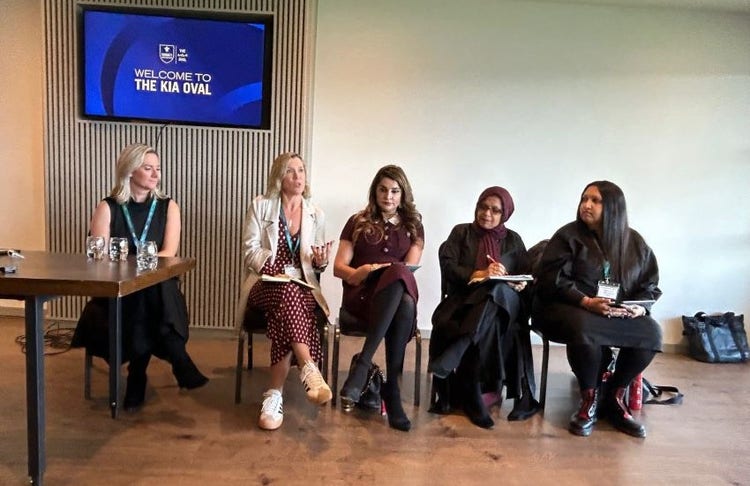
A new report from UKAI’s Women in AI group warns that rushing to adopt AI risks outsourcing organisational values, and says voluntary guidance will not be enough
Britain’s push to become a sovereign AI power risks hard-wiring other people’s values and long-standing biases into the decisions organisations make about their staff and customers. That was the warning at the launch of Fair AI, a new report from UKAI’s Women in AI group, at the UKAI Sovereign AI event at The Oval on Monday.
The report, which is free to download from the UKAI website, introduces the Fairway Framework. This is a voluntary tool to help organisations think about which decisions they hand to AI, how quickly, and with what consequences.
Whose values?
Opening the panel, Claire Roberts, Founder of AI consultancy Full Fathom Five, and member of the Women in AI working group at UKAI set out the stakes by raising the work of PhD researcher Sarah Wyer (whose blog on AI bias can be seen here) who Roberts said, had put millions of simple, open-ended prompts to ChatGPT, such as “a man could…” and “a woman should…” etc. and analysed the responses for theme and sentiment. The answers about men were largely positive. The answers about women were, in Roberts’ words, “terrifying”, with a deep-seated hostility running through them. The predominant theme for answers to prompts about women was sexual violence.
“Would you employ somebody that shared that kind of belief openly?” Roberts asked the room. “Would you let that person deal directly with your clients? Would you let that person make decisions about people? That’s really what you’re doing with AI.”
Her concern is less that organisations are adopting AI than that, in redesigning how they work, they also redesign how decisions are taken. They risk handing control of their corporate values “to a company that is not our own, a company that’s not within our borders”.
In other words, an entity completely beyond their control.
Cost versus value
The framework’s central idea is “net AI value”. Most IT leaders, Roberts said, are under pressure to move quickly because AI companies have worked very effectively to create FOMO, and an environment where the answer to any question about how to make a process more cost effective is simply, “AI.”
Roberts acknowledged the pressure on government and on IT leaders. "If we want our economy to be stronger, we want sovereign AI, we want to be a sovereign AI power, we need everybody to get on board and engage,” she said.
The problem is that around a year after the Copilot licences have been purchased, the training and workshops are done, “somebody somewhere, usually the CFO, wants to know what has changed and how to measure ROI.”
Business leaders then reach for the easiest metrics. What can they do faster? More cheaply? Or with fewer people. But those numbers can mislead. A recruitment process that runs 40% faster can be extrapolated into two fewer full-time posts, yet “nobody can find those two people that are sitting around doing nothing”.
The question the report wants us to ask is: “What did we give away to get to that 40% less?” Lost skills, judgement, learning and trust are much harder to put a number on, argued Roberts, and that is “the biggest risk right now”.
Hard to see harms
Amy Low, chief executive of digital inclusion charity AbilityNet, said the harms are already here but very difficult to quantify. Disabled people are being affected in recruitment, she said, citing a University of Washington study that found CVs listing disability-related awards or scholarships were ranked lower than identical CVs without them.
Deaf, disabled and neurodivergent technologists are also disproportionately hit by layoffs, Low added and disabled candidates are “filtered out from moving into leadership positions, often through paternalistic ideals and this is also being replicated at scale by AI.”
Quantifying these losses is difficult because organisations measure who succeeds or fails within a system, Low said, but not those “rejected at the digital front door or getting a certain way through a digital journey then being filtered out.”
Voluntary or statutory?
The panel also discussed whether voluntary frameworks can ever be enough. Zarah Shah, Responsible AI and Frontier Technology Expert and Chair of UKAI’s Women in AI group, said the guide asks organisations to build governance into the whole lifecycle, from before they buy or build a system, through data quality and bias mitigation, to assurance. But, she said, “you can’t force somebody to do the right thing”.
Shah described a gap between the perception and reality of accountability for AI.
“Many organisations, whether they're private, public, or third sector do not have visibility of the AI estate. If they do have visibility, they have no power to stop anything. They suffer from what I call ‘ethics theatre.’ There is no oversight, only a perception of oversight.”
Shah described the fragmented regulatory landscape. The ICO, CMA, Ofcom and FCA each regulate AI within their own remit, alongside standards such as ISO 42001 and the EU AI Act where it applies but there is no single AI regulator. Existing agencies are under-resourced.
Baroness Uddin, a member of the House of Lords and of the UKAI group pointed out that the same fragmentation exists within parliament.
“There are so many pockets of good work, but we are being left alone to our own devices on this. The AI group is siloed from the digital ID group and the cyber security group, and that's just in Parliament. That is reflected right across corporate and voluntary organisations.”
On the question of legislation, Baroness Uddin was unequivocal.
“Absolutely statutory backing is needed,” she said. She urged attendees to press their MPs and ministers collectively and tied data sovereignty to responsibility
Skills and the sovereignty gamble
The panel closed on skills. Roberts described a client that celebrated cutting new-starter ramp-up from six months to six weeks but asked what such an employee can actually do. “What we’ve got is a half-cut robot,” she said. If firms lose experienced staff and stop training juniors, she warned, they could find themselves unable to run their businesses if sovereign AI ambitions falter or relations with the US sour.
Shah’s answer was a policy proposal: tax technology companies each time they build a data centre and use the money to upskill people through the regional hubs in the government’s AI Opportunities Action Plan, focusing on under-served areas.
Whether any of these very interesting plans and proposals emerge in any useful legislative form remains to be seen. Our legislative system, unlike the AI, is not built for speed.
For now, the Fairway Framework is a useful resource for organisations in the strategy phase weighing what they can feasibly gain from AI against what they will sacrifice in the process.