Under pressure: How Anglian Water is automating its way through a wave of challenges
Anglian’s Hive platform helps it navigate obstacles from droughts to data centre builds to blocked drains

Anglian Water is swimming in data. There’s asset data in the SAP ERP system, there’s people data in Workday HR. Data is constantly flowing in from IoT sensors in pipes and pumping stations, from smart meters and maintenance vans, and via geospatial feeds and mapping software showing where things are and what’s connected to what.
Together, these troves of data form what CDO Matt Edwards calls the “golden triangle”: Anglian’s assets, how they are performing, and their current location.
The company's vision, part of its digital transformation, is to use this data to arrive at “truly interactive digital twinning,” he said. The initial step is to have basic twins established for all water, water recycling (WR) and bio-resources sites by 2030.
By 2035 “smart maintenance” should be a reality, i.e. risk-based maintenance informed by real-time information and AI-led interventions ahead of predicted failures.
And by 2045 the water company hopes that a combination of advanced sensors, IoT infrastructure and digital twins will allow for “transformational AI operational management across water and WR sites,” meaning that interactions with the twins are fully mirrored in the physical world of pipes and pumping stations.
It’s a progression from diagnostic through predictive to prescriptive activities, with process optimisation, capacity management and compliance undertaken with increasing autonomy.
“We're moving from understanding what happened in the past to what's happening now, to why it happened, what will happen, and what should I do? And then ultimately doing what I should do, that’s the robotic element," Edwards explained. "There's a most definite maturity curve that we are recognising.”
Under pressure
Anglian Water’s area of operation covers southeast England, the driest part of the UK. It’s facing several pressures, not least climate change which threatens prolonged droughts and wetter winters; its northernmost catchments in Lincolnshire are already prone to flooding. There’s an urgent need to protect natural ecosystems while simultaneously supporting more housing as populations rise. And there are data centre builds and hydrogen production, both of which projected to rise sharply in the region to support the government’s growth and decarbonisation agendas.
As well as prompting the construction of interconnect pipelines to link wetter areas to dry ones, this confluence of pressures means planning and operational decisions must be prioritised on need.
“We only have a finite amount of money,” said geospatial strategy manager Mike Wingell. “So how do we truly understand risk, how do we then visualise the risk, and how do we get that information to our internal stakeholders to be able to make better decisions?”
One part of the answer is Hive, an ambitious project (so named because it's a series of interlocking portals like a honeycomb). Hive is a graphical data visualisation platform that enables a single view across a multitude of data sources, both static and dynamic. Decision makers can float across the data rather than drowning in its depths, surfacing only the information that’s relevant to them.
The Hive platform is based on Esri ArcGIS, hosted on Microsoft Azure and integrates SAP ERP, Workday HCM, telemetry, weather data from the Met Office, vehicle data, realtime IoT sensor data, and external feeds such as Environment Agency flood alerts into a coherent, continuously updated, single source of the truth, Wingell explained.
“We take all those datasets and we put geospatial intelligence around them to give that situational awareness of what's going on. People out in the business that are using this can have the confidence that the data and the information being provided is accurate and up-to-date.”
With work commencing in June 2024, Wingell’s team has developed Hive according to the Agile methodology in close collaboration with stakeholders to ensure they can find what they need, when they need it, with real-time updates and dynamic data visualisations helping them to make more informed operational decisions.
The first area covered was water recycling and sewage (a hot political topic, obviously), since when the platform has expanded to embrace potable water supply, with work ongoing to incorporate environmental and biodiversity data too.
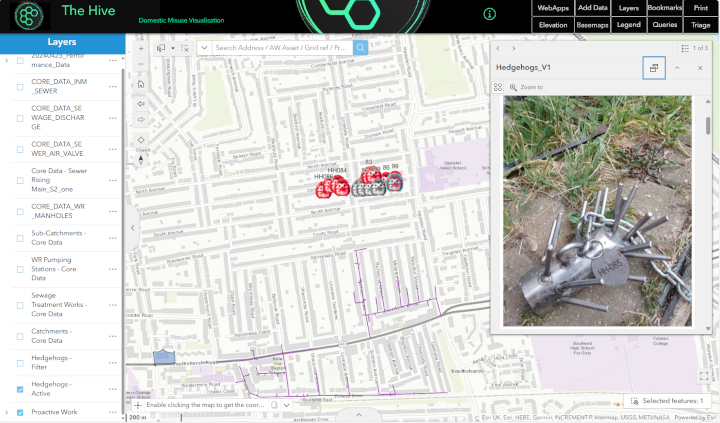
In a live presentation shown to Computing, Wingell demonstrated how the Hive can be used to triage maintenance jobs based on proximity to rivers and pollution risk, with numerous catchment characteristics taken into account. It can visualise how the new experimental hedgehog filters designed to keep wet-wipes out of waste pipes are doing. It can even incorporate feeds from third-party services, such as live footage from cameras installed in sewers, and integrations with Facebook allow Anglian Water to alert neighbourhood groups about disruptions, all from a single screen.
Share and share like
Importantly, Hive is based on standard ArcGIS so that it can be easily adopted by other water companies, partners, local authorities and government agencies, most of which are already users of Esri’s geospatial software.
“We're speaking across the industry, saying how do we combine resources better for a better collective outcome for everybody?” Wingell said. “So it's like a shared space whereby if we develop this with their help then we could have a more favourable outcome from an industry perspective.”
For example, dynamic information about individual catchments could be published as a resource for stakeholders, enabling planners, regulators and agencies to incorporate it into their workflows and contribute to the resource in the spirit of open data. It could even be made a resource for the general public.
“That’s an aspiration of mine. You could have a look at the detail yourself without the need to contact us, or highways [agency], or the council or the EA to work out who's accountable for it. Then we can work more harmoniously together to make a better outcome for both the environment and our customers.”