Google’s agents are out of the lab – now come the hard questions
And lock-in is out of fashion
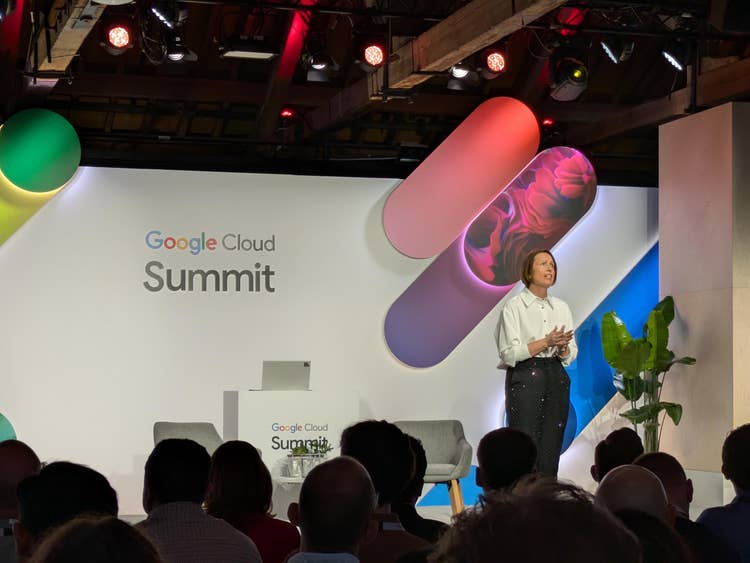
Google insists the agentic era is here, and promises to confront three stubborn enterprise problems – lock-in, sovereignty and cost – to convince you of the same.
Last summer we asked, “Where are all the AI agents?” While some vendors were making big claims about the power of agents, the reality was mostly found in PoCs.
Google was one of those who pushed agentic hard in 2024, only to see interest wither in 2025. The company only mentioned “agentic” once out of every keynote at last year’s Cloud Summit event.
That was not the case in 2026. Agentic AI was everywhere at this summer’s Cloud Summit London (even the posters in the toilets promised an AI future), and customers couldn’t wait to show off their in-production use cases.
It’s a case of “Build it and they will come – eventually.”
A key point that came out of the Cloud Summit this year was Google’s apparent devotion to interoperability and avoidance of lock-in – something I raised with Hayete Gallot at the event last year.
Google Cloud VP Maureen Costello, who led the event’s opening keynote, said Google’s unified stack of first-party AI solutions “is not an approach that creates a lock-in. Rather, a core principle throughout this stack is openness.”
VP Andi Gutmans reiterated this commitment when he took the stage to talk about Google’s Agentic Data Cloud. Launched at Cloud Next 2026, this system is designed to make enterprise data ready and usable for agentic AI.
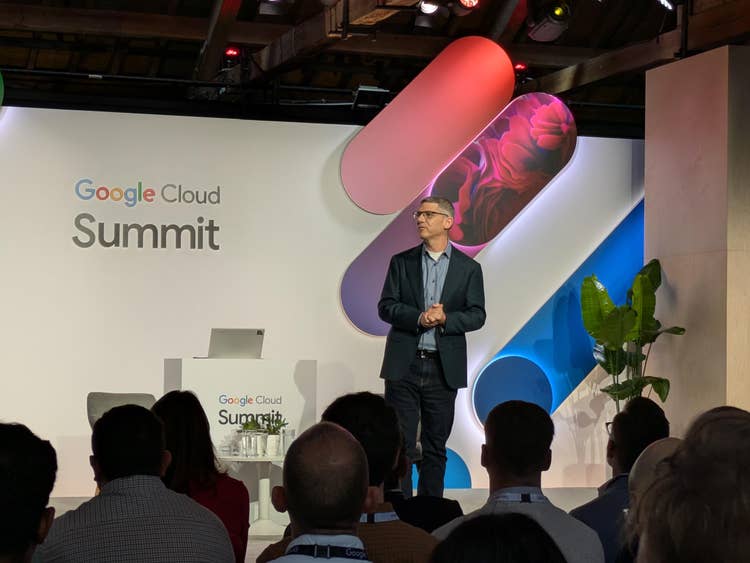
Accepting that not everyone is or will ever be a GCP partner, Google has designed the Borderless Lakehouse – a way to activate all of your data for AI, no matter where it sits.
“We built an Apache Iceberg to basically tear down the walled gardens and connect operational systems, analytical systems [and] applications, so you can activate all of your data with AI and with the Knowledge Catalog, no matter where it sits.”
He added, “It feels like you're querying data that's sitting inside of GCP.”
Customers also stressed the importance of interoperability. Jo Drake, CTO of ecommerce firm THG Ingenuity (interview to be published soon), told me about the company’s AI Shopping Assistant can be installed on any retail website regardless of whether the user is a THG partner or not.
Steel in the ground
Sovereignty has been a hot issue this year, and Google announced its newest model – Gemini 3.5 Flash – will be available with in-country processing in the UK, which will be especially attractive for regulated industries like financial services.
However, there’s still no certainty about how data residency and in-country processing will fare against the US Cloud Act. Google believes turning over encrypted data, without decryption keys, will fulfil its legal obligations, but as I wrote last year that is yet to be tested in court.
Since last year Google has expanded its Google Cloud Dedicated offering to Germany as well as France, but for now in-country processing and Data Boundary are all that’s available for UK customers concerned about data sovereignty.
But sovereignty doesn’t start and end with data; it also requires “steel in the ground,” said Costello. Google has “a long-term commitment to expand our physical footprint with major infrastructure projects.”
As part of a previously announced £5 million commitment, the search giant is opening a new datacentre in Waltham Cross this September, as well as its long-talked-about hub at King’s Cross, Platform 37, later in the year.
Taking tokenomics head-on
Rising token costs have dominated headlines recently, and the rapid adoption of AI agents has made this a pressing issue. As agents are semi-autonomous there is no way to control their token consumption, and companies can be left with large bills – and IT leaders facing angry calls from the CFO.
Gutmans warned that the move from human scale to AI scale will create “an order of magnitude” more work, but also means a cost spiral of more agents consuming more tokens.
To avoid the tech you install actually costing you money, Gutmans said the Agentic Data Cloud has been designed with efficiency in mind.
Google’s Knowledge Catalog takes in data from across an organisation and “activates it” by adding metadata and context – but, specifically, only the smallest amount of context necessary to get the desired outcome.
“If you put too much context into the model it's going to be super expensive and slow, burn lots of tokens, and you won't be able to get to reasonable outcomes.”
The price of AI was a major point at a customer roundtable later in the day, and we’ll have that write-up for you – delving into how companies like Kingfisher, Rightmove, THG Ingenuity and Deloitte are controlling their costs – very soon.