AI sovereignty starts with choice, not self- sufficiency
Industry leaders advise building AI flexibility in now before new dependencies take hold
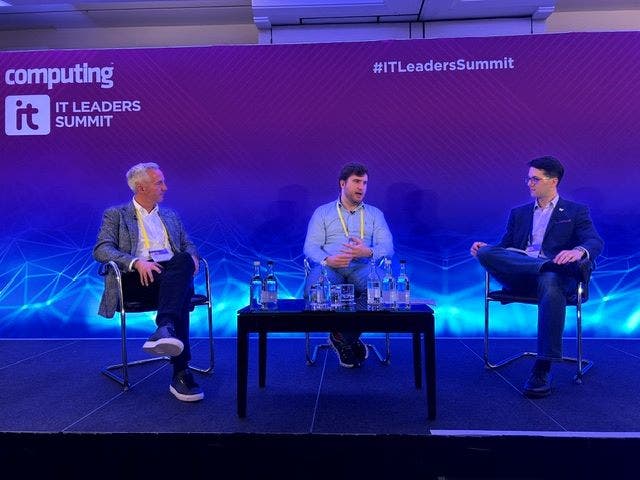
A panel at the IT Leaders' Summit discusses how the UK can avoid repeating the cloud dependency mistakes of the past in the AI era
Sovereign AI strategy was on the agenda at the IT Leaders Summit in London, with HPE’s MD for UKIMEA, Matt Harris, and Alistair Pullen, CEO & Founder of British AI coding company Cosine, talking to Computing editorial director Tom Allen about the increased awareness of who controls crucial layers of the AI tech stack – and where they are controlled from.
The AI stack is complex, and not all of it needs to be homegrown for the UK to have some control over its own destiny. Alistair’s focus, as CEO of a UK-based AI start-up, was the sovereignty of his potential customers.
“We build models in the UK, so if a large enterprise deploys my model where they would otherwise be using a model from Anthropic or OpenAI, they are able to have complete control. If you have GPUs somewhere, you should be able to run AI models of your choice and deploy and run them for whatever use cases you like and whatever level you like, and no one can take that away.
“I think, as a country, we are least-capable at the hardware level right now, but there are companies trying to work on this. We have real talent in this country. That said, I think capital markets in all part of the stack really need to pick up to enable us to have those capabilities domestically.”
Matt took an equally pragmatic approach to the degree of sovereignty that was feasible for UK enterprise, but highlighted the bigger challenge facing businesses in establishing more control over their AI destinies: they don’t make any of these decisions in a vacuum. Decisions are the product of a much bigger national and international picture.
Cloud parallels
Matt drew a parallel between the development of AI strategy and cloud strategy 15 years ago.
“If we follow what we did with cloud, which was a government cloud-first policy, we end up completely dependent on three, maybe four American companies. If a US president decides to put tariffs on cloud and increase prices by 20% then we all have to live with that. There is no alternative and no reversing that decision.
“AI is so big that the government is trying to work out how we keep innovation that exists in the market now, but allows our leaders to have choice. You build choice by longer term thinking. Where can we use models which are British, and how do we create policies and conditions for companies like Alastair’s to thrive? How do we build national capability in systems?”
Practical steps
All great questions, but what can enterprises realistically do, given the extent of US cloud dominance in UK infrastructure today?
Alastair took a positive view, having convened a consortium of 30 of the largest UK enterprises to feed into the process of building Cosine's sovereign models.
“They’ve all told us what they want those models to be good at and how they would like them to be deployed. It isn’t a complete solution, but it is a stepping stone to detaching ourselves from those large US hyperscalers. We won’t be the only people doing this and that is a good thing. The more choice there is, the better.”
“I think it is in companies' interests to build in flexibility. We have made our product services agnostic to the model we use. Of course, we'd love to use a Cosine model but if you want to use a Mistral one, you're absolutely welcome to, and the products will still work. And vice versa, you can use our models for other products.
“Conventionally, that goes against the playbook of the SaaS model. You want to lock them in, and then you have total price control. But at this point, buyers are wise to that and they do worry about this stuff, and I think the sovereignty narrative is getting more traction as a result.”
Trade-offs are inevitable
Matt developed the point.
“The wise buyer or strategist isn’t necessarily the one moving to the best model now but the one making a decision that gives them more choice later down the line."
There are trade-offs in every scenario. For some organisations, if data is highly sensitive the challenge is determining the highest level of security and sovereignty they can realistically afford, then building a policy and strategy around that.
“Others may decide to prioritise innovation and accept greater flexibility, even if that creates future dependencies, because they see that trade-off as worthwhile.”
Matt concluded with another reminder to learn from history
“Not many organisations carried out this kind of analysis during the cloud era, and that is one reason we find ourselves in our current [highly US-dependent] situation.”
“Now the stakes are much higher.”