Interview: Nick Wirth, technical director, Marussia Virgin F1 team

By Martin Courtney

24 Feb 2011

Be the first to comment

Virgin Racing 2010 F1 car

When this year’s F1 season finally starts – following the cancellation of the Bahrain Grand Prix due to political unrest – the Marrussia Virgin Racing team, which debuted last season as Virgin Racing, will once again field a car designed entirely using computational fluid dynamics (CFD) simulation.

Further reading

Nick Wirth, the team’s technical director, tells Computing how Marussia Virgin can cut its operational costs and gain a competitive edge by using the maximum amount of CFD capacity allowed under F1’s stringent resource restriction agreement (RRA), and why it has increased the capacity of its existing datacentre to handle the processing load.

Computing: Can CFD modelling to design and test F1 cars completely replace physical wind tunnel testing?

Wirth: Even scale models within CFD by definition are not the real thing and you still have to take what you design to a wind tunnel or track.

But a huge part of the process is when people build components wrongly – we say this is the way we want it, and they do not do it, so the shape distorts under load.

All the teams do validation on that and that will continue; but the heavy lifting of design can be handled by CFD and we are now doing it all virtually.

Every eight-week cycle we report back to the FIA [F1’s governing body] saying how much time we spent testing the car in the wind tunnel, and how much with CFD and it is close to 100 per cent of that [the team’s allowance] in that period.

What systems do you use to handle the CFD modelling?

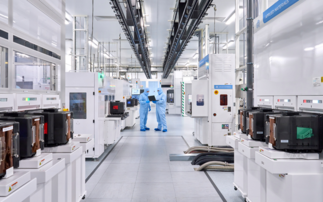
We are in the early stages of testing a new, high-performance computing cluster provided by IT services firm CSC, and the existing cluster in our old datacentre in Bicester will be moved to a larger facility in Banbury.

The whole thing is predominantly based on Dell equipment, though some elements, such as network switching, were supplied by other vendors.

It is a complete installation: the best bits of the existing system are more than a year old but processors move on, memory moves on, network switching moves on and that is critical to the massive high-speed operations we need.

How much compute power do you need to run the CFD software?

We cannot talk too much about servers or million instructions per second in terms of absolute processing power because F1 rules limit your use to no more than 40 teraflops on average over the eight-week period, although to hit that number you have to have a combined capacity of much more.

The combined system has about 10,000 compute nodes, which is the primary reason we moved to the Banbury datacentre – there was not enough space, electricity or cooling in our Bicester facility.

When did you first use CFD for design and testing?

We started in 2001 with a homemade server with one Opteron chip in it. At the time we were working as a virtual team via the internet and one of our CFD employees had the server in his bedroom until it started to overheat.

Later we grew to a network of six Opteron servers in 2004, then an Athlon network and we were running out of names – we named each cluster after a piece of furniture.

The new cluster is called Kabat, the Swahili word for wardrobe.

We have gone from six to 10,000 compute nodes in just six years.

Why did the FIA implement the RRA and how does CFD help teams cut costs?

F1 had become a massive arms race and the FIA got together and decided to do something about it because the sport could no longer afford it.

Red Bull spent more last year than they should have, and there were rumblings about that, and it was thought F1 was an unsustainable model and we saw some major car manufacturers pull out a couple of years ago.

The conventional wisdom is that the value of winning the F1 world championship is about £1bn. If one car manufacturer was spending about half a billion a year to win it, it would be sustainable, but if five or six car companies are doing the same and only one of them can win, the others are haemorrhaging cash and the lower teams are not getting anywhere, so the idea is to see how far these new developments in silicon technology will get us.

Compared to what I would call the current mid-field operators – in F1 you have to be careful about naming names – what a team outside the top four or five will spend on aerodynamics will be 20 per cent of that cost using CFD alone for the same result.

How do you think the new car will perform this season?

It depends how good the initial configuration is and how quickly we can make improvements, and we’ll find that out in the first few races.

The Red Bull car that raced in Abu Dhabi in the last race of the 2009/10 season was very different to the car that raced in the first one – about two seconds faster.

That’s how much the team developed that car throughout the year and that is where CFD will help us improve our techniques over time using computing cycles – then it’s down to us to work within the software to make the necessary improvements.

Reader comments

Have your say on this article

All fields required. Your email address will not be displayed on the site.

By submitting a comment you agree to abide by our Terms & Conditions

Technology Patent Wars

Large companies such as Microsoft, Facebook and Google have been hoovering up technology patents recently. Is this stifling innovation?

87 %

5 %

8 %